Analysis Quant (QNT) is trading at $141.25, down 5.74% in the past 24 hours, according to CoinGecko data as of 04:47 UTC on November 20, 2026. The drop extends a bruising seven-day slide of 1
Analysis
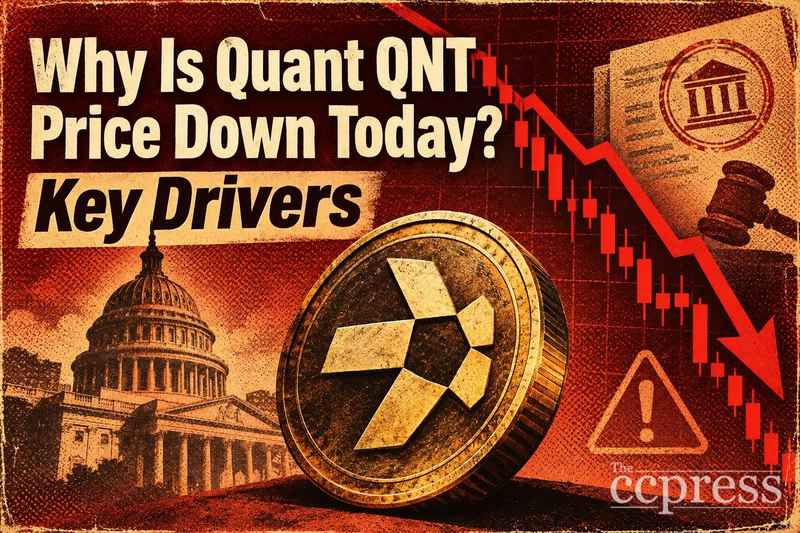
Quant (QNT) is trading at $141.25, down 5.74% in the past 24 hours, according to CoinGecko data as of 04:47 UTC on November 20, 2026. The drop extends a bruising seven-day slide of 11.12% and brings QNT roughly 25% below the highs above $200 it posted earlier in November.
Quant Price Today: What Happened to QNT?
On Binance, QNT/USDT swung from an intraday high of $156.97 down to a low of $140.67, a range of more than $16 within a single session, per Binance market data fetched at 04:47 UTC on November 20, 2026. That low nearly mirrors the CoinGecko spot price, consistent with a move observed across those two market-data sources rather than a brief spike. For related coverage, see How Crypto Influencers Are Navigating 2026 Disclosure Regulations.
Total 24-hour trading volume across all markets reached $53.6 million, according to CoinGecko, against a market cap of $2.06 billion. QNT’s circulating supply sits at 14,556,178 tokens, representing 99.6% of its maximum supply of 14,612,493, meaning there is virtually no new issuance to absorb selling pressure or dilute existing holders. Context on this theme: Analysis: The Block Reports US Crypto Crime Center With TRM Labs to Track Scams.
QNT is not an outlier today. Bitcoin dropped to approximately $61,983 to $62,144, its weakest level since July, according to KuCoin’s market report for November 20, 2026. When Bitcoin tests multi-month lows, altcoins with smaller liquidity pools can register amplified percentage declines. QNT’s 5.74% drop coincided with that broader market backdrop, though the available data does not establish the cause of its decline. More on this in Fourth Circuit Backs Maryland Regulation of Kalshi Markets.
Why Is QNT Down Today? Market and Quant-Specific Factors to Watch
Available checks did not identify a public QNT-specific event, including a hack, token unlock, exchange delisting, or governance vote, within 72 hours of the data snapshot. Research checked Quant Network’s official channels, exchange announcement pages, and reporting from CaptainAltcoin, which explicitly found no project-specific catalyst for recent QNT sell-offs. The decline may reflect broader market conditions, though the available checks do not rule out a Quant-specific factor. Background reading: Binance $6.5B Freezing Order: Asia Session Roundup.
Macro conditions are one plausible factor. U.S. spot Bitcoin ETFs recorded cumulative net outflows of approximately $2.9 billion in November 2026, including $306 million on November 18 alone, according to the KuCoin daily market report. The outflows coincided with a broader risk-off backdrop, though the available data does not establish that they caused QNT’s decline or determine the relative contribution of QNT-specific factors.
The same KuCoin report listed the Nasdaq down 2.25% and the S&P 500 down 2.02% for November 20; these figures should be read as reported market context rather than evidence of a cause of QNT’s move. Nexo’s November 19 market summary cited hawkish Federal Reserve signals as a key driver, with markets at the time pricing in roughly a 90% implied probability of a 25 basis-point rate hike at the December 9, 2026 FOMC meeting.
Sentiment is in the gutter. The Crypto Fear and Greed Index registered 12 out of 100, categorized as Extreme Fear, on November 20. At that level, the index may indicate heightened risk aversion, but it does not establish the cause of selling in any individual asset.
On the derivatives side, the Binance QNTUSDT perpetual funding rate stood at 0.0072% (positive) at the time of data capture, per Binance futures data fetched at 04:47 UTC on November 20, 2026. A positive funding rate means long holders were paying short holders. On its own, that indicates positive funding and may reflect long-side demand, but it does not establish the direction of the next price move.
One project development to monitor is the September 24, 2026 announcement, reported by TradingView, concerning The Clearing House and Quant Network. Available data cannot determine whether this or other QNT-specific factors contributed to today’s move relative to broader market conditions. This follows a pattern seen across altcoin markets this week; a broader look at similar moves can be found in the Arbitrum (ARB) 24-hour decline covered earlier this week.
The near-fixed supply dynamic is worth understanding. With 99.6% of QNT’s maximum supply already in circulation, a small portion of the maximum supply remains outside circulation. Changes in demand and sentiment may be important factors to monitor, alongside liquidity, derivatives activity and broader market conditions. The available data does not establish how this supply structure affects the current move. The broader context of exchange activity in the Asia session on November 19 offers additional color on the sell-off conditions entering today’s session.
QNT Price Levels and What Could Influence the Next Move
The $140.67 intraday low on Binance represents the floor the market tested during today’s session. Whether that level holds into the next trading period is an area traders will likely monitor closely, though it should be treated as an observable data point rather than a prediction.
On the upside, the $156.97 intraday high from Binance marks the last level where sellers reasserted control. A recovery above that zone, sustained by improved volume, would be the first observable confirmation that today’s selling has found a floor. Without that, the data suggests further consolidation at current levels remains a plausible scenario.
What to watch next: the December 9, 2026 FOMC meeting is the nearest macro catalyst capable of shifting sentiment across risk assets. A softer-than-expected Fed decision could alleviate the hawkish pressure cited by Nexo as a key driver of this week’s crypto weakness. For QNT specifically, any official communication from Quant Network regarding the Clearing House integration timeline would be the most direct project-specific development capable of shifting the token’s near-term trajectory. Until either of those signals arrives, it remains uncertain whether QNT’s price action will be driven primarily by Bitcoin and broader market conditions or by QNT-specific factors.
This article is for informational purposes only and does not constitute investment advice. Cryptocurrency markets are volatile; past price movements are not indicative of future results.
Editorial credits
AM
Adriana Mavrenko
Editor · TheCCPress
Monitors published articles around the clock and can correct or withdraw them.
Checked by TheCCPress QC Team before publishing on November 20, 2026 for cause-and-effect claims, counter-evidence, labeling, headline accuracy, factual consistency, metadata, authorship claims and risk disclosure: our AI review system checks every article before it goes live, and our editor monitors it after publication. Report an error.
TheCCPress uses AI for research, drafting and review. Our editorial team is responsible for every article and corrects or withdraws articles when needed. How we review.
Disclaimer: This article is for informational purposes only and does not constitute financial or investment advice. Cryptocurrency and digital asset markets carry significant risk. Always do your own research before making decisions.
The article Quant (QNT) Falls 5.74% in 24 Hours: Market Data and Factors to Watch first featured on theccpress.com.