Quantova, a post quantum Layer 1 and cryptography company, spent this week reporting security fixes inside the cyber agencies of four countries and several major enterprises, passing 90+ publ
Quantova, a post quantum Layer 1 and cryptography company, spent this week reporting security fixes inside the cyber agencies of four countries and several major enterprises, passing 90+ public contributions in the process. Here is the recap.
Quantova has now opened 90+ public contributions to projects outside its own stack.
It reported a critical authentication bypass in NIST's own code, where a self signed certificate was accepted as any identity.
It found a heap buffer overflow in a cryptography library maintained by AUSTRAC, Australia's financial intelligence agency.
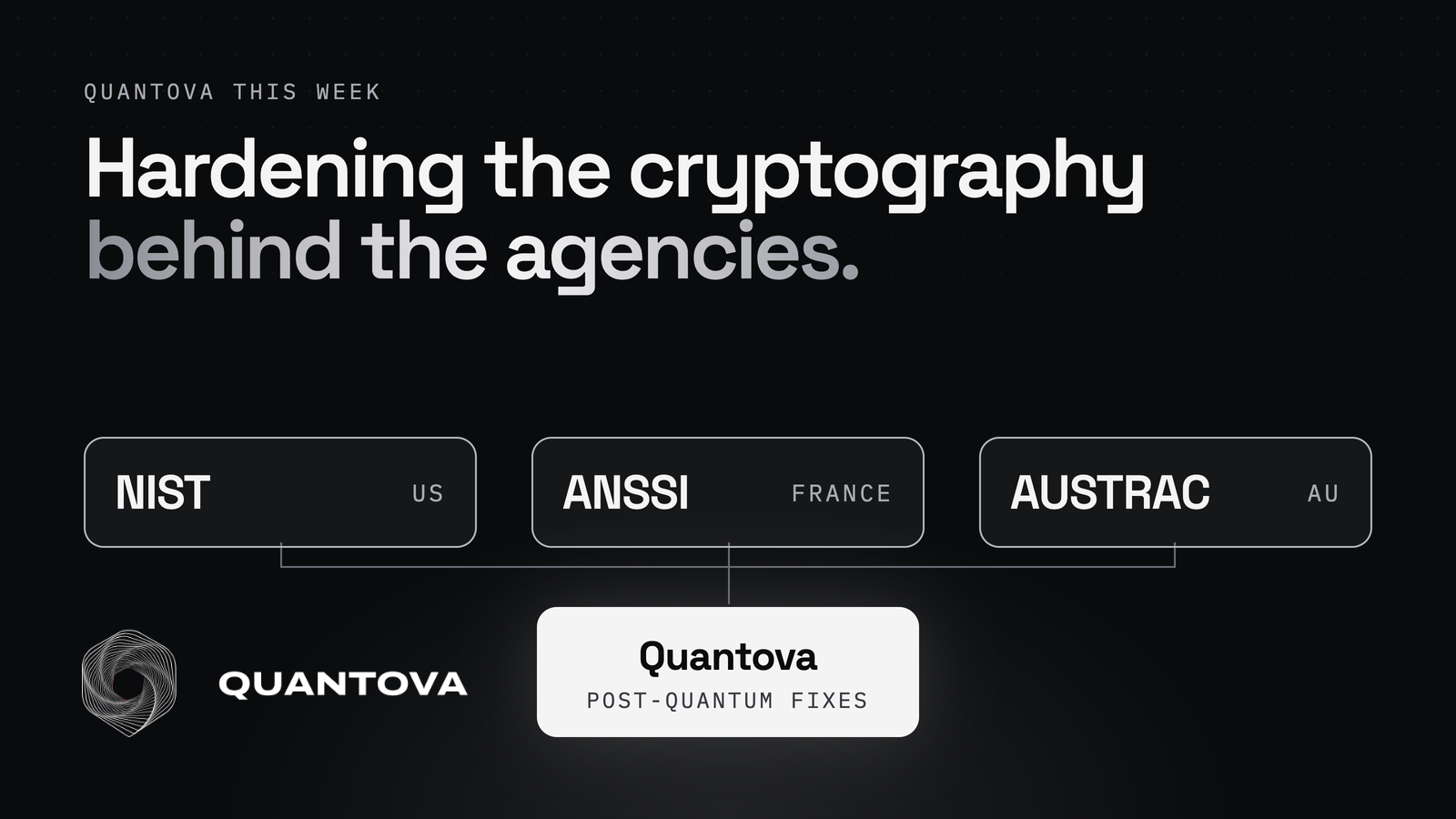
It added post quantum test vectors to France's ANSSI and security fixes to the Australian Cyber Security Centre, Palantir and Atlassian.
The through line: Quantova builds a quantum safe blockchain from the first block, and hardens the cryptography the rest of the world relies on.
Quantova has now opened more than 90 contributions to projects outside its own stack, up sharply this week. The reason is structural. Because Quantova builds its network entirely on NIST standardized post quantum cryptography, its engineers read cryptographic and security code closely every day, and when they find a flaw in code the rest of the world relies on, they report it with a fix. This week that work ran through national cyber agencies, a financial intelligence unit, and several major technology companies.
The most serious finding was a critical authentication bypass in a NIST codebase. An mTLS server was set to require a client certificate but never verified that the certificate chained to a trusted authority, so a self signed certificate would be accepted and trusted as any identity, with no real verification at all. Quantova traced it and opened the fix.
It landed alongside a second NIST fix this week, in the Automated Cryptographic Validation Program (ACVP), where the key generation validators for ML-KEM, ML-DSA and SLH-DSA declared a list of valid parameter sets but never checked registrations against it. The tools that certify post quantum cryptography are software too, and they need the same scrutiny as the algorithms themselves.
In Australia, Quantova reported a heap buffer overflow in a cryptography library maintained by AUSTRAC, the country's financial intelligence agency. The cause was a bounds check written backwards, the kind of memory corruption bug that can become a real exploit. Found, traced to the line, and fixed in the open.
The week reached two more national agencies. For France's ANSSI, Quantova added FIPS 203 and FIPS 204 known answer tests, checking ML-KEM and ML-DSA implementations against the official NIST vectors, because a post quantum standard is only as safe as the implementations that claim to follow it. For the Australian Cyber Security Centre, the work was defensive hardening, including requiring authentication before an insecure API could deploy and stopping failed security checks from being cached as permanent results.
The same discipline surfaced gaps in major enterprise software. Quantova reported fixes to Palantir, where authentication secrets were left in browser storage after login, and to Atlassian, where a query builder crashed on its own default input. Work also continued across the XRP Ledger, part of an ongoing effort to help a major chain prepare for the post quantum era.
None of these are blockchain features. They are the careful, defensive security work that keeps the broader internet standing, done by a team whose core expertise is cryptography. It is also the clearest signal of what Quantova is: a company building a quantum safe network from the first block, while reading the code the world's defenders rely on and making it more correct.
The quantum transition is bigger than any one chain. The same breakable cryptography, and the same ordinary software bugs, sit under almost everything, and the work of fixing them is being done in the open.
What is Quantova? Quantova is a sovereign post quantum Layer 1 blockchain, built from scratch on NIST standardized cryptography, along with a suite of SDKs that let enterprises, governments and AI systems prove their records against quantum attack.
What did Quantova contribute this week? Quantova reported security fixes to NIST, France's ANSSI, Australia's AUSTRAC and the Australian Cyber Security Centre, plus Palantir, Atlassian and the XRP Ledger, including a critical authentication bypass in NIST's code and a heap buffer overflow in AUSTRAC's cryptography library.
Why does a blockchain company contribute to NIST and other cyber agencies? Because Quantova's core expertise is cryptography. Its engineers read the code behind post quantum standards and security tooling, and report fixes when they find flaws, since the quantum transition depends on that code being correct everywhere, not just on one chain.
Are these contributions public? Yes. All of Quantova's contributions are open source and visible on GitHub at github.com/Quantova.