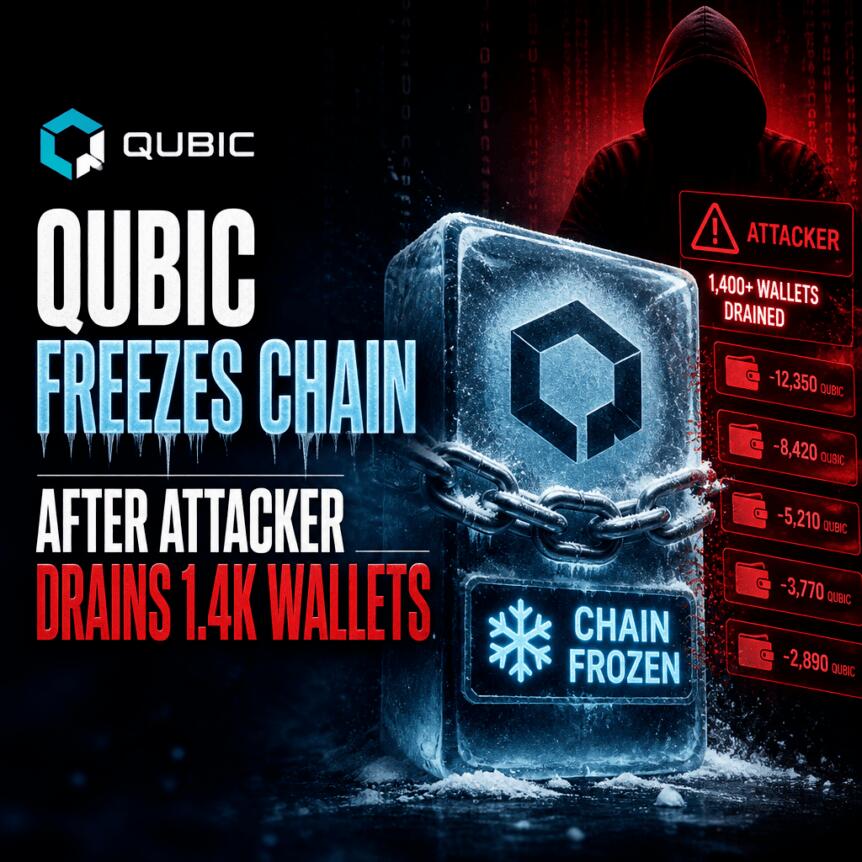
Qubic, a layer-1 blockchain that supports feeless transactions and smart contracts, has halted operations after reporting an exploit that reportedly drained roughly $1.4 million from more tha
Qubic, a layer-1 blockchain that supports feeless transactions and smart contracts, has halted operations after reporting an exploit that reportedly drained roughly $1.4 million from more than 1,400 accounts. The project says the attacker took funds by targeting weaknesses in how certain wallet seeds were generated—an issue that has surfaced in different forms across the crypto industry.
According to a statement posted on X, Qubic paused the network at block “tick 85,371,949” and remained paused at the time of writing. The team claims that most of the stolen assets never left Qubic’s network and were frozen in place, while a smaller portion was transferred to MEXC and reportedly frozen there shortly afterward.
Key takeaways
- Qubic says it halted the network after a wallet-seed generation flaw led to a theft affecting 1,400+ accounts.
- The project claims 87.1% of drained funds stayed on Qubic and were frozen, while 12.9% was sent to MEXC and frozen within about an hour.
- Qubic attributes the vulnerability to wallet seeds generated via certain Apple browser/app paths and older Qubic mobile app versions.
- The team says it has fixed seed generation in its latest web wallet release by switching from JavaScript’s Math.random() to crypto.getRandomValues().
- A network-level vote by Qubic’s Computors is expected to determine what happens to the frozen funds, with a technical report promised after a recovery plan is set.
Network paused after reported seed-based drain
Qubic described the incident as an attack enabled by weakly generated wallet seeds. In its X statement, the project said the network was stopped at “tick 85,371,949,” and indicated that it remained paused when the statement was being published.
Qubic further said the vulnerability affected wallet seeds created using any browser on iPhones or iPads, as well as Safari on a Mac until Oct. 18, 2026, and the Qubic iOS app prior to July 2025. The project estimated that the exploit resulted in the theft of 2.94 trillion Qubit (QU).
While the token amount was reported in QU, Qubic framed the outcome in terms of security impact by stating that the stolen funds were largely contained. The team said 87.1% of drained funds never left the Qubic network and remained frozen, with the remaining 12.9% sent to MEXC before being frozen by MEXC’s team within about an hour.
Why “weak seeds” keep becoming a recurring failure point
This incident joins a broader pattern of crypto attacks that exploit inadequate randomness when generating wallet secrets. Earlier reporting from Cointelegraph cited multiple cases where attackers benefited from compromised or weakened seed generation.
In July, Coldcard disclosed that attackers stole funds from wallets whose seeds were weakened by a firmware bug. Similar weaknesses were also reported in 2023 involving Trust Wallet’s browser extension and Libbitcoin Explorer, according to the earlier Cointelegraph coverage referenced in this report.
For readers and builders, the core lesson is that wallet seed security is tightly coupled to the quality of randomness available in the environment where the seed is created. If a wallet uses a predictable random source—directly or indirectly—then the seed may be vulnerable to reconstruction, enabling attackers to derive the corresponding private keys.
Qubic says it fixed seed generation, and is planning recovery via governance
Qubic said it has already addressed the underlying seed-generation problem in its latest web wallet. The project linked to its GitHub wallet repository, and a referenced GitHub commit for version 4.26.4 describes a specific change: replacing JavaScript’s Math.random() with the cryptographically secure crypto.getRandomValues() when creating wallet seeds.
The distinction matters. While Math.random() can be useful for non-security purposes, it is not designed to provide cryptographic-grade unpredictability. By contrast, crypto.getRandomValues() is intended for cryptographic randomness in browser environments, reducing the risk of seed predictability.
On recovery, Qubic said its core team is identifying affected wallets and preparing recovery options for a vote by the network’s Computors. That governance step is expected to decide what happens to the funds that the project says are currently frozen.
Qubic also said it would publish a full technical report after a recovery plan is agreed, but it has not announced when the network will restart. The absence of a restart timeline adds uncertainty for users who need network availability, and for traders or integrators who depend on Qubic for operations.
Security costs remain high even as the ecosystem matures
Qubic’s halt underscores a continuing challenge across the industry: while vulnerabilities are increasingly well-documented, seed and randomness failures still have real, immediate consequences. In the third quarter, hacks and exploits accounted for 19% of crypto crime cases but represented 40% of reported losses, according to AMLBot’s 2026 investigations report. The report reviewed 250 investigations opened since the start of the year.
That imbalance is important for how investors and developers think about risk. A smaller share of incidents can still drive a larger share of losses, especially when flaws enable direct theft of funds rather than slower financial disruption.
In that context, Qubic’s stated containment—freezing most funds on-network and freezing the rest after transfer to MEXC—may reduce the magnitude of long-term fallout. But it does not eliminate the operational uncertainty for affected users, nor does it resolve which wallets will be eligible for recovery.
For now, Qubic’s next steps—publishing its full technical report and completing the Computors vote on the frozen funds—will be the key milestones to watch. Users should also monitor whether wallet seed generation guidance and version requirements become more explicit as the recovery plan takes shape.
This article was originally published as Qubic Freezes Chain After Attacker Drains 1.4K Wallets on Crypto Breaking News – your trusted source for crypto news, Bitcoin news, and blockchain updates.