Raiffeisen Bank Bitpanda Deal Expands Digital Asset Plans in Europe Raiffeisen Bank International has partnered with Vienna-based broker Bitpanda to bring digital asset purchasing services to
Raiffeisen Bank Bitpanda Deal Expands Digital Asset Plans in Europe
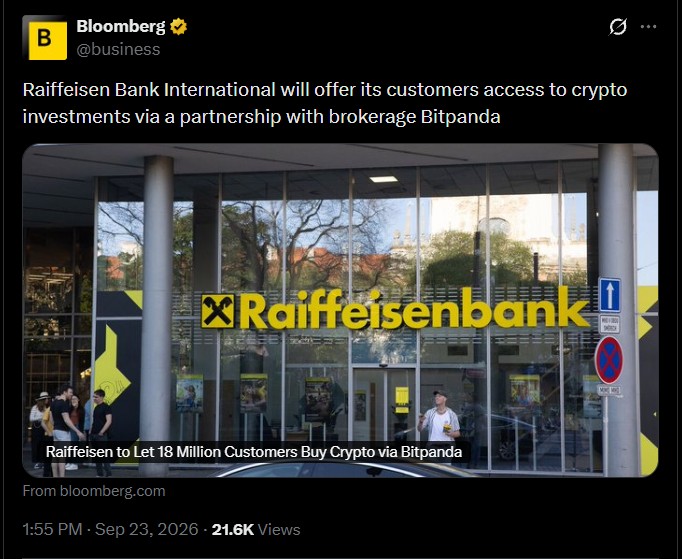
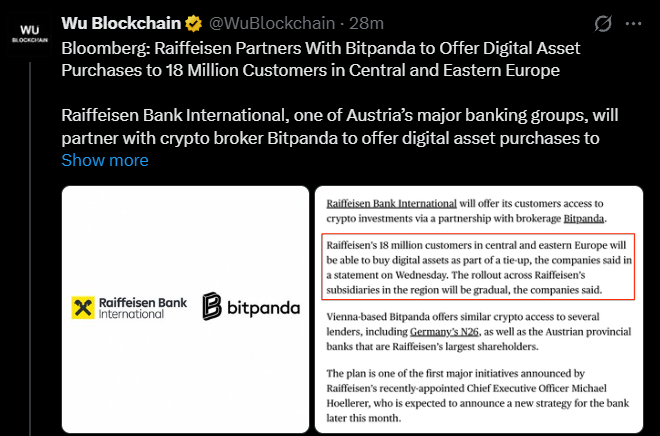
Raiffeisen Bank International has partnered with Vienna-based broker Bitpanda to bring digital asset purchasing services to its Central and Eastern European customer base.
The deal, reported by Bloomberg and confirmed by both companies, could eventually reach roughly 18 million people across RBI's regional network.
It marks one of the first significant moves under new RBI chief executive Michael Höllerer, who is expected to lay out the bank's broader strategy before the month is over.
At a Glance
Banking Group: Raiffeisen Bank International (RBI)
Digital Asset Partner: Bitpanda Enterprise
Potential Customer Reach: Around 18 million
Target Region: Central and Eastern Europe
Rollout: Gradual, through regional subsidiaries
Infrastructure Provider: Bitpanda Enterprise
Earlier Model: Austria (2024)
CEO: Michael Höllerer
Bitpanda Enterprise to Provide the Infrastructure for RBI's Regional Expansion
Under the arrangement, Bitpanda will supply the underlying technology through its business-focused arm, Bitpanda Enterprise, rather than operating as a customer-facing product itself.
RBI's individual subsidiary banks will retain control over which digital asset (DA) offerings they launch and when. Each market will shape its own rollout according to local demand and regulatory conditions, meaning the framework is designed for flexibility rather than a single, uniform product across the whole region.
Bitpanda has already supplied comparable infrastructure to other financial institutions, including Germany's N26, giving it established experience embedding crypto access inside traditional banking apps.
Source: Bloomberg Data
Austria Provided the Blueprint for the New RBI Crypto Framework
The collaboration builds on groundwork laid in Austria. In 2024, Raiffeisenlandesbank Niederösterreich-Wien became one of the first traditional banks in the European Union to let customers buy DA directly inside their existing banking app, powered by Bitpanda technology.
That pilot demonstrated that a mainstream retail bank could offer crypto access without requiring customers to open a separate exchange account. The new RBI-wide agreement effectively takes that single-bank experiment and turns it into shared infrastructure available to the wider network.
RBI Plans a Phased Rollout Across Central and Eastern Europe
Because RBI operates across numerous countries with differing regulatory environments, the expansion will not arrive everywhere at once. Each subsidiary bank will decide its own timeline, product scope, and compliance approach before introducing services locally.
This staged strategy reflects the reality that digital asset rules vary considerably between EU member states and neighboring markets, and it allows individual banks to align offerings with regional demand rather than forcing a single launch date.
Digital Asset Access Moves Closer to Mainstream Banking
The partnership reflects a broader shift in how people may eventually access cryptocurrency. Rather than relying solely on dedicated exchanges or specialist apps, customers could increasingly buy digital assets through banks they already use for everyday transactions.
Bitpanda's prior work with N26 shows this pattern is not isolated to RBI, suggesting traditional lenders across Europe are steadily warming to embedded crypto services as customer interest grows.
Source: Wu Blockchain
What the 18 Million Customer Reach Means for Crypto Adoption
It's worth distinguishing between potential reach and actual usage. The 18 million figure represents RBI's total customer footprint across the region, not a projection of how many people will actively trade digital assets.
Still, distribution through an established banking relationship removes friction that has historically kept some users away from crypto no new account, no separate password, no unfamiliar platform. That kind of accessible infrastructure could matter more for long-term adoption than any single marketing push.
MiCA and Local Regulations Will Shape the Expansion
Regulatory compliance will heavily influence how quickly and in what form these services appear. The EU MiCA (Markets in Crypto-Assets) framework, along with country-specific rules, will guide what each subsidiary bank can offer and how. Notably, Bitpanda received a fine in Austria in August 2026 tied to MiCA-related compliance issues.
There is no indication this fine is directly connected to the RBI partnership, but it underscores that regulatory scrutiny remains active in this space even as institutional adoption accelerates.
RBI's New Strategy Could Put Digital Assets in Focus
With Höllerer expected to unveil RBI's broader strategic direction later this month, this partnership may be just one piece of a larger plan. What happens next will depend on individual subsidiary banks: specific product announcements, chosen launch markets, and regulatory sign-offs will determine how quickly digital assets become a visible part of RBI's retail offering.
Conclusion
The RBI-Bitpanda partnership signals a notable step toward mainstream banking adoption of digital assets in Central and Eastern Europe, building on a proven Austrian model. However, the framework is infrastructure-first; actual product rollouts will unfold gradually and unevenly across markets. Readers should watch for individual subsidiary announcements and regulatory developments in the coming months.
YMYL Disclaimer: This article is for informational purposes only and does not constitute financial, investment, legal, or professional advice. Readers should conduct independent research and consult a qualified advisor before making financial decisions. Cryptocurrency investments are subject to high market risk. Please do your own research before investing in any digital assets. This content does not represent investment advice.