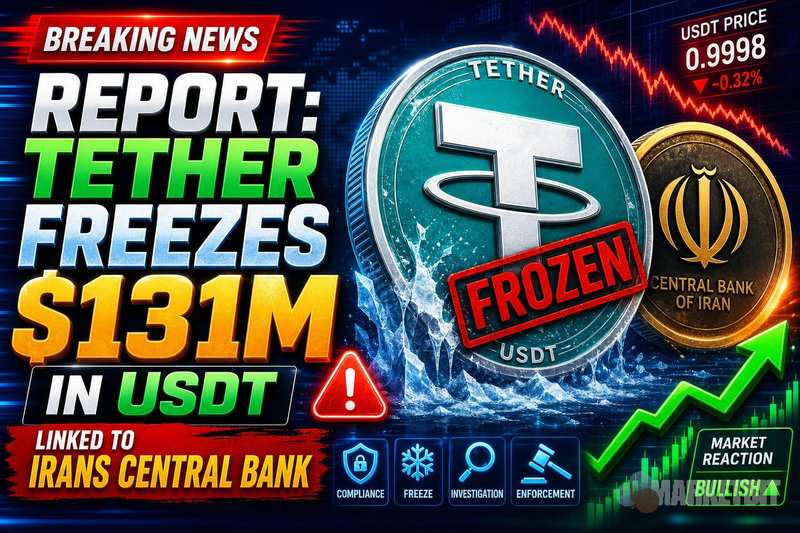
Tether froze $131 million in USDT tied to Iran's central bank after the United States added four related crypto wallets to its sanctions list, according to reporting on the enforcement action
Tether froze $131 million in USDT tied to Iran's central bank after the United States added four related crypto wallets to its sanctions list, according to reporting on the enforcement action.
The freeze was described in a report that Tether moved to lock $131 million in USDT connected to wallets controlled by Iran's central bank, as reported by CoinDesk. The same reporting frames the action as directly tied to a new U.S. sanctions designation. For related coverage, see Arthur Hayes Buys ETH Above $1,900 Weeks After Selling at $1,700.
The U.S. Treasury's Office of Foreign Assets Control listed the four wallets in a recent OFAC action, providing the official basis for the freeze. The designation identifies the wallets as connected to Iran's central bank. For related coverage, see Strategy Pauses Bitcoin Buys Until Preferred Shares Recover.
Why the Iran central bank link raises the stakes
A tie to a national central bank places this freeze in the sanctions and national-security arena rather than in routine compliance. Central-bank exposure signals state-level involvement, which carries heavier regulatory and geopolitical weight than an isolated wallet flag. For related coverage, see BTC, ETH, XRP, ZEC Price Analysis for July 16.
The connection matters because it puts stablecoin rails at the center of enforcement against a sanctioned state institution. It underscores how far compliance scrutiny now extends into on-chain dollar-denominated assets, a theme also visible as jurisdictions move to bring crypto under existing law, such as South Korea's reported plan to fold crypto into a decades-old asset statute.
What this means for Tether and stablecoin control
The action highlights that stablecoin issuers retain the technical ability to freeze token balances. Tether has stated it acts on such freezes in coordination with authorities, noting cooperation with OFAC and U.S. law enforcement across a broader set of frozen USDT.
That issuer-level control is central to how compliance is enforced on public blockchains, and it sits alongside a wider push by mainstream firms into regulated dollar tokens, including Visa's launch of a stablecoin services platform for merchants. The reported freeze shows the flip side of that expansion: the same infrastructure can be used to lock funds on demand.
The U.S. Treasury Department, which oversees OFAC, maintains the authority behind these designations, through its sanctions programs.
What to know
- The event: A report says Tether froze $131 million in USDT linked to Iran's central bank.
- The basis: OFAC added four related wallets to its sanctions list in a recent action.
- The takeaway: Stablecoin issuers can freeze balances, placing USDT compliance under fresh scrutiny.
Details beyond the reported figure and the sanctions listing remain limited at the time of writing, and readers should treat the specifics as an evolving report rather than a fully confirmed account.
Disclaimer: This article is for informational purposes only and does not constitute financial or investment advice. Cryptocurrency and digital asset markets carry significant risk. Always do your own research before making decisions.
Read original article on marketbit.net