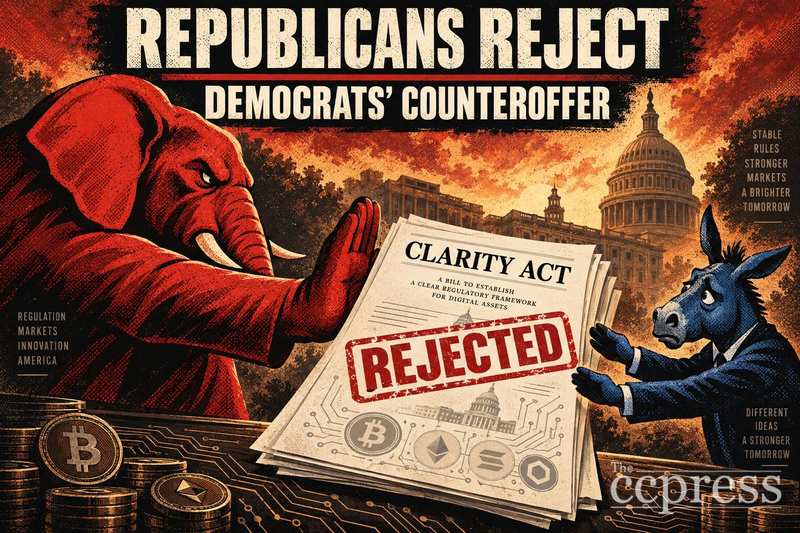
Republicans have rejected Senate Democrats’ CLARITY Act counteroffer, blowing up a fragile crypto-market bill just before a make-or-break procedural vote. The rejection, led by Republican neg
Republicans have rejected Senate Democrats’ CLARITY Act counteroffer, blowing up a fragile crypto-market bill just before a make-or-break procedural vote. The rejection, led by Republican negotiator Cynthia Lummis, cracked open a partisan fight over ethics rules and left the landmark digital-asset legislation on life support.
The collapse came fast. On September 15, 2026, CoinDesk reported that Republicans spurned the Democratic counteroffer ahead of the vote, citing a statement Lummis supplied directly to the outlet. For related coverage, see Clarity Act Senate Vote Follows Democrats’ Counteroffer.
Lummis did not mince words. “Senate Democrats’ counter offer looks identical to their opening position at the start of recess,” she said, framing the Democratic move as a step backward rather than a compromise. For related coverage, see XRP Price Stalls as CLARITY Act Hits Senate Roadblock Over Stablecoin Yield.
Senate Democrats’ counter offer looks identical to their opening position at the start of recess,— Sen. Cynthia Lummis, in a statement to CoinDesk
She also argued Republicans had already agreed to nearly all of the Tillis-Gallego ethics framework, casting her side as the one that moved. Those are her characterizations as a partisan negotiator, not an independently verified comparison of the competing drafts.
This was a negotiating rejection, not a floor vote. No chamber-wide roll call rejected the counteroffer itself. That distinction matters, and it sets up what happened next on the Senate floor.
What the Counteroffer Proposed and Why It Was Rejected
The chronology started late Monday. Democrats sent their counterproposal on September 14, hours before the cloture vote, according to Unchained reporting that cited Politico and three sources familiar with the matter.
Republicans say they had bent far already. Lummis, John Boozman and Tim Scott claimed their final draft incorporated 126 substantive changes requested by Democrats, a count attributed to the Republican sponsors themselves.
The core fight centered on ethics restrictions covering officials’ crypto interests, plus disputes over state enforcement and stablecoin rewards. Those same fault lines have dogged the bill for weeks, including an earlier standoff after Senate Republicans revised the CLARITY Act to address DeFi and prediction markets.
Democrats’ push to reshape the bill echoes their earlier demand on a vertical integration provision that Republicans resisted. The two sides never closed the gap on who polices the market or how officials’ holdings are treated.
What the counteroffer actually said in full text remains unpublished. No official counteroffer language or standalone Lummis press release was reviewed, so the substance rests on the sponsors’ characterizations and secondary reporting rather than the primary drafts.
The Rejection Set Up a 49-50 Floor Defeat
The talks’ collapse fed straight into failure. CoinDesk’s September 15 report, updated at 19:05 UTC, recorded a 49-50 vote on advancing the legislation, short of the 60 votes required.
That was a procedural defeat, not the death of the bill and not a final-passage vote. The measure failed to clear the threshold to move forward, freezing its path in the Senate.
Prediction markets had already braced for this. CoinDesk reported a 14% Polymarket probability of the CLARITY Act becoming law in 2026 on Tuesday morning, a historical snapshot rather than a live quote. Lummis has long framed this stretch as decisive, telling supporters it was “now or never” for the bill.
Bitcoin Slid, but the Vote Was Not the Only Driver
Crypto markets did not shrug it off. CoinDesk’s post-vote market report said Bitcoin was down about 3% over 24 hours and briefly approached $75,000, while also flagging broad risk reduction ahead of the Federal Reserve decision.
The data backs a cautious read. At retrieval on September 16, Bitcoin traded at $75,682 with a 24-hour change of roughly -3.09%.
Bitcoin price snapshot
$75,682
Bitcoin price in USD, retrieved from CoinGecko on September 16, 2026 at 00:19:14.735821 UTC. This snapshot follows both the counteroffer rejection and the later procedural defeat; the API supplied no last-updated timestamp. The linked public page may show newer values.
That decline window includes the rejection, the later vote and macro jitters, so it cannot isolate the counteroffer’s impact.
Bitcoin 24-hour change
-3.09%
CoinGecko reported a 24-hour Bitcoin change of -3.088837817333018%, rounded here to -3.09%, at retrieval on September 16, 2026 at 00:19:14.735821 UTC. This window includes the rejection, the later procedural vote and broader market developments; it does not isolate the counteroffer’s impact. The linked public page may show newer values.
Bitcoin’s market capitalization stood near $1.52 trillion on 24-hour trading volume of about $39.75 billion at the same retrieval time.
Broader sentiment stayed calm, not panicked. The Fear & Greed Index read 51, squarely Neutral, on September 16 at 00:00 UTC, though that daily gauge measures the whole market, not reactions to this bill.
What Comes Next for the CLARITY Act
The procedural math is now the story. Without 60 votes, the bill cannot advance in its current form, and the sides remain split on ethics rules, state enforcement and stablecoin rewards.
Whether negotiators return to the table is unresolved. No new schedule, deadline or next negotiating step has been established, and rejection of the counteroffer does not by itself end the talks.
The Digital Asset Market Clarity Act would define how crypto assets are treated and hand the CFTC greater oversight of spot markets. With one draft rejected and one vote lost, the question is blunt: can either side blink before the window for a 2026 deal closes for good?
Disclaimer: This article is for informational purposes only and does not constitute financial or investment advice. Cryptocurrency and digital asset markets carry significant risk. Always do your own research before making decisions.
The article Republicans Reject Democrats’ CLARITY Act Counteroffer first featured on theccpress.com.