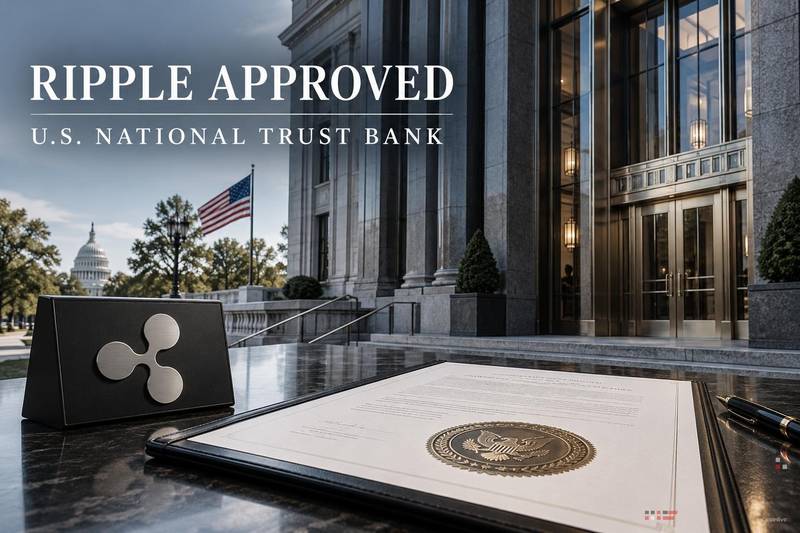
Ripple has received approval to operate as a U.S. national trust bank, a regulatory milestone that could expand the company's ability to offer custody and institutional financial services dir
Ripple has received approval to operate as a U.S. national trust bank, a regulatory milestone that could expand the company's ability to offer custody and institutional financial services directly under federal oversight. The approval marks a significant step in Ripple's effort to deepen its footprint in the U.S. financial system.
TLDR KEYPOINTS
- Ripple has been approved to operate as a U.S. national trust bank, bringing the company under direct federal banking oversight.
- National trust bank status enables institutions to offer custody and fiduciary services; Ripple's approval could unlock new institutional product lines.
- The full scope of permitted activities and the approval's effective date have not yet been disclosed; watch for further regulatory filings.
What a National Trust Bank Charter Means for Ripple
A national trust bank is a federally chartered institution authorized to provide trust and fiduciary services, including asset custody, without engaging in commercial retail banking. Oversight for such charters falls under the Office of the Comptroller of the Currency, which regulates all national bank charters in the United States. For related coverage, see BitGo Gains OCC Nod for National Trust Conversion.
For Ripple, obtaining this designation places the company inside the formal U.S. banking framework rather than operating solely as a technology or payments firm at the edges of it. The distinction matters: a federally chartered trust bank carries a higher degree of regulatory credibility with institutional counterparties than a state money-transmission license alone. For related coverage, see Cross River Bank Partners With Ripple to Expand RLUSD Use.
Ripple is not the first crypto-adjacent company to pursue this path. BitGo also received OCC approval for a national trust conversion, signaling a broader trend of digital-asset firms seeking federal bank charters to serve institutional clients directly.
Custody and Institutional Services: What Could Change
Trust bank status is particularly relevant to digital-asset custody, an area where institutional demand has grown sharply as banks and asset managers seek regulated counterparties for holding crypto. With a national trust charter, Ripple could position itself to custody client assets under a federally regulated framework, a prerequisite some institutional allocators require before engaging a custodian.
Ripple has existing institutional distribution infrastructure. The company's On-Demand Liquidity product already moves value across borders using XRP as a bridge asset; Brazilian bank Travelex became the first Latin American bank to use Ripple's ODL, illustrating that institutional adoption of Ripple rails is not hypothetical. A trust bank charter could allow Ripple to expand those relationships beyond payments into broader custody and fiduciary arrangements.
The company has also been building stablecoin infrastructure. Cross River Bank partnered with Ripple to expand RLUSD use, and separately integrated RLUSD into its core banking platform, suggesting Ripple's ambitions extend well beyond a single product line. Trust bank approval provides the regulatory umbrella under which those services could be offered to a wider institutional base.
What to Watch Next
Several details remain outstanding: the approval's effective date, the exact activities permitted under the charter, and any conditions the OCC may have attached. These disclosures will determine the practical reach of Ripple's new status, and they are likely to emerge through official OCC filings or Ripple's own announcements in the coming weeks.
Watch also for product announcements tied to the charter, specifically custody offerings and new institutional partnerships that were not previously possible without federal bank status. Any new agreements in the vein of Ripple's existing banking integrations would signal that the company is moving quickly to operationalize the approval.
The broader regulatory environment for crypto banking is shifting; traditional institutions like Schwab and Deutsche Bank are also expanding digital-asset offerings, increasing competitive pressure on crypto-native firms to secure equivalent regulatory standing.
Additional source references: source document 1.
Disclaimer: This article is for informational purposes only and does not constitute financial or investment advice. Cryptocurrency and digital asset markets carry significant risk. Always do your own research before making decisions.
Read original article on coinlive.me