Ripple announced on June 2, 2026, that it has expanded its Washington, D.C., office, a move the company said reinforces its long-term engagement with U.S. policymakers, regulators, and indust
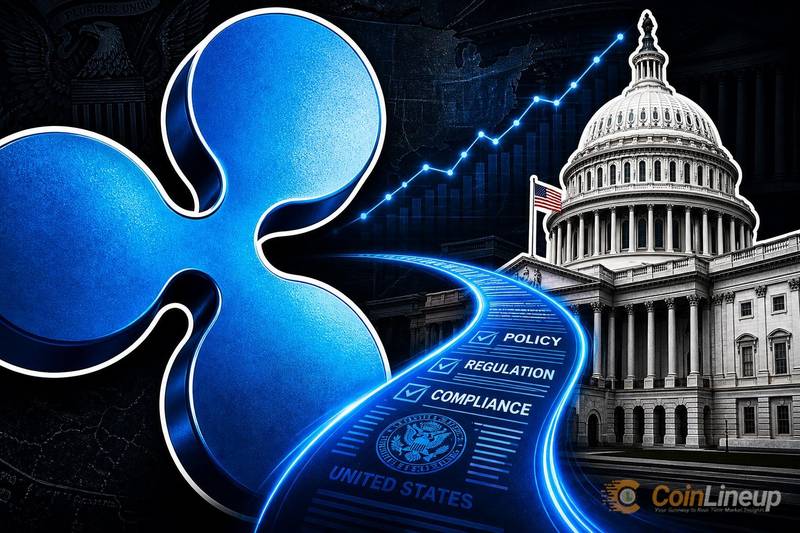
Ripple announced on June 2, 2026, that it has expanded its Washington, D.C., office, a move the company said reinforces its long-term engagement with U.S. policymakers, regulators, and industry partners at a time when federal crypto legislation is actively advancing through Congress.
The expanded office will serve as a hub for policy engagement and stakeholder convening, according to Ripple's announcement. The company said the expansion comes as lawmakers consider frameworks for market structure, stablecoins, payments modernization, and responsible blockchain innovation.
Ripple Chief Legal Officer Stu Alderoty said "the future of digital assets should be built with policymakers and regulators, not around them." The statement signals Ripple's intent to position itself as a collaborative voice in Washington's evolving crypto policy landscape.
Why Ripple sees Washington as central to its strategy
The office expansion follows documented engagement between Ripple and federal regulators. An SEC Crypto Task Force memo shows that commission staff met with Ripple Labs representatives on May 20, 2025, to discuss approaches to crypto asset regulation. Ripple's April 3, 2025, submission to the task force had outlined plans to discuss the SEC's role in digital-asset oversight, short-order clarity actions, and safe harbor considerations.
That regulatory groundwork gives Ripple's physical expansion in Washington a concrete policy backdrop. Rather than relying solely on reactive legal defense, the company is investing in sustained proximity to the agencies and congressional offices shaping digital asset rules.
The move also lands amid active federal legislation. H.R. 3633, the Digital Asset Market Clarity Act of 2025, passed the House on July 17, 2025, by a 294-134 vote and was referred to the Senate Banking Committee on September 18, 2025. The bill establishes a regulatory framework for digital commodities, exactly the kind of market-structure clarity Ripple has publicly advocated for.
CLARITY Act House Vote 294-134 The House approved the bill on July 17, 2025, giving Ripple's D.C. expansion clear legislative context.
Coin Center's Peter Van Valkenburgh has called the CLARITY Act "a thoughtful and comprehensive framework for the regulation of digital asset markets," reflecting broader industry support for the legislation. The CLARITY Act's progress through the Senate remains a key milestone for the industry.
How deeper engagement could shape Ripple's U.S. operations
Ripple's business model, spanning cross-border payments, the XRP ledger, and its RLUSD stablecoin, depends heavily on regulatory clarity in the United States. Regular access to congressional staff, agency officials, and policy forums gives the company a channel to advocate for rules that accommodate its product lines.
The approach represents a shift from litigation-driven strategy to proactive policy engagement. Ripple's SEC Crypto Task Force submission specifically sought clarity on how existing securities law applies to digital assets, a question that directly affects how XRP and RLUSD are classified and regulated in U.S. markets.
At press time, XRP traded at $1.22, down roughly 5.8% over 24 hours, with a market capitalization near $75.3 billion. The broader crypto market reflected caution, with the Fear & Greed Index sitting at 11, deep in "Extreme Fear" territory.
What Ripple's Washington push signals for the wider industry
Ripple is not alone in expanding its Washington footprint. Crypto firms have increasingly invested in policy teams and D.C. offices as regulatory developments affect market access, product launches, and compliance costs. The U.S. Treasury's recent sanctions on Iranian crypto exchanges illustrated how directly federal action can reshape the operating environment for digital asset companies.
The expansion suggests a maturing industry approach to regulation, one that treats policy engagement as a core business function rather than an afterthought. Major crypto-native firms are not just building products but also accumulating strategic positions and dedicating resources to long-term regulatory positioning in the United States.
With the SEC's Crypto Task Force actively meeting industry participants and market-structure legislation advancing through the Senate, Ripple's bet on Washington reflects a calculation that the next phase of U.S. crypto policy will be shaped by those with a seat at the table.
Disclaimer: This article is for informational purposes only and does not constitute financial or investment advice. Cryptocurrency and digital asset markets carry significant risk. Always do your own research before making decisions.
Read original article on coinlineup.com