Artificial intelligence is starting to act less like software and more like an economic participant. Not in some distant science-fiction sense, but in a very practical way. AI agents increasi
Artificial intelligence is starting to act less like software and more like an economic participant.
Not in some distant science-fiction sense, but in a very practical way. AI agents increasingly need to buy access to APIs, pay for computing power, unlock data, or settle small service fees without a human approving every step.
That creates a simple problem with large consequences: if machines are going to use digital services on their own, they also need a way to pay on their own.
Related: Ripple CEO sends harsh message to JPMorgan’s Dimon
The race to become the payment layer for AI
This is where the x402 protocol enters the picture. Built around the long-unused HTTP 402 “Payment Required” status code, the protocol is designed to let AI agents and web services pay for API access, data, and digital services directly through blockchain-based payments.
The market remains young, but the first signs are already visible. Automated payments between software systems are beginning to move through blockchain rails, particularly where speed, low fees, and instant settlement matter.
These are often tiny transactions worth only a few cents. But in a world where AI agents can make thousands or even millions of requests, microtransactions can quickly become a meaningful market.
The early winners are already emerging.
According to a CoinDesk report citing data from Web3 Trackers, more than 120 million x402 transactions have already been processed, with more than $41 million in settled USDC volume. The average payment size is about five cents, underscoring how the market is currently centered on machine access and automated usage fees rather than large transfers.
So far, the activity is concentrated on two networks: Base and Solana.
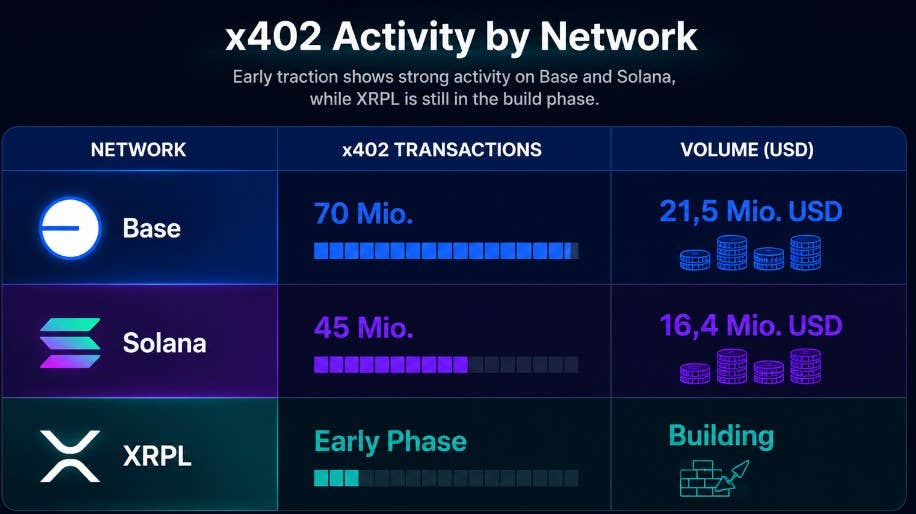
Base leads with roughly 70 million transactions and $21.5 million in volume, while Solana follows with around 45 million transactions and $16.4 million. Most of these automated payments run through USDC, the dollar-pegged stablecoin that has become one of crypto's most important settlement assets.
Base and Solana currently dominate x402 transaction activity, while XRPL remains in an early development phase.
That makes the competitive landscape difficult for any new entrant. Developers already have working infrastructure. Users already have liquidity. Stablecoin payments are already flowing. Once a standard begins to form, switching away from it becomes harder.
But this is exactly the market Ripple is now targeting.
Trending on TheStreet Roundtable
Ripple’s challenge
The company has introduced the XRPL AI Starter Kit, a set of developer tools designed to connect AI agents directly to the XRP Ledger. According to Ripple, the toolkit supports x402-powered payments using XRP and Ripple USD, better known as RLUSD, allowing AI agents to pay for APIs, computing resources, and other digital services.
In other words, Ripple wants AI agents to pay with XRP and RLUSD instead of relying almost entirely on USDC across Base and Solana.
The argument is not only about branding. Ripple is leaning on the technical structure of the XRP Ledger.
The network is designed for fast settlement, low transaction costs, and built-in payment functionality. XRPL documentation describes payment confirmation as typically happening within three to five seconds after the next ledger close.
For automated systems, that matters. A human can tolerate some friction. A machine making thousands of small payments cannot.
There is another feature Ripple is likely to emphasize: the XRP Ledger’s built-in decentralized exchange. XRPL documentation on payment paths explains that a single payment transaction can combine liquidity from different sources and deliver the desired asset. Ripple describes this as a way for an agent to send RLUSD while the recipient receives XRP, with the conversion handled by the protocol-native DEX.
That could become useful in a machine-payment setting. An AI agent may not care whether the sender starts with RLUSD and the receiver wants XRP. The payment layer simply has to settle the transaction quickly and reliably.
Popular on TheStreet Roundtable:
Ripple also presents this as a security advantage. Many blockchain payment systems rely heavily on smart contracts. That creates flexibility, but also risk. Bugs, exploits, and poorly written contract logic have repeatedly caused losses across crypto. Ripple argues that because XRPL has native payment functions and a built-in DEX, some payment flows do not require external bridges or newly deployed swap contracts.
That could make the pitch more attractive to institutional users, especially those that want automated payments but do not want every payment path to depend on untested software. Still, the opportunity comes with complications.
The x402 protocol itself links traditional web requests with blockchain payments. Solana’s x402 documentation describes the basic flow like this: a client requests a protected resource, the server replies with a 402 payment requirement, the client pays, sends proof back through an X-PAYMENT header, the server verifies the payment, and only then returns access.
That sounds elegant, but it also creates operational risk. The website and the blockchain must remain properly synchronized. If something goes wrong, a service could accept the wrong payment proof, assign a payment to the wrong request, or allow an old payment to be reused.
For a human user, that would be annoying. For a machine-driven payment system running at scale, it could become a serious problem.
This is the real story behind Ripple’s latest move. It is not just another XRP integration. It is a bet that the next major payments market may not be driven by people at all, but by autonomous software systems paying each other in real time.
Ripple is positioning XRP and RLUSD for that future. Whether developers follow is another question.
Related: Economist who predicted 2008 crash reveals next Bitcoin target