Robinhood CEO Vlad Tenev said the US regulatory framework for tokenized markets still lacks the long-term clarity investors need to commit “serious assets,” even after the SEC created a tempo
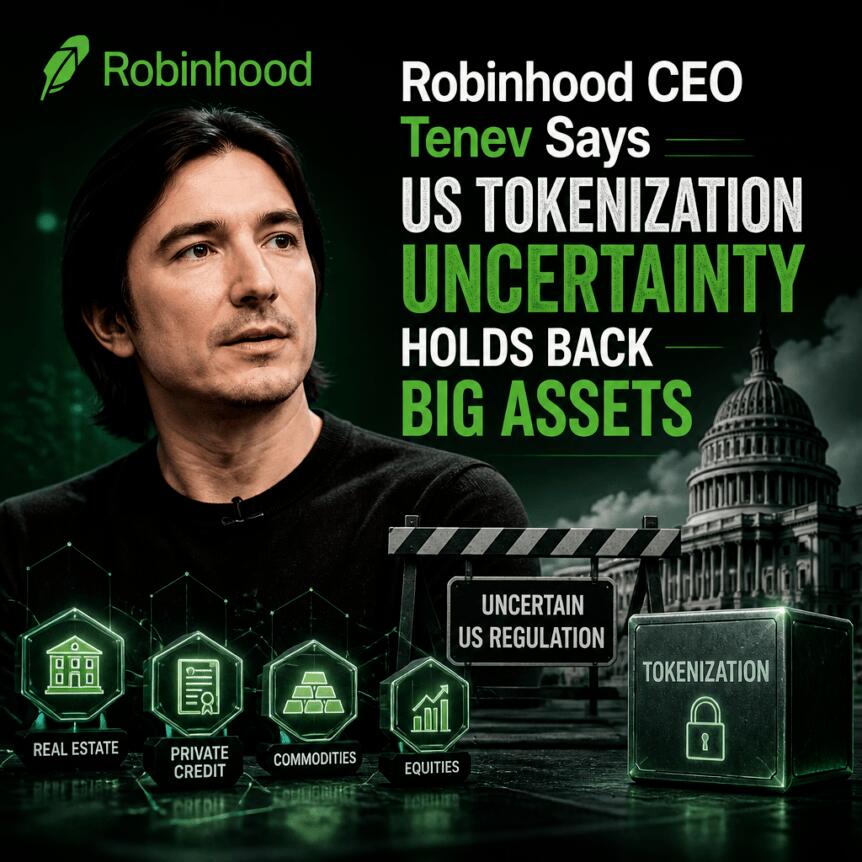
Robinhood CEO Vlad Tenev said the US regulatory framework for tokenized markets still lacks the long-term clarity investors need to commit “serious assets,” even after the SEC created a temporary route for certain forms of onchain stock trading this year.
Speaking during the company’s third-quarter earnings call, Tenev framed the SEC’s “innovation exemption” as a meaningful step, but argued that additional rulemaking or legislation will likely be required to reduce the uncertainty around what rules may look like years from now. He also reiterated that Robinhood’s plans for tokenized private-company stock depend on regulatory arrangements.
Key takeaways
- Vlad Tenev welcomed the SEC’s temporary innovation exemption but said longer-term regulatory certainty is still missing.
- Robinhood is working on a US approach for tokenized private-company stock that fits accreditation constraints.
- Robinhood’s crypto business declined year over year, while its prediction market segment saw sharp growth.
- Robinhood’s current tokenized “stock” products are structured as tokenized debt securities, leaving them outside the SEC’s innovation exemption due to rights requirements.
Why tokenized equities still need clearer rules
On Tuesday’s earnings call, Tenev said the SEC’s innovation exemption is “a really positive step,” but emphasized that investors and customers appear reluctant to allocate substantial capital to tokenized markets without a clearer view of the rules’ longevity.
His comments centered on a practical concern: uncertainty about how regulation might evolve over the next several years could deter market participants from treating tokenized trading as a serious channel for large-scale deployment.
The timing matters because the SEC’s pathway is framed as temporary. The underlying message from Robinhood’s CEO was that while short-term regulatory accommodation can help projects move forward, the industry still needs durable clarity to unlock larger commitments.
SEC exemption still doesn’t fit Robinhood’s current structure
Robinhood offers roughly 200 stock tokens on Robinhood Chain. According to the company’s product description referenced in the report, those offerings are backed by underlying shares but structured as tokenized debt securities.
That structural choice is significant for regulatory classification. The innovation exemption requires “equivalent rights,” including items such as dividends and voting rights. Because Robinhood’s tokenized products are designed to provide economic exposure without the same shareholder rights as traditional stock, the report notes their current format leaves them outside the SEC’s innovation exemption.
This distinction helps explain why Robinhood may view the current regulatory update as helpful—but not fully decisive for the broader tokenized-equities segment. Even if a temporary framework exists for certain onchain equity trading, products that do not meet the exemption’s rights requirements may still face a different compliance environment.
Backlash from traditional market participants underscores the friction
Regulatory uncertainty is only part of the picture. The broader rollout of tokenized stock offerings has also encountered resistance from traditional issuers and market stakeholders.
Earlier coverage cited in the report pointed to 16 companies that objected to their shares being offered on the proposed OKXICE venue, including major names such as Microsoft, Alphabet, and Goldman Sachs. Separately, AMC CEO Adam Aron criticized Robinhood’s tokenized stock products, reflecting that even where tokenization might be technically feasible, acceptance among conventional corporate stakeholders remains contested.
For investors, this matters because issuer pushback can affect what assets become available, how liquidity develops, and whether tokenization scales beyond early offerings. In other words, regulatory pathways and market confidence must align for the ecosystem to expand.
Growth projections for tokenized equities contrast with near-term hesitation
Despite the current friction, market researchers see meaningful expansion potential. Binance Research projected that the tokenized equities market could reach $349 billion by 2030 in its base-case scenario, up from $4.43 billion as of Sept. 15, according to the report.
That long-range growth outlook contrasts with Tenev’s near-term message: even if tokenization could become a large market, the transition may depend on regulators offering more predictable rules that last long enough for investors to plan multi-year allocations.
Tenev also said Robinhood hopes to share more about its US tokenization plans “in the near future,” while acknowledging that rulemaking or legislation is likely still required—even with the SEC’s temporary step in place.
Robinhood’s earnings: crypto revenue down, prediction markets surge
Tenev’s regulatory remarks came alongside financial results that showed a mixed picture across Robinhood’s business lines.
Robinhood reported that cryptocurrency revenue fell 55% year over year to $120 million in the third quarter. Crypto notional trading volume declined 38% to $50 billion. Trading volume on the Robinhood app dropped 48% to $21 billion, while Bitstamp volume fell 28% to $29 billion.
Not every segment followed the same trend. The company’s prediction market business grew sharply: event-contract revenue rose sixfold to $173 million, and contracts traded increased more than sevenfold to 16.4 billion.
Across the broader platform, total net revenue rose 12% to a record $1.42 billion, though it still came in below analyst expectations. Adjusted earnings per share were $0.60, missing estimates by 4 cents.
What to watch next
For tokenized equities, the next signals likely come from whether the SEC moves toward more permanent rules that address the rights requirements central to the innovation exemption—and whether compliance models like Robinhood’s tokenized debt approach can be made to fit within a durable framework. Meanwhile, investors should track how Robinhood’s overseas tokenized private-stock plans progress and how its crypto trading decline compares with ongoing growth in prediction markets.
This article was originally published as Robinhood CEO Tenev Says US Tokenization Uncertainty Holds Back Big Assets on Crypto Breaking News – your trusted source for crypto news, Bitcoin news, and blockchain updates.