When Robinhood launched its Layer-2 blockchain on July 1, 2026, the company's vision appeared straightforward: build infrastructure for tokenized real-world assets (RWAs), stocks, and the nex
When Robinhood launched its Layer-2 blockchain on July 1, 2026, the company's vision appeared straightforward: build infrastructure for tokenized real-world assets (RWAs), stocks, and the next generation of on-chain finance.
The market had different plans.
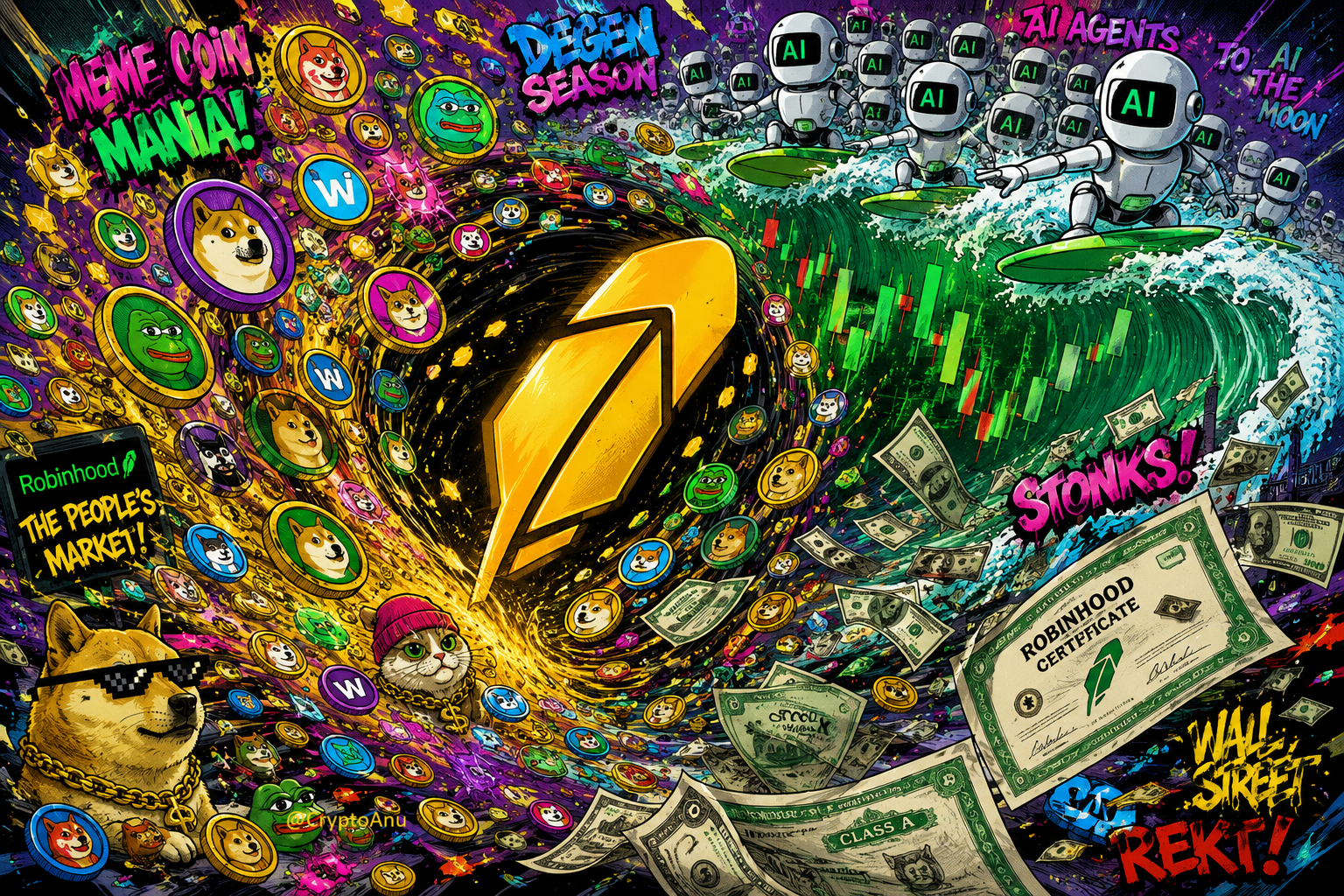
Within weeks, Robinhood Chain transformed into one of the fastest-growing memecoin ecosystems ever observed. Instead of stock tokens dominating activity, speculative meme assets captured nearly all of the attention—and the blockchain's on-chain metrics exploded.
This raises an important question: Are we witnessing the birth of another Solana-style meme economy, or simply the latest speculative bubble?
The Numbers Are Staggering
According to public Dune Analytics dashboards, Robinhood Chain has already processed approximately:
- Over 258,000 memecoins traded
- Around $13.7 billion in cumulative DEX volume
- More than 2 million active wallets
- Over 123 million on-chain transactions
Considering the network launched only weeks ago, these figures are remarkable.
Several launchpads fueled this explosive growth.
Pons.family surpassed 100,000 token launches, NOXA deployed more than 60,000 tokens, while Flap contributed nearly 100,000 additional launches. During peak periods, tens of thousands of new tokens were appearing every single day.
Few blockchain ecosystems have expanded at this pace.
Quantity Doesn't Equal Quality
While launch activity has been extraordinary, survival rates paint a much harsher picture.
Analysis suggests that approximately half of newly launched tokens never receive even a single swap.
Many projects simply appear, attract no liquidity, and disappear almost immediately.
Even among tokens that achieve trading activity, most rapidly lose liquidity within days.
This illustrates one of the defining characteristics of modern memecoin ecosystems: creating a token has become trivial, while building sustainable demand remains exceptionally difficult.
Traders Face Brutal Odds
The blockchain may be growing rapidly, but profitability tells a different story.
According to Bubblemaps' analysis of more than 164,000 wallets trading Robinhood Chain's leading memecoins:
- Approximately 63% of traders lost money
- Only 37% finished profitable
Even more revealing is the distribution of profits.
Only dozens of wallets generated six-figure gains, while many others suffered equally significant losses.
This follows a familiar pattern observed during previous meme cycles on Solana, Base, and Tron: a small number of early participants capture enormous returns while the majority become exit liquidity.
CASHCAT Became the Flagship
Among hundreds of thousands of launched assets, CASHCAT emerged as the ecosystem's dominant memecoin.
The token briefly reached a market capitalization exceeding $150 million before experiencing a sharp correction exceeding 70%.
On-chain wallet analysis shows that major holders have diversified across numerous Robinhood Chain projects, including PONS, TENDIES, INDEX, VIRTUAL, WOOD, JUGGERNAUT, and several other ecosystem tokens.
Rather than concentrating exclusively on one asset, sophisticated participants appear to be building exposure across the broader ecosystem.
Security Has Improved—But New Risks Have Emerged
Unlike previous meme seasons, many Robinhood Chain launchpads implement permanently locked liquidity pools, reducing the likelihood of traditional liquidity-pull rug pulls.
However, new risks have become increasingly common.
Researchers have identified frequent wallet bundling, sniper bot activity, insider allocations, copycat deployments, and highly concentrated ownership structures.
These issues often produce similar outcomes to traditional rug pulls, despite different underlying mechanics.
Liquidity may remain locked, but heavily concentrated token ownership can still result in rapid price collapses.
Memecoins Have Overtaken RWAs
Perhaps the most surprising observation is how quickly the market redirected Robinhood's intended vision.
The chain launched with tokenized stocks and real-world assets as its primary narrative.
Instead, memecoins now account for the overwhelming majority of trading activity.
This demonstrates an important principle within crypto markets.
Developers may build infrastructure for one purpose, but users ultimately determine how blockchains are utilized.
In Robinhood Chain's case, the community overwhelmingly chose speculation over traditional finance.
Is History Repeating Itself?
Robinhood Chain shares striking similarities with previous meme-driven ecosystems.
Solana's explosive meme season, Tron's SunPump boom, and Base's speculative cycles all followed comparable patterns:
- Extremely low transaction costs
- Massive token creation
- Rapid retail adoption
- Explosive volume growth
- High failure rates
- A handful of long-term survivors
History suggests that most of today's 258,000 memecoins will eventually disappear.
Yet history also shows that every major ecosystem eventually produces a small number of projects capable of surviving beyond the initial speculative frenzy.
Final Thoughts
Robinhood Chain is still in its earliest stages.
The current data reveals extraordinary adoption, unprecedented token creation, and remarkable trading activity—but also significant risk.
Whether Robinhood Chain becomes the next dominant memecoin ecosystem or simply another short-lived speculative cycle will depend on what happens after the hype fades.
For now, one conclusion is difficult to ignore:
The blockchain may have been designed for tokenized finance.
The market decided it wanted memes instead.