Key Takeaways CEO Vlad Tenev has announced that Robinhood will introduce voting rights and direct one-to-one share redemptions for Stock Token holders The existing token products provide only
Key Takeaways
- CEO Vlad Tenev has announced that Robinhood will introduce voting rights and direct one-to-one share redemptions for Stock Token holders
- The existing token products provide only price tracking and are classified as synthetic debt products rather than actual equity ownership
- The announcement follows public pressure from AMC Entertainment CEO Adam Aron, who demanded Robinhood cease offering AMC-linked tokens
- Competitor Coinbase is implementing similar voting features, having already enabled direct redemptions and dividend distributions
- Industry experts like Securitize’s Carlos Domingo question whether the “stock token” label accurately represents these financial products
Robinhood has announced plans to introduce traditional shareholder privileges to its Stock Token offerings following mounting public scrutiny regarding the actual ownership structure. CEO Vlad Tenev made the announcement via X, stating that both in-kind redemptions and voting capabilities will be implemented.
Johann Kerbrat, who leads Robinhood’s cryptocurrency division, elaborated that the brokerage is developing a one-to-one share redemption mechanism, with shareholder voting privileges for qualifying token owners planned for future rollout. Kerbrat referenced the company’s Say platform as potential voting infrastructure.
The stock token products from Robinhood are presently available exclusively to non-U.S. customers via a Jersey-based subsidiary. The legal framework classifies them as debt securities rather than equity instruments.
Current participants receive price movement exposure linked to the reference stock but possess neither the actual shares nor any beneficial ownership rights. This classification places them in the synthetic derivative category, despite Robinhood maintaining that actual shares are held in custody matching token issuance on a one-to-one basis.
The announcement arrives in the wake of a public confrontation with AMC Entertainment’s CEO Adam Aron. Aron demanded Robinhood discontinue its AMC-linked token offerings, contending that AMC never authorized these products and that token purchasers lack fundamental shareholder protections.
Market-Wide Scrutiny Intensifies
This controversy has illuminated broader concerns within the tokenized securities marketplace. Identical ticker symbols can represent dramatically different ownership structures and associated rights.
In January, the SEC delineated three primary frameworks for securities tokenization. These categories span from direct issuer-tokenized securities to third-party custodial structures to completely synthetic instruments that merely replicate price movements.
Coinbase is pursuing parallel enhancements to its own offerings. CEO Brian Armstrong announced Monday that voting rights would be incorporated into Coinbase’s tokenized equity products.
Coinbase’s tokenized stock offerings presently include one-to-one redemption capabilities for underlying shares and distribute dividends, positioning the platform ahead of Robinhood’s current feature set.
Skepticism Remains Among Industry Figures
The announced improvements have not silenced all critics. Carlos Domingo, who heads tokenization platform Securitize, issued pointed criticism of Robinhood’s product architecture.
“These products are not ‘stocks,'” Domingo wrote on X. He argued that marketing them as stock tokens creates investor confusion.
Domingo highlighted an additional complexity: the technical challenge of extending shareholder rights to tokens that transfer freely across blockchain addresses, where beneficial ownership may be difficult to verify.
He further noted Robinhood’s current dividend treatment, which increases token quantities rather than distributing cash payments, as another divergence from standard equity ownership conventions.
The dividend distribution mechanism at Robinhood differs markedly from traditional brokerage practices. Rather than cash disbursements, the platform augments token balances, a distinction critics cite as evidence of the fundamental differences between these tokens and authentic stock ownership.
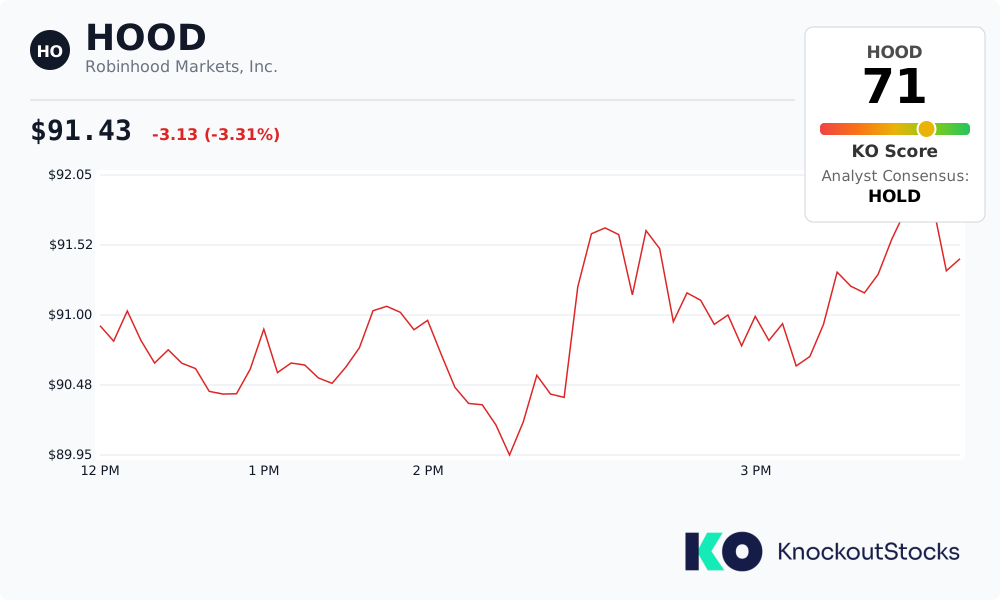 Robinhood Markets, Inc., HOOD
Shares of Robinhood (HOOD) closed at $114.33 in the most recent trading session.
The post Robinhood (HOOD) Stock: CEO Announces Voting Rights for Tokenized Stock Products appeared first on Blockonomi.