TLDR Rocket Lab signs its largest Electron deal with 20 new Synspective missions Synspective plans annual StriX satellite launches from 2028 through 2031 under deal Synspective’s total planne
TLDR
- Rocket Lab signs its largest Electron deal with 20 new Synspective missions
- Synspective plans annual StriX satellite launches from 2028 through 2031 under deal
- Synspective’s total planned Electron missions with Rocket Lab now increase to 47
- Rocket Lab’s launch backlog moves above 100 missions after the new contract
- StriX satellites will expand radar imaging coverage across key global markets
Rocket Lab stock rebounded in pre-market trading after the company secured its largest commercial Electron launch contract. RKLB closed at $69.68, down 0.03%, before rising 3.19% to $71.90 before the market opened. The new agreement covers 20 Electron missions for Japanese Earth observation company Synspective.
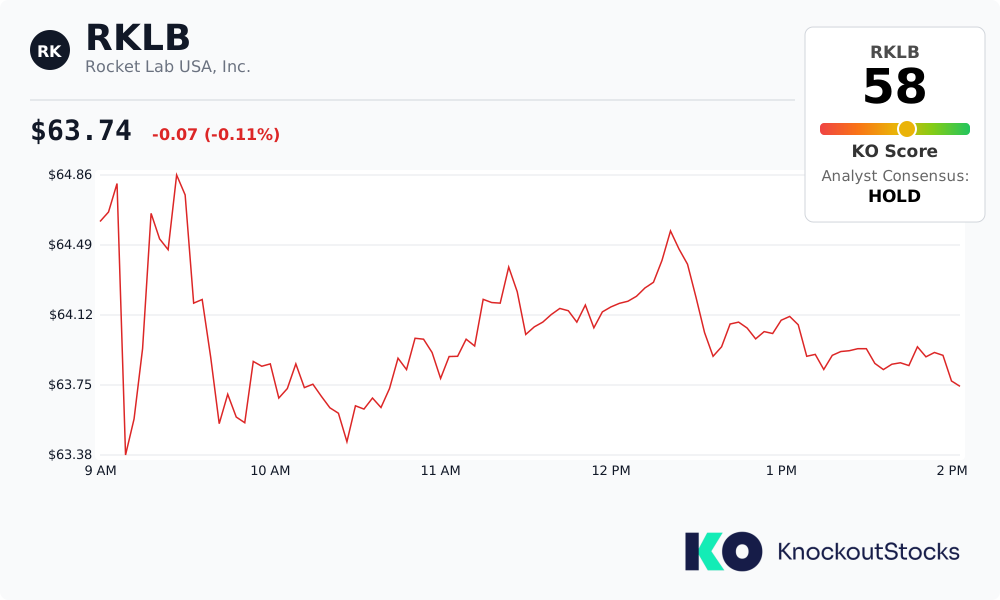
Rocket Lab USA, Inc., RKLB
Rocket Lab Secures Record Electron Launch Deal
Rocket Lab signed a multi-year agreement to launch 20 Synspective satellites between 2028 and 2031. The deal raises Synspective’s total planned Electron missions with Rocket Lab to 47. That figure makes Synspective Rocket Lab’s largest launch customer by mission count.
The missions will deploy Synspective’s StriX synthetic aperture radar satellites into sun-synchronous orbit. Rocket Lab will conduct the launches from its Launch Complex 1 facility in New Zealand. The schedule will support Synspective’s planned constellation expansion over four years.
Synspective wants its satellite network to image locations worldwide within hours under varied conditions. Its radar technology can collect images during darkness and through cloud cover. Therefore, dedicated launches give the company more control over deployment timing and orbital placement.
Synspective Expands StriX Satellite Constellation
Rocket Lab and Synspective have worked together since the earlier stages of the StriX program. Electron has supported repeated satellite deployments as Synspective has expanded its Earth observation network. The new contract extends that relationship into a longer launch schedule.
Synspective uses StriX satellites to provide radar-based Earth observation data for commercial and public applications. The system can support disaster monitoring, infrastructure analysis, and other location-based services. As a result, faster constellation growth could improve coverage and shorten revisit times.
The 20-mission agreement also gives Synspective a clearer schedule for future satellite deployments. Regular annual launches should support planned production and network expansion. Meanwhile, Rocket Lab gains long-term demand for its Electron launch service.
Rocket Lab Backlog Passes 100 Missions
The Synspective agreement adds to several multi-launch contracts Rocket Lab has secured during 2026. Those agreements have pushed the company’s launch backlog above 100 missions. The growing backlog gives Rocket Lab more contracted activity across future launch periods.
Rocket Lab positions Electron as a dedicated launch option for operators with smaller satellites. Dedicated missions can provide greater control over timing, destination, and mission design than shared launches. That flexibility remains important for companies building constellations under fixed deployment schedules.
Global launch demand continues to increase as companies deploy and replace larger satellite networks. Limited launch capacity can create scheduling pressure for operators with strict timelines. Rocket Lab aims to address that demand through frequent launches and a growing mission pipeline.
The post Rocket Lab (RKLB) Stock: Rebounds as Synspective Signs 20-Mission Launch Agreement appeared first on Blockonomi.