President Vladimir Putin has signed what is being described as Russia's first comprehensive law regulating crypto exchanges, establishing a formal legal framework for the sector and raising f
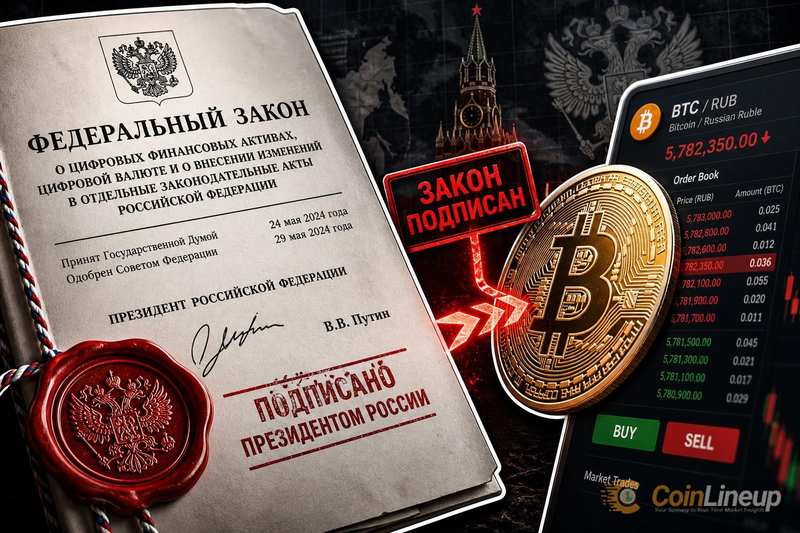
President Vladimir Putin has signed what is being described as Russia's first comprehensive law regulating crypto exchanges, establishing a formal legal framework for the sector and raising fresh questions for the platforms and users operating within it.
What Putin signed and what is confirmed so far
The confirmed event is straightforward: a Russia crypto exchange law has been signed into force. The text was published on Russia's official legal information portal as document 0001202608040007, the standard channel for enacted federal legislation. For related coverage, see Thom Tillis Says He'll Vote Against Senate Crypto Bill Without Ethics Language.
Secondary confirmation has come from state and international outlets, including Xinhua's reporting that Russia has moved to establish a legal framework for digital assets. Anadolu Agency similarly framed the measure as a first comprehensive framework for cryptocurrencies and digital assets.
A "comprehensive law" in this context means a single statute intended to cover the sector broadly rather than a narrow rule addressing one activity. Beyond that, the specific provisions, such as licensing requirements, tax treatment, or enforcement mechanics, are not reliably confirmed by the current research and should be read directly from the official document once fully available. For related coverage, see Sen. Tillis pushes Senate Banking to advance crypto market structure bill in May.
- Confirmed: Putin signed a law described as Russia's first comprehensive framework for crypto exchanges.
- Sourced: The text appears on Russia's official legal portal, with secondary confirmation from Xinhua and Anadolu Agency.
- Unconfirmed: The detailed provisions, start date, and enforcement scope remain to be verified from the law text itself.
Why the law matters for firms and users
A crypto exchange is a platform where users buy, sell, and trade digital assets such as Bitcoin for other tokens or for traditional currency. A formal law places these platforms under a defined legal regime rather than a gray area.
At a high level, a comprehensive statute can shape how exchanges operate, what compliance obligations they carry, and how users access services. This continues a legislative track that ran through Russia's parliament, where the State Duma passed the crypto bill ahead of Putin's signature.
No verified price, volume, or market-capitalization data was available in the current research, so any market reaction remains qualitative. For an everyday holder or first-time buyer, the practical point is to watch how domestic platforms adjust their onboarding and compliance rules once the law takes effect, rather than to read the signing as an immediate signal about asset prices.
What remains unclear after the signing
The research supporting this story was limited, so several material details are open. Key unanswered questions include the law's effective date, how enforcement will work, exactly which activities are covered, and whether foreign and domestic exchanges are treated differently.
Russia's crypto policy has repeatedly intersected with sanctions pressure, a dynamic visible in cases such as the UK's sanctioned-bank treatment of a Russia-linked crypto network and the EU sanctions squeeze on corporate crypto accounts. How the new framework interacts with that environment is not yet clear from the signed text.
Future confirmation should come from the official publication on the legal portal, Kremlin materials on the presidential acts record, and credible follow-up reporting. The gaps here reflect a research limitation, not evidence that the law lacks substance. Readers should treat the signing as established and the specifics as pending verification.
Disclaimer: This article is for informational purposes only and does not constitute financial or investment advice. Cryptocurrency and digital asset markets carry significant risk. Always do your own research before making decisions.
Read original article on coinlineup.com