Russia Crypto Market Warning: Who Pays if USDT or USDC Is Frozen? Russia's Ministry of Finance has put crypto investors on notice. Deputy Finance Minister Ivan Chebeskov said that if a foreig
Russia Crypto Market Warning: Who Pays if USDT or USDC Is Frozen?
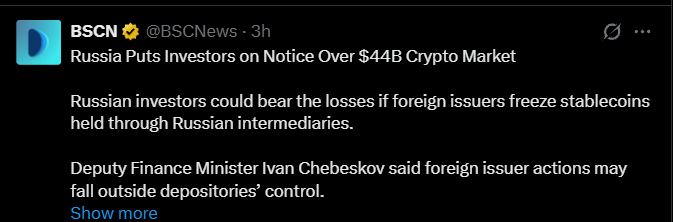
Russia's Ministry of Finance has put crypto investors on notice. Deputy Finance Minister Ivan Chebeskov said that if a foreign stablecoin issuer freezes assets such as USDT or USDC for reasons outside a Russian depository's control, the resulting loss will fall on the investor rather than the intermediary holding the asset.
The comments, made at the Moscow Financial Forum and reported by TASS, come as the country moves toward its first comprehensive framework for regulating digital currencies. This is a regulatory clarification on how risk will be divided going forward, not a report that USDT or USDC have already been frozen for Russian holders.
At a Glance
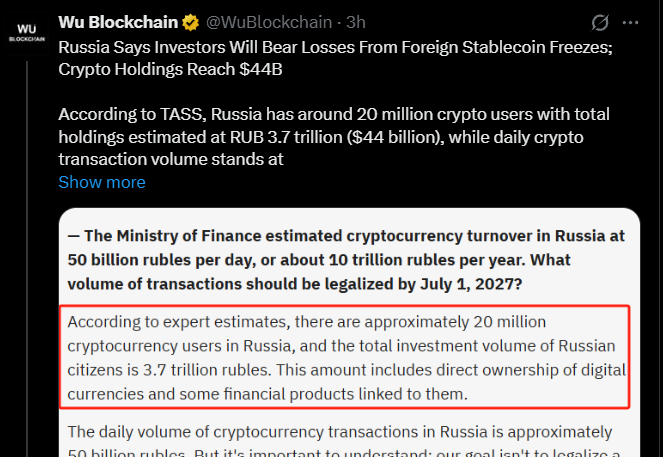
Russia crypto holdings are estimated at 3.7 trillion rubles (~$44 billion) across roughly 20 million users
Deputy Finance Minister Ivan Chebeskov warned that investors, not depositories, may bear losses if foreign stablecoin issuers freeze assets like USDT or USDC
Daily crypto market transaction volume in Russia is estimated at 50 billion rubles (~$595 million)
Non-qualified investors will face a 300,000-ruble annual limit per intermediary for crypto tied to blocking risk
A new criminal offense for unlicensed crypto exchange activity could take effect from July 1, 2027
Russia Crypto Market Reaches 3.7 Trillion Rubles
Officials estimate that around 20 million people in Russia hold cryptocurrency, with combined holdings worth roughly 3.7 trillion rubles, or about $44 billion. That figure includes both direct ownership of digital currencies and certain financial products linked to them.
Chebeskov added that daily transaction volume across the market runs close to 50 billion rubles, equivalent to roughly $595 million. Because a large share of this activity currently happens outside any regulated framework, the ministry has relied mainly on expert estimates. Officials expect the new rules to eventually produce far more precise data on the market's true size and structure.
Source: Wu Blockchain
Key Metric / Rule
Current Detail
Cryptocurrency users
~20 million
Estimated crypto holdings
3.7 trillion rubles (~$44B)
Daily transaction volume
~50 billion rubles (~$595M)
Stablecoins mentioned
USDT and USDC
Non-qualified investor limit
300,000 rubles/year per intermediary
Independent exchange capital requirement
15 million rubles
Crypto transaction reporting
Transactions outside the regulated framework
Reporting deadline
Within 180 days of FTS approval of procedures
Proposed criminal-liability date
July 1, 2027
Investors Could Bear Losses From Foreign Stablecoin Freezes
The core warning concerns dollar-pegged stablecoins like USDT and USDC. Under the newly adopted law, Russian digital depositories remain accountable for accurate recordkeeping, safe custody, proper transfers, and preventing unauthorized use of client assets.
However, if a foreign issuer blocks a specific token for reasons tied to foreign law, rather than any failure by the Russian intermediary, that loss is not automatically the depository's responsibility to cover. In effect, the investor absorbs the risk created by actions taken outside Russia's jurisdiction.
New Rules Will Define Investor and Intermediary Responsibilities
To manage this risk, Russia is introducing testing requirements for people trading crypto assets that carry blocking exposure. Qualified investors must demonstrate they understand the risks involved. Non-qualified investors face the same testing requirement plus a cap of 300,000 rubles per year through any single intermediary. The goal, according to Chebeskov, is a market where each participant's obligations are clearly defined rather than left ambiguous.
Source: BSCN Post
Russian Tax Residents Will Have to Report Crypto Transactions
Separately, Russian tax residents will be required to disclose crypto transactions to the Federal Tax Service whenever those transactions fall outside the regulated domestic framework, including any activity routed through addresses not administered by a Russian depository. Reporting must occur within 180 days of the tax service finalizing the forms, formats, and submission process for these disclosures.
Russia Plans Stricter Rules for Crypto Exchanges
On the exchange side, minimum capital requirements for non-bank crypto exchanges were lowered during negotiations, from an initially proposed 30 million rubles down to 15 million rubles, a move intended to keep independent exchanges viable alongside larger banking-linked platforms. Starting July 1, 2027, operating an unlicensed exchange could become a distinct criminal offense, though officials stressed this targets organized, unlicensed exchange operations rather than ordinary citizens transacting with their own crypto.
Russia Is Also Studying a Domestic Stablecoin
The Finance Ministry, working alongside the Bank of Russia, is exploring whether a Russian-issued stablecoin makes sense, though Chebeskov cautioned that no specific model or dedicated bill exists yet. The priority for now is gauging real demand and identifying risks before committing to a design.
Russia's Crypto Regulation Has Evolved Over More Than a Decade
Period
Regulatory Development
10+ years ago
Russia began debating legal treatment of digital currencies
Early approach
Focus on prohibition and liability
Later stage
Shift toward limited regulation and an experimental legal regime
Current stage
Move toward comprehensive regulation with defined investor/intermediary rules
July 1, 2027
Proposed criminal liability for unlicensed exchange operations
What Russia's New Crypto Rules Could Mean for Investors
For everyday holders, the shift points toward heavier reporting obligations and clearer disclosure of blocking risk before trading exposed assets. Intermediaries gain defined, limited liability rather than open-ended responsibility for foreign issuers' decisions. Officials say the practical rollout of these rules over the next year will shape how far crypto's role expands, including in cross-border trade settlement.
Conclusion
Russia's push toward comprehensive crypto regulation marks a shift from a decade of ambiguity toward a defined, if investor-cautious, legal structure. The message from the Finance Ministry is straightforward: as the $44 billion market comes under formal oversight, participants will get clearer rules, but also clearer exposure to risks originating outside Russia's borders.
Disclaimer: This article is for informational purposes only and does not constitute financial, investment, legal, or tax advice. Cryptocurrency markets are volatile and carry significant risk, including potential total loss of capital. Readers should conduct their own research and consult a qualified financial advisor before making any investment decisions.