Key Takeaways Treasury Secretary Scott Bessent revealed that unprecedented economic isolation tactics against Iran will be unveiled next week US naval forces are prepared to maintain their bl
Key Takeaways
- Treasury Secretary Scott Bessent revealed that unprecedented economic isolation tactics against Iran will be unveiled next week
- US naval forces are prepared to maintain their blockade of Iranian ports without time limits
- Tehran is pursuing membership in the BRICS New Development Bank to diversify its financial partnerships
- The S&P 500 reached an all-time closing high of 7,798.99, extending its winning streak into a third consecutive week
- Brent crude oil prices climbed beyond $87 per barrel amid strong technology sector performance
Wall Street witnessed another milestone on Thursday as the S&P 500 concluded trading at an unprecedented high of 7,798.99. The Nasdaq Composite advanced 0.81% to settle at 26,803.03, marking the third consecutive weekly advance for two of America’s three primary market benchmarks.
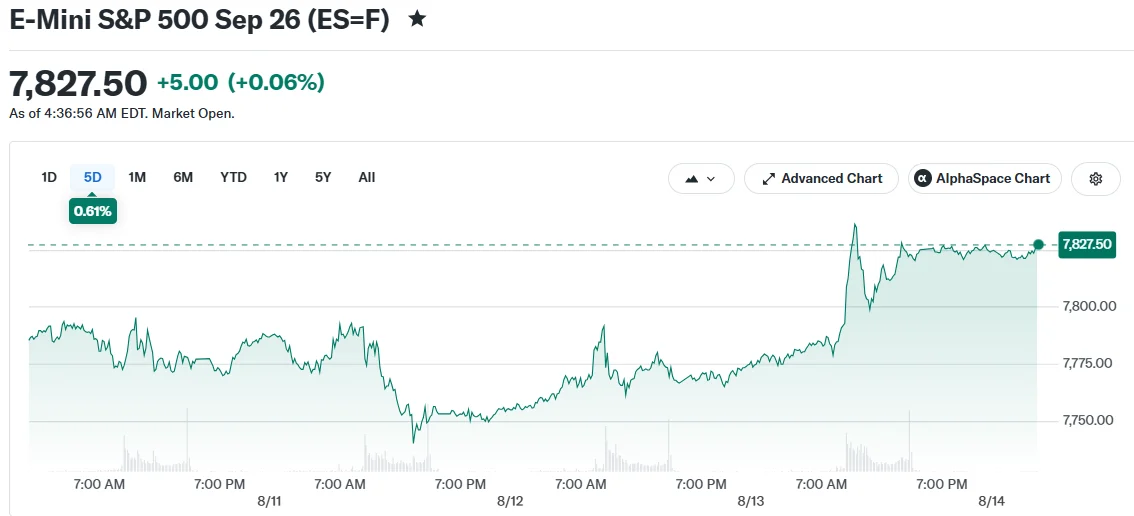 E-Mini S&P 500 Sep 26 (ES=F)
Markets across Asia largely mirrored the positive momentum. Moderating oil prices combined with stable producer price inflation data boosted investor confidence throughout the region.
Brent crude futures advanced more than 1%, climbing to $87.95 per barrel. Meanwhile, West Texas Intermediate posted similar gains, touching $82.15 per barrel.
The bullish market sentiment persisted despite ongoing geopolitical uncertainty surrounding the strategically vital Strait of Hormuz.
Historic Economic Isolation Measures Targeting Iran Coming Next Week
In a significant announcement, Treasury Secretary Scott Bessent revealed that Washington will unveil a comprehensive package of economic actions against Iran within days. He characterized these forthcoming measures as strategies “like have never been seen in the history of economic isolation on a country.”
Bessent framed the approach as a “one-two punch,” merging the upcoming financial sanctions with the ongoing naval enforcement operations blocking Iranian maritime access.
Defense Secretary Pete Hegseth confirmed separately that American naval forces possess the capability to maintain the blockade “indefinitely” through vessel rotation strategies. The USS George Washington is presently sailing toward the region to relieve the USS Abraham Lincoln, which has maintained its Middle East deployment for more than 250 days.
Facing mounting pressure, Iran has been exploring alternative financial channels. The governor of Iran’s central bank announced that the nation will imminently become a member of the BRICS New Development Bank, reflecting Tehran’s strategy to forge economic partnerships beyond Western institutions.
President Trump has issued warnings of 25% tariff penalties against nations that continue purchasing Iranian products or services, a policy that could significantly impact China, which serves as Iran’s primary commercial partner.
The standoff between Iran and the United States over control of the Strait of Hormuz continues without resolution. This critical waterway facilitates the passage of approximately one-fifth of global oil and natural gas shipments. Both nations are insisting on concessions that the opposing side has consistently rejected.
Britain’s economy expanded by 0.4% during the second quarter, positioning the nation to potentially lead G7 growth for a consecutive quarter. Corporate investment climbed 1.7%, significantly surpassing analyst predictions of a 0.5% contraction.
The International Monetary Fund had issued earlier warnings that the Iranian standoff would inflict greater economic damage on the United Kingdom than any other developed nation, given Britain’s substantial dependence on energy imports.
Nevertheless, British consumer spending exceeded projections in recent months. Contributing factors included favorable weather conditions, England’s impressive FIFA World Cup showing, and strengthening business sentiment across sectors.
A UK economist at Deutsche Bank acknowledged the robust first-half expansion but cautioned that escalating fuel costs could potentially constrain household purchasing power in coming months.
In separate technology news, Uber and Pony.ai revealed ambitious plans to introduce over 2,000 autonomous taxi vehicles across European markets, expanding operations beyond Zagreb to four additional metropolitan areas.
The post S&P 500 Reaches New Peak as Treasury Unveils Historic Iran Sanctions Strategy appeared first on Blockonomi.