Score: 5 of 5, "weak" Riskier assets: 28% of USDT Gold: about $19 billion Cushion: $7.95 billion Stocks: $4.18 billion S&P Global Ratings kept Tether's USDT at 5 on its five-point stablecoin
- Score: 5 of 5, "weak"
- Riskier assets: 28% of USDT
- Gold: about $19 billion
- Cushion: $7.95 billion
- Stocks: $4.18 billion
S&P Global Ratings kept Tether's USDT at 5 on its five-point stablecoin stability scale on Nov. 18. The agency labels that score "weak" and it is the lowest one available.
Tether Reports Record Profits (2:12)
USDT is the largest stablecoin, a cryptocurrency built to stay worth one U.S. dollar. About $183.5 billion of it was in circulation on Sept. 30, according to Tether's third-quarter report.
S&P's score is about one thing. It measures whether USDT can hold its dollar peg under stress, and S&P first cut Tether to 5 last year.
Related: World's most profitable hedge fund dumps $65M worth Bitcoin
Riskier assets grew to 28% of USDT
S&P says the assets it treats as higher risk now equal 28% of USDT in circulation, up from 24% a year earlier. They include gold, Bitcoin, publicly traded stocks, corporate bonds and secured loans.
Tether's own Sept. 30 report shows how much of that is gold. Precious metals, mostly physical gold, stood at $19.08 billion. Bitcoin holdings were $8.37 billion, secured loans were $14.18 billion and publicly traded stocks were $4.18 billion.
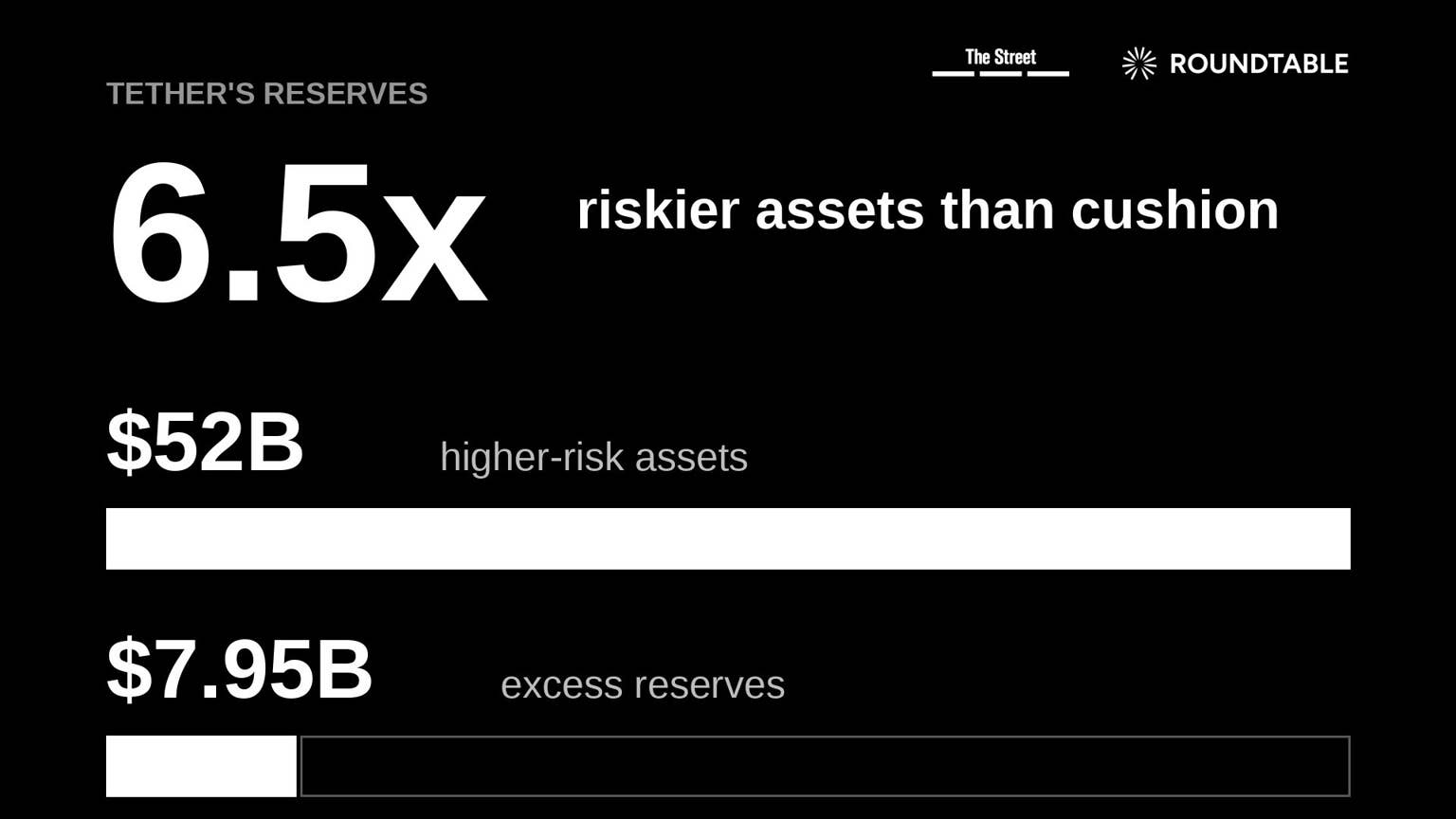
Adding up those categories and the $6 billion in other investments gives roughly $52 billion. That is more than six times the company's $7.95 billion in excess reserves, the amount by which its $191.45 billion in assets exceeds its $183.50 billion in liabilities.
Tether's higher-risk assets were roughly 6.5 times its excess reserves as of Sept. 30.
S&P's concern is that a sharp fall in those assets could erase the cushion and leave USDT undercollateralized, meaning fewer assets than tokens.
How Tether became one of the world's biggest gold buyers
Tether holds gold in two places. About $19.08 billion of it sits in the reserves behind USDT, according to the company's Sept. 30 report. At the $4,157.41-an-ounce price Tether used for that date, that works out to roughly 143 metric tons.
The second pile backs Tether Gold, a separate token called XAU₮. Each token represents one ounce of gold on a bar stored in Switzerland, and Tether says token holders own that gold. It stood at 827,418 ounces, about 25.7 tons, worth $3.44 billion at the end of September.
The XAU₮ pile grew 59% from the end of last year, according to Tether's own release. The gold in the USDT reserves rose from $12.9 billion a year earlier to $19.08 billion, S&P says, and its dollar value moves with the gold price.
More on TheStreet Roundtable
There is no public ranking of private gold holders, so "biggest" can't be checked. TheStreet has reported that Tether is one of the largest non-sovereign gold buyers in the world. CEO Paolo Ardoino has said the firm operates at a scale that puts its gold fund alongside sovereign gold holders.
Gold matters to S&P because its price swings. Treasury bills do not move the same way, so a drop in gold counts against the cushion.
What Tether says backs most of USDT
Tether says most of the reserves sit in low-risk holdings. Direct and indirect U.S. Treasury bill holdings total $132.4 billion, including $122.84 billion in Treasury bills held directly.
The company also reported $4.5 billion in net operating profit over the first nine months of 2026, including $1.5 billion in the third quarter. It says Treasury bills and reverse repurchase agreements, which are short-term loans backed by Treasurys, produced most of that income.
Tether's excess reserves nearly doubled from $4.1 billion at the end of June. S&P still did not move the score, because 5 is the floor.
An attestation is not a full audit
Tether's quarterly reports are attestations prepared by accounting firm BDO. An attestation checks that the reported figures are fairly presented as of one date. It is not a full audit of the company's finances.
In August, Tether announced that KPMG U.S. had completed a full audit of its 2025 financial statements with an unqualified opinion, the cleanest result an auditor can give. TheStreet reported on the plan for that audit in March.
S&P says the audited statements and KPMG's report have not been made public. It also says Tether's reports give limited detail on the corporate bonds and secured loans, and do not name the custodians, counterparties or banks that hold the assets.
Where Tether is regulated
Tether moved to El Salvador in 2025. S&P says the country requires issuers to hold at least one dollar of reserves for every dollar of tokens and to keep at least 70% of reserves in assets that can be sold within 30 days.
More on TheStreet Roundtable
It does not require reserves to be kept apart from the issuer's other assets, S&P says. That leaves open how well holders would be protected if Tether became insolvent.
Redeeming USDT directly with Tether is limited to verified customers and carries a large minimum, so most holders sell on exchanges instead. S&P says trading in the secondary market is typically strong, which offsets those limits.
USDT has stayed close to $1 over the past year. S&P also notes it held its peg through the 2022 collapses of Terra and FTX and the 2023 failure of Silicon Valley Bank.
What could lift the score
S&P says a smaller share of higher-risk assets could improve the assessment. Tether would also need to disclose more about what it holds, how it values those assets and how creditworthy its counterparties are.
Tether has pushed back before. After the earlier downgrade, it said it "strongly disagrees with the characterization" in S&P's report.
Disclaimer: This article is for informational purposes only and is not financial advice. Consult a qualified financial adviser before making any investment decision.