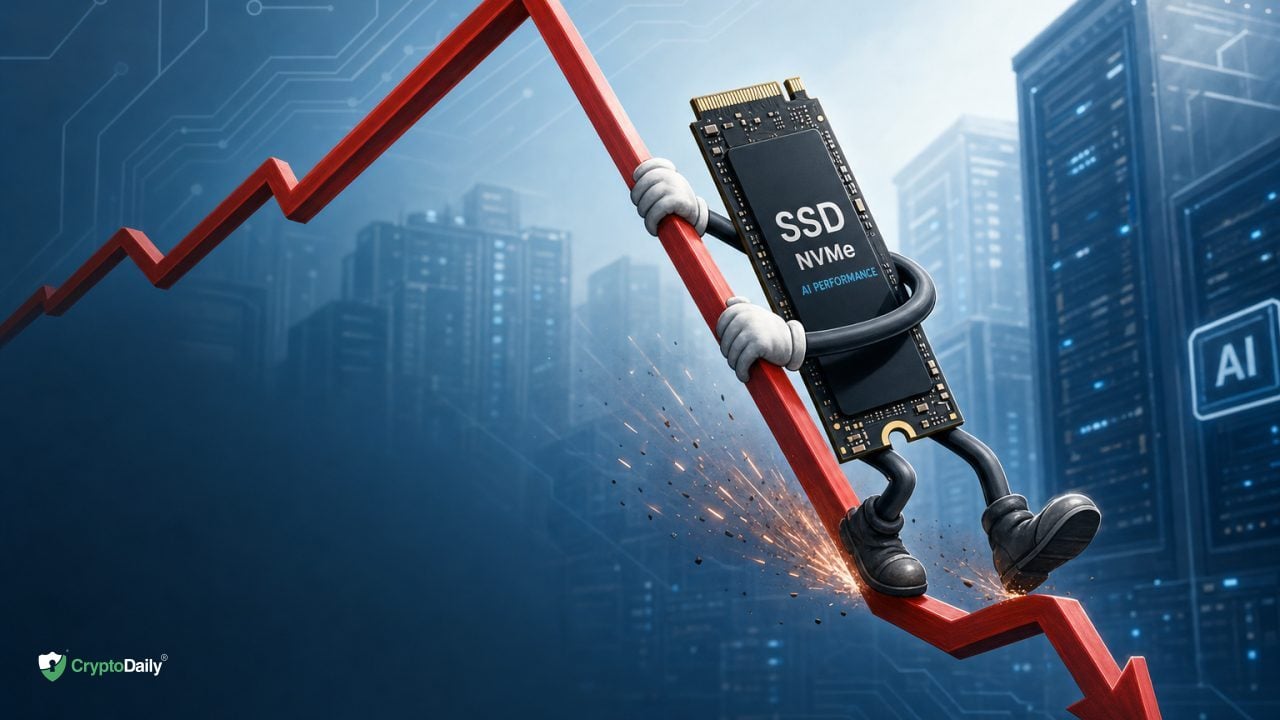
By lunchtime one Friday, SNDK had turned into the story everyone’s chat was chewing on. SanDisk ripped to a fresh intraday peak of $2,354.39 on June 22, 2026, then the air thinned out almost
By lunchtime one Friday, SNDK had turned into the story everyone’s chat was chewing on. SanDisk ripped to a fresh intraday peak of $2,354.39 on June 22, 2026, then the air thinned out almost immediately TradingView. The next session, it wasn’t just one stock wobbling. It was the whole AI hardware trade catching its breath.
On June 23, amid a wider semiconductor selloff tied to South Korea market turmoil and investors rotating around the AI capex theme, SanDisk fell roughly 13 to 14 percent in a single day Investing.com. A week later, people were still fighting the tape. On July 2, coverage called SNDK the best performer in the S&P 500 for the year, up about 635 percent year to date, even as it flashed another 14.1 percent intraday dive Kiplinger.
That’s not just volatility. It’s a temperature check. The question now is whether SanDisk’s stutter is a one-off shakeout or a sign that AI hardware is moving from relentless melt-up to a trickier phase.
The big picture: a rally that started sprinting uphill
For two years, hyperscalers and AI-native companies have thrown staggering budgets at compute. GPUs, HBM, networking, and storage vendors all rode the same wave. Memory names in particular went from deep cyclical pain to boom times. Prices firmed. Utilization bounced. Investors piled in.
By late June, froth was measurable. Bank of America’s Bubble Risk Indicator for the PHLX Semiconductor Sector clocked about 0.91 on a 0 to 1 scale as of June 30, a reading commentators flagged as a warning that the run was stretched and vulnerable to sharp reversals Investing.com.
Signal to watch: when momentum, crowding, and earnings revisions all peak together, even tiny shifts in the narrative can trigger big, sloppy drawdowns.
SanDisk sits right in the middle of that conversation. It’s a brand anchored in NAND flash and storage systems. In the AI buildout, that means pipelines for datasets, checkpoints, retrieval, and logs. If buyers slow orders, or if other parts of the stack grab wallet share, SNDK is one of the first places you’ll see it.
What SanDisk tells us about the AI stack right now
NAND is suddenly strategic again
Three years ago, flash was in a downcycle. Too much supply. Weak pricing. Then AI flipped the script. Training clusters need fast local storage to feed GPUs without bottlenecks. Inference farms need low-latency caches to keep responses snappy. Even with the spotlight on GPU shortages and HBM capacity, flash quietly became the glue that keeps data flowing.
But bandwidth still dominates the value chain
Here’s the catch. When buyers are forced to prioritize, they chase the scarcest, highest-leverage components first. That has been compute and HBM. Storage wins when clusters scale and when workflows get optimized, but if capex growth softens, the mix may skew toward compute-heavy upgrades over broader storage refreshes.
So if you’re watching SNDK dump on a day when the whole sector wobbles, you’re not just seeing one ticker slip. You’re getting a read on whether the next dollar in AI capex goes to more GPUs, better memory bandwidth, networking, or quality-of-life upgrades like storage and power.
From melt-up to wobble: how stretched the move got
Let’s anchor the narrative with what actually happened, then talk mechanics.
Date Event Market read-through June 22, 2026 SNDK hits an intraday all-time high at $2,354.39 TradingView Momentum and positioning at extremes; buyers still chasing leaders June 23, 2026 Sector selloff; SNDK drops roughly 13–14% amid Korea-driven turmoil and AI-capex repositioning Investing.com Correlated de-risking; storage and memory seen as high beta to AI spending June 30, 2026 BofA’s Bubble Risk Indicator for semis hits about 0.91 on a 0–1 scale Investing.com Froth visible in factor screens; vulnerability to air pockets rises July 2, 2026 Coverage calls SNDK best S&P 500 performer in 2026 (~635% YTD) while it slides another 14.1% intraday Kiplinger Classic late-stage action: huge gains coexisting with violent pullbacks
What the table says, out loud
When you see record highs followed almost immediately by a double-digit flush, then another whoosh lower while the narrative still touts best-in-index status, you’re in the neighborhood where fatigue creeps in. Not a top call. Just the physics of a crowded trade.
Mechanics of fatigue in AI hardware cycles
Fatigue doesn’t announce itself with a press release. It shows up as little changes in spend timing, supply response, pricing discipline, and investor behavior. The sequence usually looks something like this:
- Demand shock hits and outstrips supply. Buyers over-order to secure allocation.
- Vendors enjoy better pricing and utilization. Earnings revisions trend up.
- Capital floods in. Capacity expansions begin to land. Lead times shorten.
- Customers rebalance. Some orders slip right. Mix shifts to the scarcest bottleneck.
- Margins compress at the edges. Top-line growth slows from breathtaking to strong.
- Multiples adjust, often abruptly, especially for names priced for perfection.
Inventory, elasticity, and channel checks
With storage, elasticity matters. If flash prices creep up while customers are wrestling with power and networking constraints, some deployments can be delayed without wrecking the roadmap. That flexibility can translate into lumpier quarters for NAND-heavy names compared to compute parts that remain hard to get.
Pricing power fades first at the periphery
When buyers push back, early signs usually appear in promotions, longer deal cycles, or a quiet shift to lower-capacity SKUs. None of those are a death knell. They’re just what late innings look like before the next optimization wave kicks in.
Positioning is a catalyst by itself
The bigger the run, the thinner the exit. With SNDK printing a new high on June 22 and then coughed lower the next session, part of that move was simply crowded longs hitting the same door at once. Correlation spikes on the way down. That doesn’t mean the fundamental AI story is broken. It means the tape needed to sit down.
What the plunge is signaling about AI spending
If you strip away the noise, three scenario threads keep popping up when I talk to folks on the buy side and in the channel:
1) Spend isn’t falling, it’s rotating
Many buyers are still capacity constrained on networking and power. If more of the 2026 budget gets rerouted to optics, switches, PDUs, and power-hungry GPU racks, storage may grow but capture a smaller slice. In tapes like SNDK, that rotation looks like underperformance versus compute leaders during risk-off days.
2) Optimization is finally paying dividends
Fine-tuning, pruning, quantization, and smarter caching reduce waste. If inference per watt improves, you can meet demand growth without a linear surge in hardware. Great for efficiency, tougher for vendors whose upside case leaned on unbroken parabolic orders across the stack.
3) Macro and policy crosscurrents matter more than usual
Semis are global. News out of Korea rattled the sector on June 23 and fed into a broader de-risking across AI capex plays Investing.com. Export controls, subsidies, and data localization rules can change the mix of what gets bought when. That’s not bearish. It’s just more moving parts.
Winners and losers if the mix shifts
Potential relative winners
- Vendors tied to bandwidth and power. When clusters scale, network and energy infrastructure often get first call on incremental dollars.
- Software and tooling that turns existing fleets into higher productivity assets. Efficiency is the stealth capex reducer.
- Edge and inference-optimized solutions. As workloads spread out, local storage can still do well, but the value migrates to latency-sensitive use cases.
Watchpoints for storage-heavy names
- Deal timing and seasonality. Any slippage in enterprise or hyperscale refresh cycles will show up here first.
- Mix shifts toward higher performance tiers. If buyers crown a small number of top-end SKUs and delay mainstream deployments, revenue concentration rises along with volatility.
- Gross margin trends. Even a modest step down can compress valuation fast when multiples are near cycle highs.
How traders and allocators might read SNDK now
Stripping out emotion helps. SNDK printed a blow-off style high on June 22, cracked with the sector on June 23, and stayed jumpy into early July. BofA’s semi bubble read at 0.91 by month-end underlined what the chart was already whispering: positioning was hot and sensitivity to any headline was extreme Investing.com.
In environments like this, the tape can punish even good news if it’s not perfect. A guide that stays strong but loses some torque, a cautious comment on order visibility, or a hint that mix is changing can all land with outsized impact. That’s not a prediction. It’s just how crowded trades behave when the music slows.
For long-only allocators, the pragmatic approach is usually to focus on durability: supply discipline, customer concentration, and the balance between hyperscale and enterprise exposure. For shorter-term traders, realized volatility is now the main attraction. If you’re not being paid for the risk, it’s easy to step aside and wait for cleaner setups. None of this is investment advice, to be clear. Just pattern recognition after a run like this.
Near-term markers to watch
Execution and narrative clues
- Backlog and book-to-bill. Even a small step down can reset expectations.
- Pricing on NVMe enterprise SSDs. Signals whether supply is getting looser.
- Customer commentary from hyperscalers. If they lean into power and networking first, storage could lag near term.
- Cross-asset froth gauges. If bubble indicators cool from 0.91 and breadth improves, the worst may be done for now.
Macro spillovers
- Asia supply chain headlines. Memory and storage pricing are sensitive to regional shocks.
- Policy moves on data residency and export controls. These can redirect demand between regions and tiers.
Risks & what could go wrong
- Capex pause. If AI buyers throttle spend to digest recent builds, storage vendors can feel a sharper near-term hit than compute.
- Pricing unwind. A faster-than-expected normalization in NAND pricing would pressure margins and sentiment simultaneously.
- Supply surprise. Capacity add-ons landing into a softer quarter can turn a soft patch into a mini-downcycle.
- Macro shock. Another Korea-style jolt or currency move could spark forced de-risking across semis again.
- Execution slip. Any stumble in product transition or yield can compound a valuation reset.
- Rotation to software. If efficiency software eats a bigger slice of the ROI pie, hardware growth could decelerate without a recession.
Fatigue is subtle until it isn’t. When multiples lean forward, even tiny execution misses can snowball into larger drawdowns.
If you want a steady pulse on how crypto infrastructure narratives intersect with AI hardware and data center spend, we track those cross-currents at Crypto Daily with an eye on both market structure and on-chain demand signals.
Frequently Asked Questions
Why does a storage-focused name like SanDisk move so much with AI headlines?
Because storage is a key part of AI clusters. Training and inference both need fast local and networked storage. When AI capex ramps or slows, storage names are high beta to that trend. In a momentum market, they also become crowd favorites, which amplifies moves in both directions.
Is the June 23 selloff just macro noise or something deeper?
It was both. There was a macro shock from Korea that hit semis broadly, and there was sector-specific repositioning around the AI capex trade Investing.com. The combination exposed how crowded the trade had become after SNDK set a record high a day earlier TradingView.
Does AI hardware fatigue mean the AI trend is over?
No. It often means the easy phase is over. Growth can continue while the mix of spend changes, the bar for quarterly results rises, and valuations re-rate to something more sustainable. Fatigue is about expectations and positioning as much as fundamentals.
How does the bubble risk reading of 0.91 factor into this?
It’s a context clue. BofA’s 0.91 reading on June 30 flagged that momentum and sentiment were stretched in semis Investing.com. High readings don’t time tops, but they warn that pullbacks can be sharper and more frequent.
That’s late-cycle tape behavior. You can have incredible year-to-date gains and still get hit with big intraday declines when investors de-risk or when any news falls short of perfection. Kiplinger cited about a 635 percent YTD gain alongside a 14.1 percent intraday decline that day Kiplinger.
What should observers watch to gauge whether the selling is done?
Look for stabilization in enterprise SSD pricing, cleaner commentary on backlog and lead times, and whether hyperscalers pivot spending toward storage after addressing power and networking constraints. Also keep an eye on whether froth gauges cool from late-June levels.
Does any of this spill into crypto markets?
Indirectly. AI data centers and crypto mining both stress power and supply chains. When capex rotates toward power and networking, it can influence timelines for infrastructure upgrades that also touch Web3 services. It’s not a 1:1 linkage, but the themes rhyme.
Disclaimer: This article is provided for informational purposes only. It is not offered or intended to be used as legal, tax, investment, financial, or other advice.