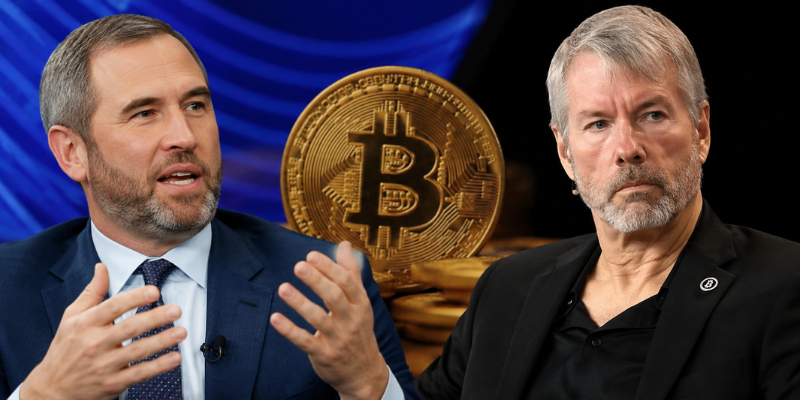
Ripple CEO Brad Garlinghouse has criticized Strategy’s Bitcoin acquisition strategy, arguing that financial engineering should not be the primary driver of value creation in the digital asset
Ripple CEO Brad Garlinghouse has criticized Strategy’s Bitcoin acquisition strategy, arguing that financial engineering should not be the primary driver of value creation in the digital asset market.
Speaking during a CNBC interview shared by Squawk on the Street, Garlinghouse said:
“I think team Michael Saylor wasn’t focused on the right stuff, and that has hurt the overall market.”
Garlinghouse later reinforced the message on X, writing that:
“Financial engineering doesn’t drive long-term value. Utility does.”
He added that the long-term value of digital assets should come from solving real-world problems rather than relying on increasingly complex capital structures to fund additional Bitcoin purchases.
The comments come as Bitcoin and XRP continue to trade under pressure following several months of weaker market performance, renewing debate over whether leveraged corporate Bitcoin accumulation strategies support markets during bull cycles but increase pressure when financing conditions deteriorate.
Strategy Introduces Bitcoin Monetization Framework
The criticism follows Strategy’s announcement of a new Digital Credit Capital Framework, representing one of the company’s most significant capital management updates since adopting Bitcoin as its primary treasury asset in 2020.
Under the framework, Strategy’s board has authorized management to monetize up to $1.25 billion worth of Bitcoin, if necessary, to strengthen the company’s balance sheet. The proceeds may be used to build cash reserves, fund preferred stock dividends, meet debt obligations and support buybacks of preferred securities or Class A shares.
The broader plan also includes up to $2 billion in authorized share repurchases, a $2.55 billion cash reserve policy and revised dividend management. The company said the framework is intended to improve liquidity while maintaining long-term exposure to Bitcoin. Strategy currently holds 847,363 BTC, remaining the world’s largest publicly traded corporate Bitcoin holder.
The announcement follows Strategy’s first Bitcoin sale in years, marking a notable shift from its long-standing “never sell Bitcoin” narrative as the company adapts to changing market conditions.
Utility Remains Ripple’s Focus
Garlinghouse contrasted Strategy’s financing approach with Ripple’s broader product strategy, arguing that sustainable demand for digital assets should be driven by practical blockchain applications rather than capital market structures.
Ripple has increasingly emphasized payments, stablecoins, digital asset custody, liquidity solutions and tokenization as central components of its 2026 business strategy, positioning XRP within enterprise payment and treasury infrastructure.
Supporters of blockchain utility echoed similar views following Garlinghouse’s remarks. XRP Ledger validator Vet said blockchain technology can address practical financial challenges, including around-the-clock settlement, weekend collateral access and the use of neutral internet-native assets for value transfer.
The discussion reflects a broader debate across the cryptocurrency industry as companies weigh treasury-driven Bitcoin accumulation against blockchain networks focused on payments, financial infrastructure and other real-world applications amid a more challenging market environment.