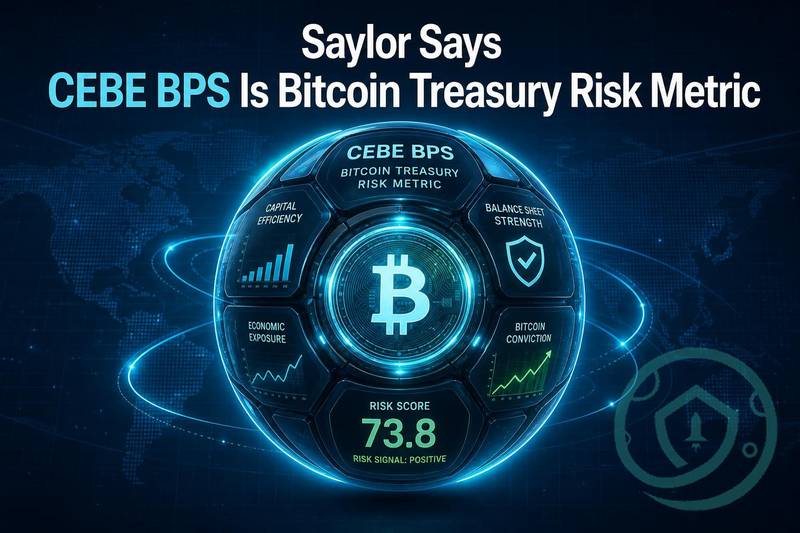
Strategy founder Michael Saylor said Common Equity Book Equivalent Basis Points (CEBE BPS) is the conservative risk metric for Bitcoin treasury firms, framing it as a measured way to evaluate
Strategy founder Michael Saylor said Common Equity Book Equivalent Basis Points (CEBE BPS) is the conservative risk metric for Bitcoin treasury firms, framing it as a measured way to evaluate balance sheet exposure to the cryptocurrency.
Saylor made the statement in a post on X, positioning CEBE BPS as a tool that captures downside risk without overstating a company's vulnerability to Bitcoin price swings.
What Saylor Meant by Calling CEBE BPS a Conservative Risk Metric
KEY POINTS
- Michael Saylor described CEBE BPS as a conservative risk metric for firms holding Bitcoin on their balance sheets.
- The metric measures exposure in basis points relative to common equity book value, offering a standardized comparison across treasury firms.
- Saylor's framing positions it as a prudent measure rather than an aggressive bet on volatility.
CEBE BPS expresses a firm's Bitcoin-related risk as basis points of its common equity book value. In plain terms, it measures how much of a company's shareholder equity is exposed to Bitcoin price movements, scaled to a standardized unit that analysts can compare across firms.
By calling the metric "conservative," Saylor suggested it accounts for risk without inflating perceived exposure. A conservative framing implies the metric does not assume worst-case liquidation scenarios or extreme correlation breakdowns, instead grounding the calculation in book value rather than market capitalization or unrealized gains.
This distinction matters because Bitcoin treasury firms often trade at premiums to their net asset value. A metric anchored to book equity strips out that premium, giving a more grounded picture of actual capital at risk. Saylor has previously argued that investor confidence depends on transparent metrics, making CEBE BPS consistent with his broader communication philosophy.
Why the Metric Matters for Strategy and Other Bitcoin Treasury Firms
Strategy, formerly MicroStrategy, holds the largest corporate Bitcoin treasury among publicly traded companies. The firm has continued adding Bitcoin to its balance sheet, making risk communication to shareholders and regulators a central concern.
Saylor's push for CEBE BPS as a standard suggests he wants investors to evaluate Strategy's position through a lens that emphasizes prudence. For a company whose stock price correlates heavily with Bitcoin, having a "conservative" benchmark helps counter narratives that frame the treasury strategy as reckless speculation. The company recently tested its selling process with a small BTC sale, signaling that risk management extends beyond metrics alone.
Other firms adopting Bitcoin treasury strategies face the same communication challenge. A shared metric would let analysts compare risk profiles across companies without relying on ad-hoc calculations or market-cap-based estimates that fluctuate with sentiment.
Investors watching Strategy may interpret Saylor's framing as a signal that the company views its current exposure as manageable under conservative assumptions. Whether the broader market adopts CEBE BPS as a standard remains an open question, but Saylor's influence in the Bitcoin treasury space gives the proposal visibility.
The push for standardized risk metrics also comes as the crypto industry explores more rigorous frameworks for institutional adoption. Efforts like post-quantum security research reflect a similar drive toward institutional-grade infrastructure across the broader digital asset space.
Additional source references: source document 1.
Disclaimer: This article is for informational purposes only and does not constitute financial or investment advice. Cryptocurrency and digital asset markets carry significant risk. Always do your own research before making decisions.
Read original article on aicryptocore.com