The uncapped "JPYSC" stablecoin marks Japan's first Type III Electronic Payment Instrument, though initial circulation remains confined to internal exchange accounts pending regulatory cleara
The uncapped "JPYSC" stablecoin marks Japan's first Type III Electronic Payment Instrument, though initial circulation remains confined to internal exchange accounts pending regulatory clearance.
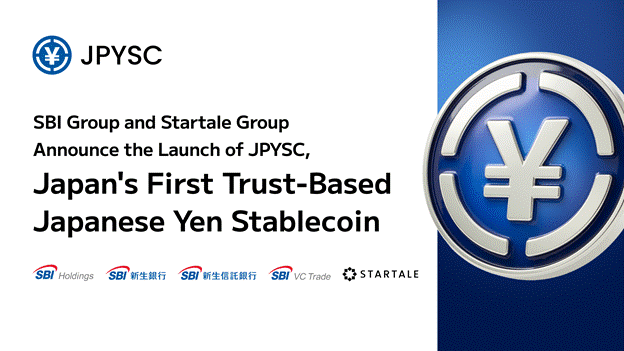
SBI Holdings, Inc. and its subsidiaries, in partnership with Singapore-based fintech firm Startale Group Pte. Ltd., announced Wednesday the launch of JPYSC, Japan's first trust-based Japanese yen stablecoin.
The digital asset represents a regulatory milestone under the nation’s Payment Services Act, bypassing the transaction caps that have restricted previous stablecoin iterations in the country.
Core Structure and Regulatory Framework
Issued by SBI Shinsei Trust Bank and distributed by licensed crypto exchange SBI VC Trade Co., Ltd., JPYSC is designated as a Type III Electronic Payment Instrument.
Unlike fund-transfer-type stablecoins previously introduced in Japan, trust-based stablecoins operate under a unique legal structure:
- No Transaction Limits: The instrument is entirely exempt from the ¥1 million ($6,250) transaction and account balance limitations governing standard fund transfer licences.
- Institutional Architecture: Reserve assets are held and managed directly by a regulated trust bank, aiming to mitigate counterparty risk for large-scale institutional participants.
- Corporate Viability: By enabling high-value transactions at lower operational costs than legacy banking networks, the issuers aim to position JPYSC for commercial corporate adoption.
Delivery Constraints and Public Blockchain Roadmap
Despite completing the technical infrastructure required for public blockchain deployment, the consortium is executing a restricted rollout. At launch, JPYSC utilisation is confined exclusively to internal SBI VC Trade accounts, meaning users cannot transfer the tokens to external, self-custodied digital wallets.
The companies stated that a transition to public blockchains both within Japan and internationally remains contingent upon further clarification of domestic regulatory treatments and tax practices.
"While legal and regulatory challenges remain before circulation on public blockchains can be realised, the SBI Group will work closely with regulators to resolve these issues," Yoshitaka Kitao, Chairman and President of SBI Holdings, said in a statement.
Institutional Liquidity and Market Positioning
The introduction of JPYSC aims to bridge traditional Japanese capital markets with decentralized financial infrastructure. As tokenised real-world assets (RWAs) such as bonds, real estate, and equities gain traction globally, compliant fiat on-ramps are becoming critical infrastructure components.
According to the project's roadmap, the consortium intends to leverage JPYSC across several key institutional verticals once public blockchain deployment is authorised:
- Onchain Foreign Exchange: Serving as a yen-denominated base asset to establish 24/7 liquidity pools against U.S. dollar stablecoins.
- Capital Efficiency: Supporting institutional lending markets and on-chain carry trades to generate yen-denominated yields.
- Cross-Border Settlement: Streamlining international trade and business-to-business transactions by bypassing traditional correspondent banking rails.
Next Milestones
SBI VC Trade disclosed plans to launch a dedicated JPYSC lending service in the near future to stimulate initial utility within its closed ecosystem. The broader expansion of the stablecoin will depend heavily on the speed at which Japanese financial regulators provide tax and operational guidance for open-network digital asset circulation.