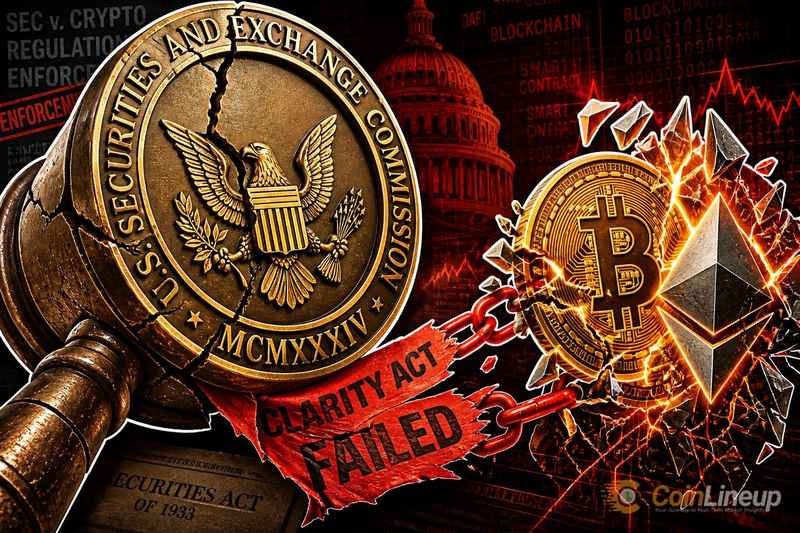
The U.S. Securities and Exchange Commission is set to move back to the center of crypto policy after the Clarity Act failed to advance through Congress, leaving SEC crypto regulation as the m
The U.S. Securities and Exchange Commission is set to move back to the center of crypto policy after the Clarity Act failed to advance through Congress, leaving SEC crypto regulation as the main near-term source of direction for digital-asset firms.
Why the Clarity Act's failure hands the SEC the wheel
The Clarity Act, formally the Digital Asset Market Clarity Act (H.R. 3633), was written to define which digital assets count as securities and which fall under commodity rules, and to spell out how exchanges and intermediaries should be supervised. For related coverage, see Top RWA Crypto Projects in 2026: 10 Real-World Asset Tokens and Protocols to Know.
With that market-structure bill stalled in Congress, the statutory framework it promised does not exist. In that vacuum, agency action becomes the primary lever for near-term oversight. For related coverage, see HTX Corporate Crypto Accounts Face EU Sanctions Dead End.
The distinction matters. Legislation from Congress sets durable, statute-level rules; SEC-led regulation works through guidance, rulemaking, and enforcement, which can shift faster but carries less permanence. The delay to the bill had already drawn criticism ahead of a scheduled vote, and its failure now leaves the regulator to fill the gap.
What the SEC is likely to take up next
The SEC has scheduled an open meeting where crypto oversight is on the agenda, signaling a forward-looking response rather than a settled framework.
The most direct question the agency historically addresses is token classification: whether a given asset is a security and therefore subject to registration and disclosure obligations. That determination shapes nearly everything else.
Beyond classification, exchange, broker, and custody oversight are recurring focus areas, covering how trading venues operate and how customer assets are held. Disclosure, registration, and enforcement priorities round out the areas the SEC typically drives through interpretation rather than statute.
These are informed expectations based on how the agency operates, not confirmed decisions. The failure of a defined bill means the specifics now depend on regulatory interpretation.
What it means for firms and investors
For crypto companies, a regulator-led path extends compliance uncertainty. Firms planning around the Clarity Act's proposed definitions must now plan around agency guidance that can change with enforcement posture rather than fixed statutory language.
Investors face a similar recalibration. A framework built on regulatory interpretation is read differently from one anchored in new law, because the boundaries can be tested case by case rather than being fixed in a statute.
The debate over the bill was not confined to markets. Coin Center argued that the fight over the Clarity Act reached beyond crypto, framing it as part of a broader contest over control of the internet.
The bill also split lawmakers who otherwise favor federal rules. Senator Elizabeth Warren backed federal crypto regulation while opposing the Clarity Act, underscoring that the legislative path forward was contested rather than a clean partisan divide, and she has pressed for scrutiny of the administration's crypto ties alongside that push.
With the bill stalled, the SEC's open meeting is the next concrete step to watch for how oversight takes shape.
Disclaimer: This article is for informational purposes only and does not constitute financial or investment advice. Cryptocurrency and digital asset markets carry significant risk. Always do your own research before making decisions.
Read original article on coinlineup.com