The U.S. Securities and Exchange Commission issued a formal "Innovation Exemption" on September 17, 2026, designed to facilitate the trading of tokenized National Market System (NMS) stock, w
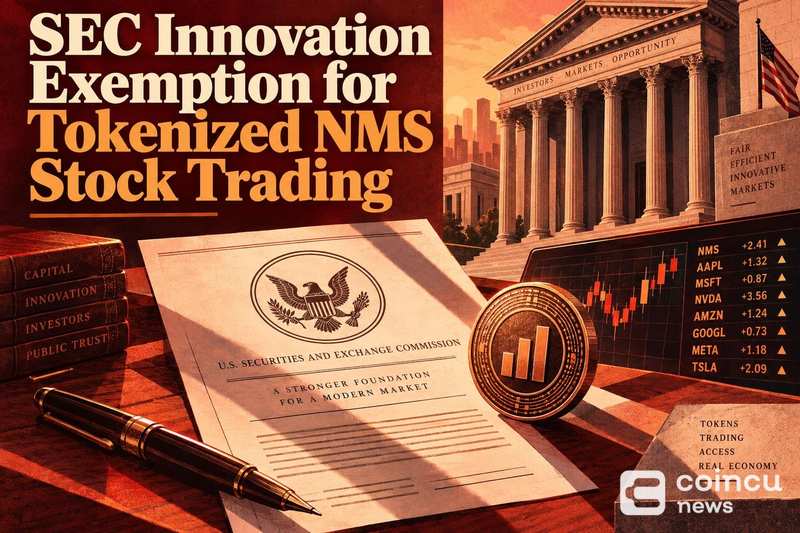
The U.S. Securities and Exchange Commission issued a formal "Innovation Exemption" on September 17, 2026, designed to facilitate the trading of tokenized National Market System (NMS) stock, while simultaneously opening a public comment period to shape the long-term regulatory framework governing these instruments.
The action, published as Release No. 2026-90, marks the agency's first direct intervention specifically targeting the trading infrastructure for blockchain-based representations of exchange-listed equities, a category that sits at the intersection of traditional securities law and distributed ledger technology. The accompanying rulemaking reference is File No. 4-927.
What the SEC's Innovation Exemption Announces
An innovation exemption is a time-limited relief mechanism the SEC uses to permit activities that existing rules were not designed to accommodate, without waiting for full rulemaking to conclude. The exemption creates a conditional pathway under which qualifying market participants may engage in tokenized NMS stock trading subject to terms the SEC specifies, rather than applying decades-old equities rules that predate blockchain settlement. For related coverage, see SEC Considers Innovation Exemption Following Stablecoin Bill Passage.
NMS stocks, as defined under Regulation NMS, are exchange-listed equities subject to order-protection, access, and market-data requirements. Tokenizing an NMS stock, meaning representing ownership or economic exposure on a blockchain ledger, does not by itself alter the underlying security's regulatory classification, which is why a targeted exemption rather than a blanket approval is the mechanism the SEC chose. The exemption addresses the gap between how existing exchange and broker-dealer rules operate and how tokenized representations of those securities would actually settle and trade.
SEC Chair Paul Atkins framed the action as a bridge toward durable rulemaking, signaling that the exemption is an interim measure while the agency develops permanent rules, not a final determination on how tokenized equities will be treated across all contexts.
How the Exemption Connects to Tokenized NMS Stock Trading
Tokenized representations of NMS stocks present structural questions that current exchange registration, clearing, and settlement rules do not cleanly answer: which entity is the registered holder of record, how does on-chain settlement interact with T+1 clearinghouse obligations, and whether a smart-contract transfer constitutes a reportable trade under NMS trade-reporting rules. The exemption's stated purpose of "facilitating" trading implies the SEC is providing relief from at least some of these requirements, though the specific terms are contained in the official materials rather than the headline announcement alone.
This development follows a period during which the SEC had been publicly considering an innovation exemption framework in the wake of U.S. stablecoin legislation, and after Citadel Securities formally opposed earlier tokenized stock exemption proposals, citing market-structure integrity concerns. The release of a concrete exemption alongside a comment request suggests the SEC moved forward despite ongoing industry disagreement about the appropriate scope of relief.
The request for comment is a procedural signal that the exemption's current terms are not intended to be permanent. Comment processes allow broker-dealers, exchanges, custodians, and investor-protection advocates to identify implementation problems, gaps in investor disclosure, or unintended consequences before the agency converts interim relief into binding rules. Interested parties should monitor the official release for comment deadlines, submission instructions, and the specific questions the SEC is posing, none of which are confirmed from the headline announcement alone.
Key policy questions the comment process is likely to address include: how tokenized NMS stock custodians demonstrate compliance with existing customer-protection rules, whether on-chain transfers satisfy best-execution obligations, and how secondary market venues trading tokenized equities should be registered. The SEC's prior consideration of innovation exemptions post-stablecoin legislation suggests investor protection and market-structure stability are the agency's primary benchmarks for evaluating comment submissions.
What Market Participants Should Watch Next
The concrete next steps for anyone operating in or building toward tokenized equities markets are: review the full exemption terms in Release No. 2026-90 for the specific conditions and limitations; check File No. 4-927 for accompanying rulemaking materials; confirm the comment deadline once the official Federal Register notice is published; and track whether the SEC issues follow-on no-action letters to specific platforms seeking to operate under the exemption's terms.
For institutional players, the Atkins speech characterizing this as a "bridge toward durable rulemaking" is the most consequential signal: it means the current exemption framework may be modified or replaced, and building compliance infrastructure around interim terms carries transition risk. What exchanges, custodians, and tokenization platforms specifically need clarified, including capital requirements, reporting obligations, and custody standards applicable to blockchain-settled equities, will be shaped by how robustly the industry responds to the comment process. The SEC's earlier handling of a blockchain ETF exemption request from F/m Investments offers a precedent for how granular the agency's conditions can be when approving novel tokenized product structures.
FAQ: SEC Innovation Exemption and Tokenized NMS Stock
What did the SEC announce?
The SEC issued an "Innovation Exemption" under Release No. 2026-90 to facilitate the trading of tokenized NMS stock, paired with a request for public comment on the framework.
Does the announcement mean every tokenized stock can be traded?
No. An innovation exemption is conditional and time-limited. It creates a specific pathway under terms the SEC defines, not a broad approval for all tokenized equity activity. Participants must review the official exemption terms to determine whether their activities qualify.
The comment process invites broker-dealers, exchanges, investors, and other stakeholders to identify implementation questions and policy gaps before the SEC develops permanent rules, per Chair Atkins' framing of the exemption as a bridge toward durable rulemaking.
The authoritative sources are the SEC's official press release for Release No. 2026-90 and the accompanying File No. 4-927 rulemaking page, where comment submission instructions and deadlines will be posted.
Disclaimer: This article is for informational purposes only and does not constitute financial or investment advice. Cryptocurrency and digital asset markets carry significant risk. Always do your own research before making decisions.
The post SEC Innovation Exemption for Tokenized NMS Stock Trading was initially published on Coincu.