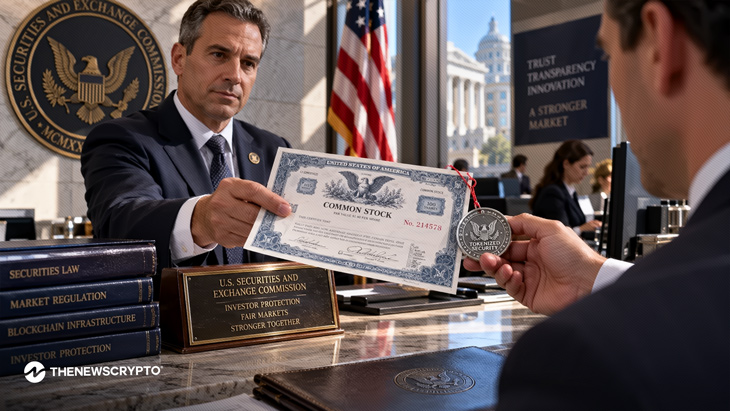
The SEC’s Innovation Exemption allows qualifying TSVs to trade certain tokenised NMS stocks onchain without being treated as an exchange under the Exchange Act. The relief is temporary and co
- The SEC’s Innovation Exemption allows qualifying TSVs to trade certain tokenised NMS stocks onchain without being treated as an exchange under the Exchange Act.
- The relief is temporary and conditional, expires after five years, and is subject to public comment as the SEC considers longer-term rules for onchain markets.
The Securities and Exchange Commission (SEC) has issued a temporary, conditional exemptive relief order that allows Tokenised Securities Venues to trade tokenised NMS stocks using permissioned automated market makers and liquidity pools, without being classified as an exchange under the Exchange Act.
Moreover, the order, dubbed the “Innovation Exemption,” marks one of the most significant steps the SEC has taken toward bringing U.S. capital markets on-chain.
SEC Chairman Paul Atkins framed it plainly: this is about bringing America’s capital markets into the digital age, not about bending existing rules to fit new technology. The exemption is temporary, set to expire five years after publication, and comes with a public comment period to shape what comes next.
What the Innovation Exemption Actually Allows?
TSVs, Tokenised Securities Venues, bring together buyers and sellers of tokenised NMS stock through AMM Liquidity Pools in a permissioned environment. To qualify for the exemption, venues must meet strict conditions. Smart contracts must be auditable, public, and deployed on a public, permissionless distributed ledger.
TSVs must verify that tokenised stocks carry the same rights and privileges as their traditional equivalents. Additionally, trading must stop in any tokenised NMS stock the moment the underlying stock halts on its primary listing exchange. Public notice requirements around operations and trading activity apply to every TSV and its affiliates.
Also, the order includes a conditional exemption for liquidity providers contributing proprietary capital to AMM Liquidity Pools, giving regulatory clarity to market participants who would otherwise risk being classified as dealers under the Exchange Act.
Symbol limits and volume caps calibrated by limit up, limit down tiers keep the scope controlled. U.S. dollar-denominated transaction data, including price, size, time, pool address, end-of-day pool size, and daily volume, will be publicly available at regular intervals to reduce information asymmetries and support monitoring.
Why This Matters Beyond?
The SEC has used exemptive authority this way before. Money market funds, index funds, and ETFs all grew out of initial exemptive relief that allowed the agency to observe, collect data, and build permanent rules around what actually worked. The Innovation Exemption follows the same path: controlled experimentation first, data-driven rulemaking second.
Jamie Selway, Director of the SEC Division of Trading and Markets, stated:
“Today’s approval of exemptive relief for on-chain secondary trading on a TSV – known as the ‘Innovation Exemption’ – marks an important milestone for the Commission’s work to open our capital markets for tokenized securities. The division stands ready to work with interested parties seeking to operate a TSV and field questions from investors and market participants.”
Tokenisation has long been discussed as a way to reduce settlement costs, enhance transparency, and unlock liquidity in historically illiquid asset classes. Significantly, this order is the first time the SEC has created a formal, structured pathway for that to happen in U.S. equity markets.
Furthermore, the public comment period is now open. The Commission is explicitly asking for detailed, data-supported feedback, metrics, case studies, and operational narratives to shape what the permanent framework looks like.
Crypto Market Highlights
H100 Group Sees Insider Buying as CEO Eirik Grøttum Acquires Over 407K Shares