With Congress failing to advance a comprehensive digital asset market structure bill, U.S. crypto oversight is increasingly shifting from legislation to rulemaking. That change is happening a
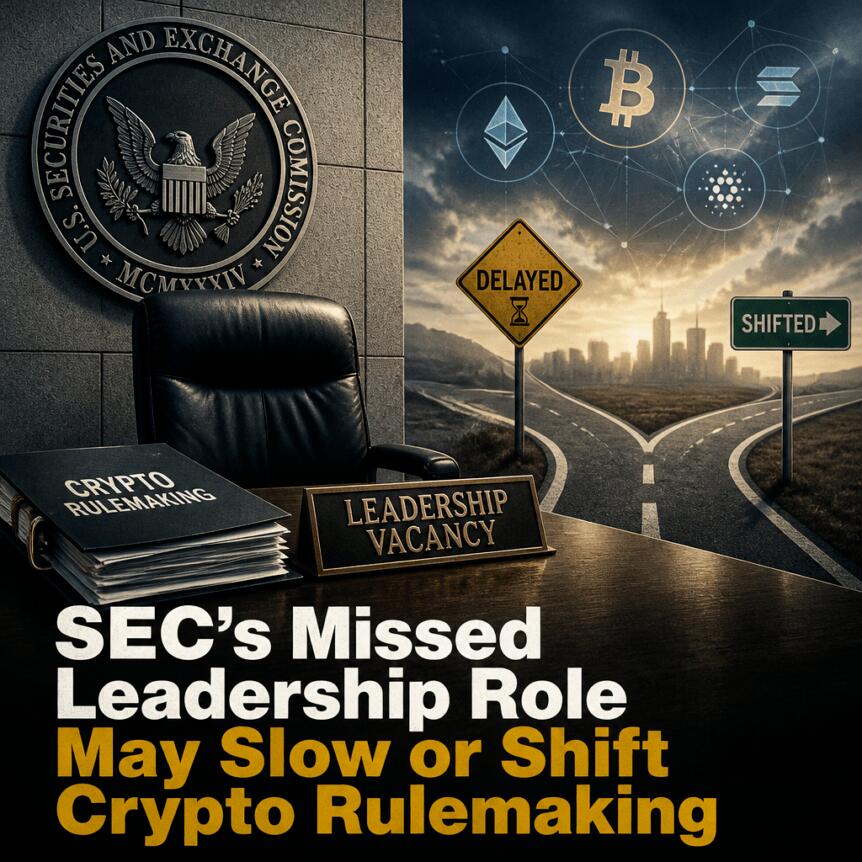
With Congress failing to advance a comprehensive digital asset market structure bill, U.S. crypto oversight is increasingly shifting from legislation to rulemaking. That change is happening as the two main federal regulators responsible for crypto-related enforcement and market guidance— the Securities and Exchange Commission (SEC) and the Commodity Futures Trading Commission (CFTC)—face a leadership vacuum that leaves key decisions concentrated among a very small number of commissioners.
According to the current staffing situation described by Cointelegraph, both agencies are operating below their intended commissioner complement and have moved forward with proposals that could effectively fill parts of the legislative gap. The developments raise a practical question for market participants: how much regulatory authority can be exercised quickly, and by whom, when leadership is thin.
Key takeaways
- The SEC’s final quorum rule, effective Oct. 2, allows a quorum with just one commissioner in situations where only two are present and one may need to recuse.
- The SEC and CFTC are both pursuing proposed rules that could shape crypto oversight through regulatory frameworks rather than new statutes.
- Leadership at both agencies remains limited, with only two SEC commissioners noted and a comparatively sparse Senate-confirmed setup at the CFTC.
- If nominations to fill vacant seats are not announced, rulemaking could be carried out by a minimal number of commissioners for months.
- Congress still has an opportunity to act on the Digital Asset Market Clarity (CLARITY) Act, though some experts doubt it will progress in a late legislative window.
Rulemaking fills a congressional gap
After lawmakers did not pass a broad digital asset market structure measure, regulators accelerated efforts to adjust the regulatory framework through agency action. The central issue is that the SEC and CFTC can influence how crypto businesses operate—especially around token classifications, exchange oversight, and market conduct—without a new stand-alone bill.
In this context, the source notes that both agencies have put forward proposals that appear designed to substitute for parts of what Congress has not enacted. The SEC, for example, proposed rules in August aimed at giving companies a safe harbor to reduce the risk that certain tokens are treated as “investment contracts.” Cointelegraph also reports that the CFTC followed with its own October proposal, with CFTC chair Michael Selig saying the agency would rely on its “existing statutory authorities” to address crypto regulation, particularly via exchanges.
SEC Chair Paul Atkins signaled a continuation of the approach, adding on Oct. 2 that “more regulatory proposals [were] on the horizon” for crypto. The pattern—proposals framed as using existing powers—suggests regulators believe they can move quickly even without new comprehensive legislation.
The leadership problem: SEC and CFTC run short
A major complicating factor is that the SEC and CFTC are not operating with their full intended leadership. The source states that the SEC is down to two commissioners after the departure of Commissioner Hester Peirce earlier this month, with Chair Paul Atkins and former Acting Chair Mark Uyeda remaining. The CFTC situation is described as even more constrained, with Michael Selig identified as the only Senate-confirmed chair and commissioner since December 2025, while the agencies are meant to each have five commissioners.
For crypto market participants, the practical implication is not just enforcement priorities, but also the governance mechanics behind major rulemaking decisions. When fewer commissioners are available, procedures like quorums and recusals can effectively determine who has the operational ability to move policy forward.
SEC quorum changes create a “one-person” path in some cases
On Sept. 30, the SEC issued a final rule affecting quorum requirements for agency action, according to the SEC’s own filing. Cointelegraph reports that the rule took effect on Oct. 2 and was presented by the SEC as “promot[ing] flexibility and finality of agency rulemaking.” In many cases where only two commissioners are present, the rule reduces the number required for a quorum to just one person.
This matters because it changes the likelihood that a single remaining commissioner—particularly when a colleague must recuse—can technically pass formal rules applicable to the broader market. The source points to a Financial Times op-ed by Robin Wigglesworth, warning that with only two commissioners, it is “entirely possible” one of them could be unavailable for an issue, leaving just one person sufficient to approve formal rules affecting the “vast multitrillion-dollar securities markets.”
In response, Mark Uyeda wrote an op-ed disputing the framing. He argued that the SEC’s “commitment to its mission remains unchanged” despite having only two commissioners and no announcement from President Donald Trump about additional nominations to fill vacant seats. Uyeda characterized the quorum adjustment as clarifying that the SEC can establish a quorum when all but one commissioner is disqualified from a matter.
Uyeda also criticized the idea that the SEC was “hastily” revising its rule to ensure the remaining commissioners could “have their way,” calling the criticism misleading about why the SEC changed quorum requirements and why, in his view, the change is better.
What this means for crypto companies awaiting clarity
Both agencies are using proposed rules to reshape crypto oversight while waiting for legislative follow-through. The source notes that the dispute around market structure legislation centers on the Digital Asset Market Clarity (CLARITY) Act. Even with proposed agency frameworks underway, market uncertainty remains for issuers, exchanges, and market intermediaries—particularly because the boundaries of token treatment and exchange-related obligations can influence fundraising structures, product listings, and compliance programs.
At the same time, the staffing reality creates a different kind of uncertainty: not only what rules might emerge, but how quickly they can be adopted and by whom. The source states that as of Tuesday, the White House had not announced nominations for either the SEC or CFTC. If that remains the case, Cointelegraph suggests rulemaking could be conducted by a single commissioner at each agency for months, potentially accelerating outcomes while simultaneously concentrating decision-making power.
For investors and builders, the key watch item is whether the agencies can maintain momentum with thin leadership while ensuring procedural legitimacy and consistency. For compliance teams, it is not enough to track proposals; they also need to monitor final adoption timing, because quorum mechanics can shorten the path from proposal to formal rule in specific circumstances.
Meanwhile, Congress still has a chance to act on the CLARITY Act, but some experts referenced in the source do not see lawmakers moving it during a lame-duck period between the 2026 midterm elections and the start of the next session in January. If that assessment holds, regulators’ rulemaking path may become the dominant channel for near-term change—making both the content of proposals and the governance conditions under which they are approved increasingly important.
Going forward, crypto market participants should watch for two things at once: whether nominations are announced to restore fuller leadership at the SEC and CFTC, and how agencies translate their proposed crypto-related rulemaking into final, enforceable requirements—especially in areas tied to token classification and exchange regulation.
This article was originally published as SEC’s Missed Leadership Role May Slow or Shift Crypto Rulemaking on Crypto Breaking News – your trusted source for crypto news, Bitcoin news, and blockchain updates.