Securitize CEO Carlos Domingo described a full-page ad in the Wall Street Journal fighting stock tokenization as “misleading” and said the campaign would benefit regulated companies like his
Securitize CEO Carlos Domingo described a full-page ad in the Wall Street Journal fighting stock tokenization as “misleading” and said the campaign would benefit regulated companies like his own.
Domingo blames offshore synthetics for the backlash
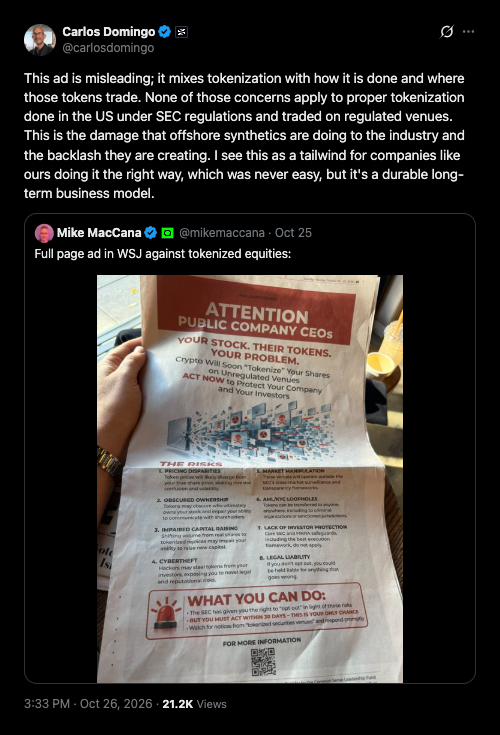
“This ad is misleading; it mixes tokenization with how it is done and where those tokens trade,” Domingo wrote on X on Monday.
“None of those concerns apply to proper tokenization done in the US under SEC regulations and traded on regulated venues,” he continued.
“This is the damage that offshore synthetics are doing to the industry and the backlash they are creating,” Domingo wrote.
I see this as a tailwind for companies like ours doing it the right way, which was never easy, but it’s a durable long-term business model.
Domingo wrote. Securitize is publicly traded and tokenizes securities for conventional issuers.
Carlos Domingo responds to the Wall Street Journal ad in a post on
X on October 26, 2026.
Gabriel Shapiro, a co-founder of MetaLeX, wrote that Robinhood, Kraken, and Coinbase could end up holding swing votes for token buyers who can’t vote. “Public companies will care about this more than crypto people expect,” Shapiro wrote.
Common Sense fund pushes bosses toward a 30-day veto
“Your stock. Their tokens. Your problem,” the ad opened. It ran on page B5 of the Journal’s business section in the weekend edition of October 24 and 25.
The ad said crypto will soon “tokenize” shares on unregulated venues. A photo of the printed page was posted on X on October 25, a day before Domingo replied.
It was financed by the Common Sense Leadership Fund. The group is a 501(c)(4) nonprofit organization founded in 2021 and based in Arlington, Virginia.
The ad told public company CEOs to use a 30-day window and object to blockchain copies of their shares. It identified price variation between venues, hidden token holders, restricted access to capital, exposure to cybersecurity, and market manipulation.
The ad warned that CEOs could be held liable for “anything that goes wrong.”
The 30-day window comes from the SEC’s Innovation Exemption, an order issued on September 17 that runs until September 17, 2031. Any venue that wants to list a company’s stock as a token made by someone else has to tell that company first.
A company that doesn’t answer the platform’s notice within 30 days is counted as agreeing to have its stock listed as a token. A company that objects only blocks the platform that sent the notice, and any other platform has to send its own.
According to Cryptopolitan, 26 issuers have already objected to OKXICE, a 50-50 venture between NYSE owner Intercontinental Exchange and OKX.
IBM, Oracle, Intel, and IonQ were added to the list on October 27, following Microsoft, Alphabet, and Goldman Sachs.
Nasdaq has said it will opt its own shares out too, because OKXICE doesn’t show best prices in real time or report to the consolidated tape.
Tokenized stocks surpass a value of $3.7 billion.
The smartest crypto minds already read our newsletter. Want in? Join them.