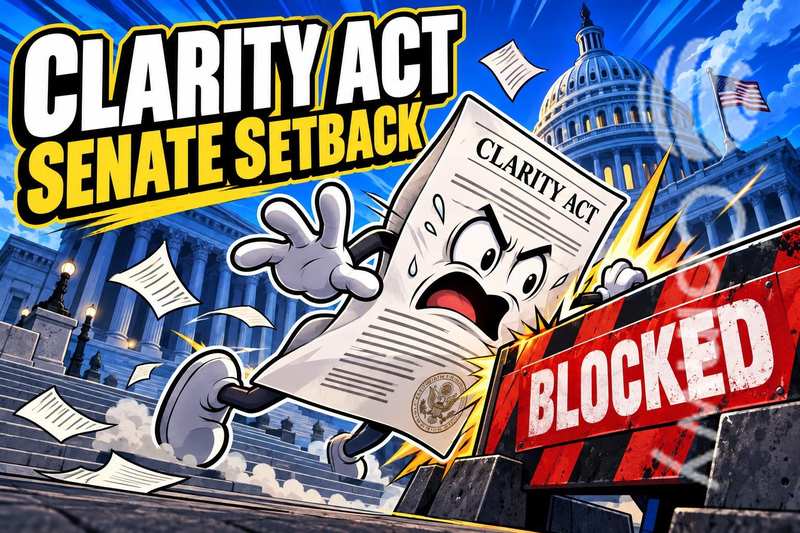
The US Senate has rejected the CLARITY Act, a bill designed to introduce a federal regulatory framework for digital assets, after narrowly failing to secure the 60 votes required to advance.
The US Senate has rejected the CLARITY Act, a bill designed to introduce a federal regulatory framework for digital assets, after narrowly failing to secure the 60 votes required to advance. The final floor vote stood at 49 in favor and 50 against, blocking the path to cloture and leaving current cryptocurrency oversight unchanged.
Breakdown of the Senate vote
The bill lost key support from several Democrats who had participated in negotiations for months before voting against it. Among those opposed were Senators Kirsten Gillibrand, Mark Warner, Cory Booker, Raphael Warnock, Ruben Gallego, Angela Alsobrooks, and Catherine Cortez Masto.
Three Republican Senators—Susan Collins, Josh Hawley, and Jerry Moran—also voted no. Senator Thom Tillis opposed the measure via a procedural motion to recommit, further weakening the bill’s prospects.
Eleanor Terrett, an experienced financial reporter, cited an unnamed industry leader describing the bill’s fate succinctly: “It died.”
Several Democrats who had spent months negotiating the CLARITY Act, including Gillibrand, Warner, Booker, Warnock, Gallego, Alsobrooks, and Cortez Masto, voted no, halting the bill’s advancement.
Content and changes in the CLARITY Act
The proposed CLARITY Act intended to divide regulatory responsibilities between the Securities and Exchange Commission (SEC) and the Commodity Futures Trading Commission (CFTC), granting distinct oversight powers for different types of digital assets. The legislation had previously cleared the House of Representatives in July 2025 and made its way through the Senate Agriculture and Banking Committees in 2026, but it met with significant opposition on the Senate floor.
In the days leading up to the vote, Republican lawmakers implemented 126 changes at the request of Democrats and circulated a 635-page amended version. Nonetheless, Democrats produced their own counter-offer the morning of the vote, which Republicans did not accept. Although President Donald Trump had reportedly agreed to Democratic proposals involving new ethics provisions, these concessions failed to secure the necessary votes.
Republican dissent also influenced the outcome. Senator Collins raised concerns about the bill’s effects on community bank deposits, an issue Jerry Moran shared. Josh Hawley, meanwhile, argued the act would favor major financial technology firms over smaller banks and competitors. Senator Tillis opted for a procedural maneuver rather than an outright no.
Mini dictionary: CLARITY Act, a legislative proposal to clarify and modernize the federal regulatory approach to digital assets in the United States by assigning oversight responsibilities to both the SEC and CFTC and defining clear rules for crypto asset classification and trading.
SenatorPartyVoted “No”Kirsten GillibrandDemocratYesMark WarnerDemocratYesCory BookerDemocratYesRaphael WarnockDemocratYesRuben GallegoDemocratYesAngela AlsobrooksDemocratYesCatherine Cortez MastoDemocratYesSusan CollinsRepublicanYesJosh HawleyRepublicanYesJerry MoranRepublicanYesThom Tillis*RepublicanProcedural
Implications and next steps
With the defeat of the CLARITY Act, legislative momentum for a federal digital asset framework has stalled. Senator Cynthia Lummis projected that the next opportunity to introduce comprehensive crypto regulation may not arrive until 2030, potentially leaving investors and companies subject to evolving agency guidance rather than clear statutory law.
The SEC and CFTC have indicated plans to advance digital asset policy through regulatory actions in absence of Congressional approval. However, SEC Chair Paul Atkins cautioned that, without congressional backing, such rules could lack long-term stability.
If Democrats take control of the House in the upcoming elections, the path for any crypto market structure legislation will become significantly more challenging.
The newly seated Congress in January will assume responsibility for further consideration of digital asset regulation, but prospects for significant movement remain uncertain.
The post Senate rejects CLARITY Act after 49-50 vote, delaying crypto regulation until 2030 appeared first on COINTURK NEWS.