The Senate has voted to keep war and death off America's prediction markets. The catch is that the biggest war markets aren't on America's regulated exchanges in the first place. On Nov. 19,
The Senate has voted to keep war and death off America's prediction markets.
The catch is that the biggest war markets aren't on America's regulated exchanges in the first place.
On Nov. 19, the Senate passed the DEATH BETS Act by voice vote, according to the Senate floor log, sending it to the House.
A voice vote means senators approved it aloud, with no individual votes recorded.
The bill's full name spells out the target, the Discouraging Exploitative Assassination, Tragedy, and Harm Betting in Event Trading Systems Act.
Related: Analyst warns Anthropic IPO is pulling money out of Bitcoin
Terrorism, war and death come off the board
A prediction market lets people buy and sell contracts on real-world outcomes. If you think an event will happen, you buy a "yes" contract. It pays out if the event happens and expires worthless if it doesn't.
In the U.S., regulated prediction markets operate as exchanges overseen by the Commodity Futures Trading Commission (CFTC), the federal derivatives regulator.
The bill would bar CFTC-registered exchanges from listing or clearing two kinds of contracts.
The first covers contracts that expressly reference terrorism, assassination, war or "United States Armed Forces military operations," along with "any similar activity, as determined by the Commission."
The second covers contracts whose outcome, at the time of listing, "is reasonably expected to resolve principally based on a death of an individual."
The "registered entity" wording matters. It means an exchange registered with the CFTC, which is why the bill reaches Kalshi and Polymarket US but not Polymarket’s international site.
"Expressly" matters too.
The contract has to name the banned topic. The Senate narrowed the bill to that word from the version Schiff introduced in March, which had covered anything that "involves, relates to, or references" war or death.
From the archives | Watch: The rising popularity of prediction markets
The rising popularity of prediction markets (2:55)
Kalshi, a CFTC-regulated prediction market, says it already stays away from these topics.
On its banned-markets page, the company says it offers no contracts on war, death, nuclear war, assassination, kidnapping, rocket explosion or missile strike markets.
"Violent markets, including war and kidnapping, are banned on Kalshi and not allowed by the CFTC," the page adds.
For Kalshi, the bill mostly writes its existing policy into law.
That does not mean Kalshi stays away from the conflict entirely. It lists contracts near it, including shipping through the Strait of Hormuz and Iran’s leadership.
The Hormuz return-to-normal contract had drawn $4.5 million in volume by April, InGame reported.
Those contracts ask about trade and politics and do not name war, so the bill’s text does not appear to reach them.
DC Forecasts scanned all 22,526 open Kalshi events on Nov. 20 and found no contract on a war or a death.
Meanwhile, Polymarket runs two separate businesses.
Its U.S. arm, Polymarket US, is operated by QCX LLC, "a CFTC-regulated Designated Contract Market," according to the company's website. That platform would fall under the bill.
Its international platform "is not regulated by the CFTC and operates independently," the company says. The bill wouldn't reach it.
The split has a history. The CFTC ordered Polymarket’s operator to pay a $1.4 million penalty in January 2022 over unregistered markets, and the international site has blocked U.S. users since that settlement.
Nothing in the new bill changes what the CFTC can do to an exchange that never registered.
Trending on TheStreet Roundtable:
The war markets live offshore
Polymarket's international site hosts some of the biggest geopolitical contracts around.
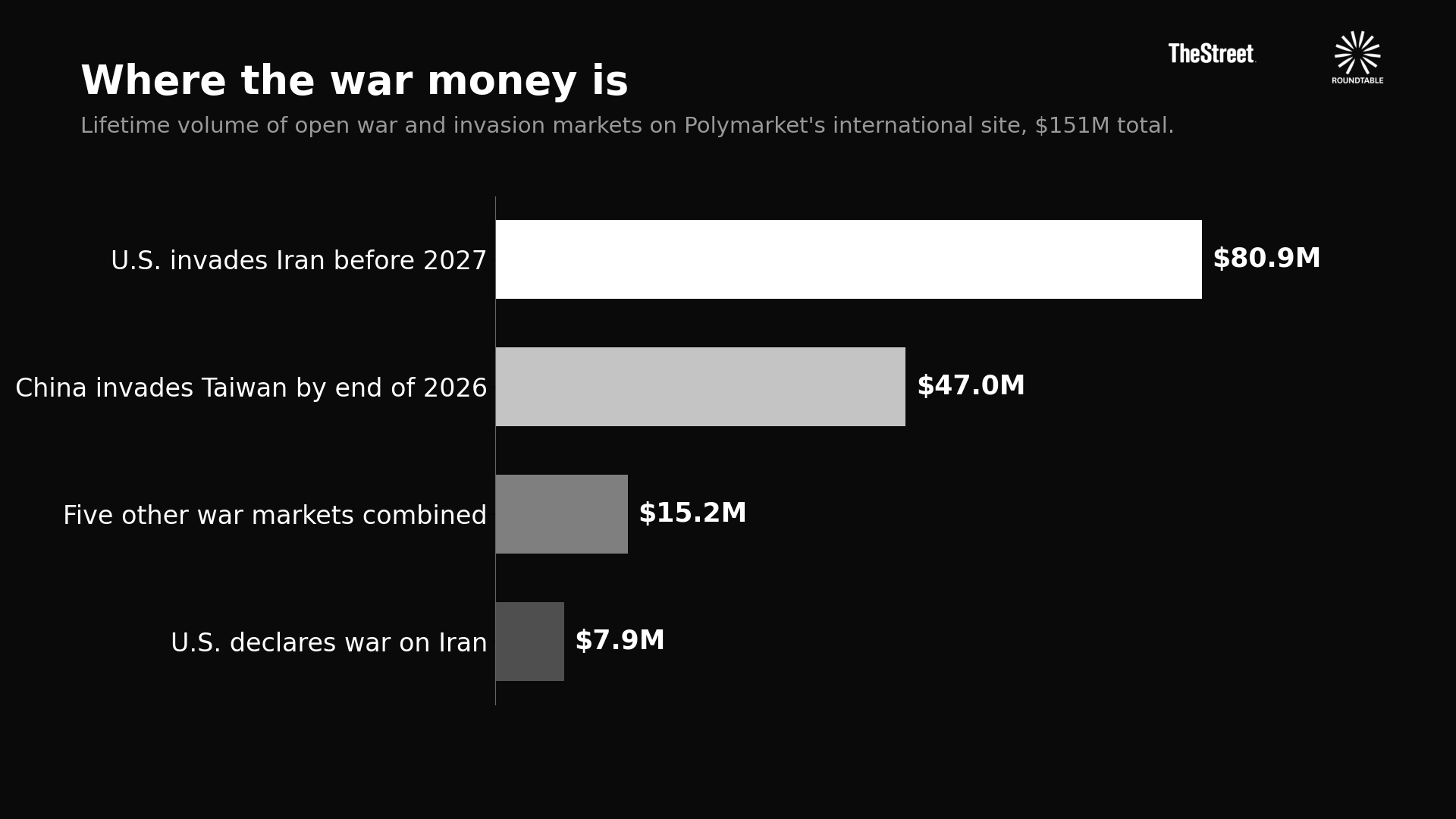
A contract on whether the U.S. will invade Iran before 2027 has drawn about $80.9 million in trading volume. One on whether China invades Taiwan by the end of 2026 has drawn about $47 million.
A market on whether the U.S. officially declares war on Iran has drawn about $7.9 million.
Those three are the biggest of eight open war and invasion markets on the site. Together the eight have traded a combined $151 million over their lifetimes, not in a single month.
All three remain open until Dec. 31, 2026.
How the regulated venues compare
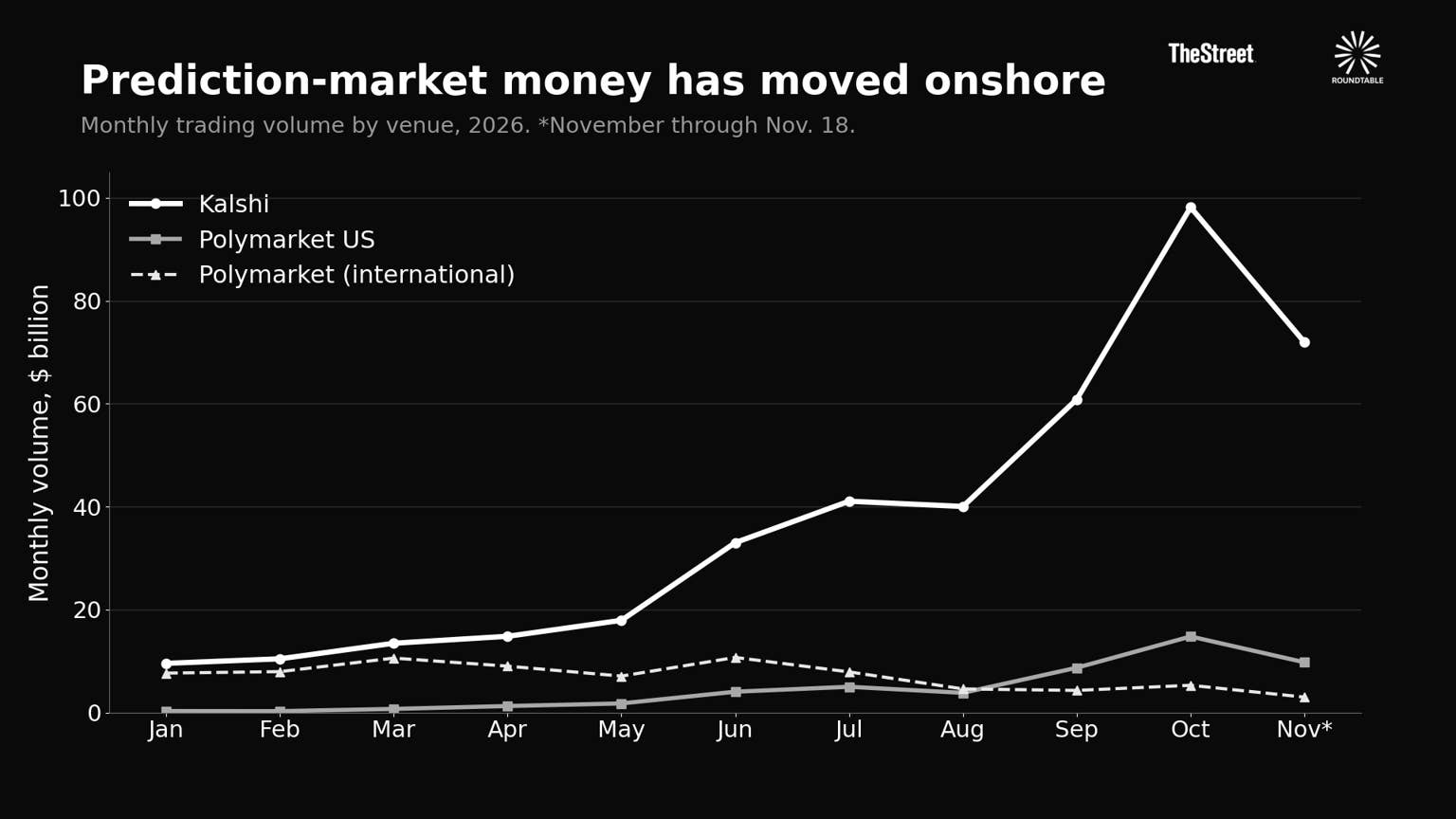
The money has moved onshore. In October, Kalshi handled $98.15 billion in trading volume, according to The Block's data dashboard.
Polymarket US, the CFTC-registered exchange, handled $14.77 billion. Polymarket's international site handled $5.29 billion.
That is a reversal from January. Back then, the offshore site did $7.66 billion, close to Kalshi's $9.55 billion, and Polymarket US did just $282.4 million.
Since then, Kalshi's monthly volume has grown more than tenfold, and Polymarket US's has grown about 52 times. Over the same stretch, the international site's volume fell by half from its June peak of $10.7 billion.
This creates an odd split for the bill. Most of the dollars now trade on the regulated venues that say they don't list war or death contracts.
Meanwhile, the war markets sit on the smaller offshore site, which the bill can't reach directly. In November through Nov. 18, that site traded $2.99 billion. Kalshi traded $71.94 billion in the same period.
Schiff’s list of trades
Sen. Adam Schiff, the California Democrat who introduced the bill in March, laid out his case on the Senate floor.
He said markets had offered trades on whether the Artemis II mission and its four astronauts "would explode," whether Nicolás Maduro would be removed from power and whether the Ukrainian town of Myrnohrad would be captured by Russia.
He also pointed to trades on how devastating wildfires could be, and on "every twist and turn in the war with Iran, sometimes with inside information."
He warned that such markets create incentives that could "encourage lethal events," calling it "a whole new version of the very idea of a contract kill."
He didn't say which platforms listed those markets.
Schiff also took aim at the CFTC's chairman, saying the regulator is "acting as a legal infantry for the industry" by challenging state laws.
The CFTC’s choice becomes a rule, if the House signs off
Current law already lets the CFTC block contracts involving terrorism, assassination or war if they're contrary to the public interest. The bill would make that a requirement.
The CFTC’s own rule already says a registered exchange shall not list contracts that "involve, relate to or reference" terrorism, assassination, war or gaming.
Kalshi’s lawyers have argued the rule is not an outright ban, InGame reported.
Writing a flat ban into law settles the question for future listings.
It would take no contract off a regulated exchange today, because the exchanges say none are listed.
Sen. John Curtis, a Utah Republican, co-led the bill with Schiff.
"There should be no financial incentive to profit from terrorism, war, or from the death of another human being," Curtis said on the Senate floor.
Both senators stressed the bill doesn't change how sports contracts are treated.
They are addressing that in a separate bill, the Prediction Markets Are Gambling Act, which would bar sports and casino-style contracts on federally regulated exchanges.
The House already has a companion bill, H.R. 7942, introduced in March by Rep. Mike Levin, D-Calif. It has sat in committee since April, and it is not clear whether the House will act before this Congress ends.
Polymarket, meanwhile, has asked the CFTC for permission to let U.S. users reach its international site, crypto.news reported in July.
If the CFTC agrees, the question of which rules cover war contracts for U.S. traders gets harder.
The House still has to pass the DEATH BETS Act, and the president would need to sign it, before it becomes law.
Even then, the biggest war markets would keep trading on Polymarket's international site, where U.S. regulators can't reach them.
More from Roundtable 100
Readers who follow our market coverage can also see the Roundtable 100, which ranks the top 100 investable tech stocks every week, including digital assets. Find it at roundtable100.com.
This article is for informational purposes only and is not investment advice.
Related: Goldman Sachs pushes billions into one asset and halves another