What the Six Senators Asked Treasury to Change Stablecoin regulation took a new turn as six senators asked Treasury to widen the GENIUS Act safe harbor to cover state-regulated issuers. Their
What the Six Senators Asked Treasury to Change
Stablecoin regulation took a new turn as six senators asked Treasury to widen the GENIUS Act safe harbor to cover state-regulated issuers. Their letter to Secretary Scott Bessent is dated November 17, 2026.
Sen. Cynthia Lummis released it on November 18. It targets a Treasury plan that protects some federal applicants, but not state firms, when the law starts on January 18, 2027.
Lummis (R-WY) and Kirsten Gillibrand (D-NY) led the push. Angela Alsobrooks (D-MD), Kevin Cramer (R-ND), Pete Ricketts (R-NE), and Mark Warner (D-VA) also signed, per the Lummis press release.
They want a GENIUS Act safe harbor for issuers in states that will have a framework before January 18, 2028. Otherwise, the senators’ letter warns, firms may chase a federal license for certainty. That, they say, is the opposite of their intent.
How the Treasury Proposal Treats Federal Applicants
A safe harbor shields a firm from penalties if it meets set rules. Treasury’s notice of proposed rulemaking (NPRM), published in the Federal Register as 91 FR 53368, covers Section 3.
Regulators may waive rules for up to 12 months from the start date. The waiver covers subsidiaries of insured banks and applicants with a pending application on that day. State-qualified firms are not on that list.
The NPRM says knowingly joining an illegal issuance can bring a fine of up to $1 million per violation and up to five years in prison. Readers of crypto regulation news should note this rule is still a proposal.
Why State Issuers Need a GENIUS Act Safe Harbor, Senators Say
States must show their rules are “substantially similar” to federal rules. A committee of the Treasury Secretary, the Fed chair (or vice chair for supervision), and the FDIC chair reviews each filing. The steps sit in an interim final rule effective September 30, 2026.
The Lummis office says reviews will run through 2027. It adds that Congress expected Wyoming, New York, and Nebraska to qualify from the start. Issuers with $10 billion or less in coins outstanding can use the state route.
Key Dates Behind the GENIUS Act Safe Harbor Request
Date
Event
Source
Jul 18, 2025
GENIUS Act enacted (Public Law 119-27)
Federal Register NPRM
Aug 18, 2026
The Treasury publishes the Section 3 proposal.
Federal Register
Sep 30, 2026
Review procedures take effect.
Treasury interim rule
Nov 17-18, 2026
Letter dated and released
Lummis's office
Jan 18, 2027
Act and OCC final rule start.
OCC
Jan 18, 2028
Date in the senators’ request
Letter
Jul 18, 2028
Exchanges barred from selling non-permitted coins
NPRM
What the GENIUS Act Safe Harbor Means for Issuers and Holders
The GENIUS Act safe harbor request matters most to state-regulated firms and their regulators. The proposal covers issuers and exchanges, so people who only hold stablecoins need take no action. The OCC final rule already covers issuers the OCC oversees.
The sources word the trigger differently. The letter says states that “will have a framework” by January 2028. The press release says states that “have certified” their regimes. The final text may settle it. The final text may settle it.
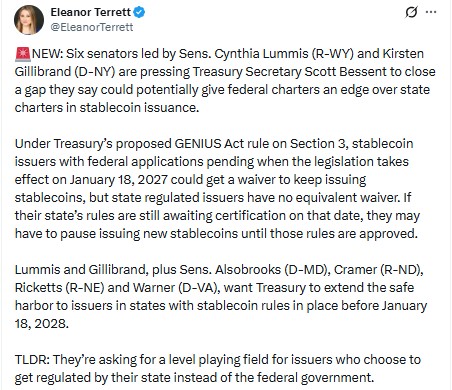
Reporter Eleanor Terrett said on X that state firms might have to pause new issuance while reviews are pending. The letter itself cites business disruption and uncertainty, not a pause.
Pushback has been reported from Anchorage Digital policy head Kevin Wysocki, who questioned how much a wider shield would change. He said firms pick federal oversight to avoid switching regulators above $10 billion, though exemptions exist.
Analysis: a 12-month waiver counted from January 18, 2027, ends January 18, 2028. That matches the senators’ date, but the match is simple math, not a Treasury statement. For more stablecoin news, watch for the final Section 3 text.
Disclaimer: This article is for information only and is not financial advice. Crypto assets are volatile, so verify details with official sources before acting.