A report that the seven largest hedge funds have collectively reached a record 22% net exposure is drawing attention to crowded-trade risk, as concentrated positioning among the industry's bi
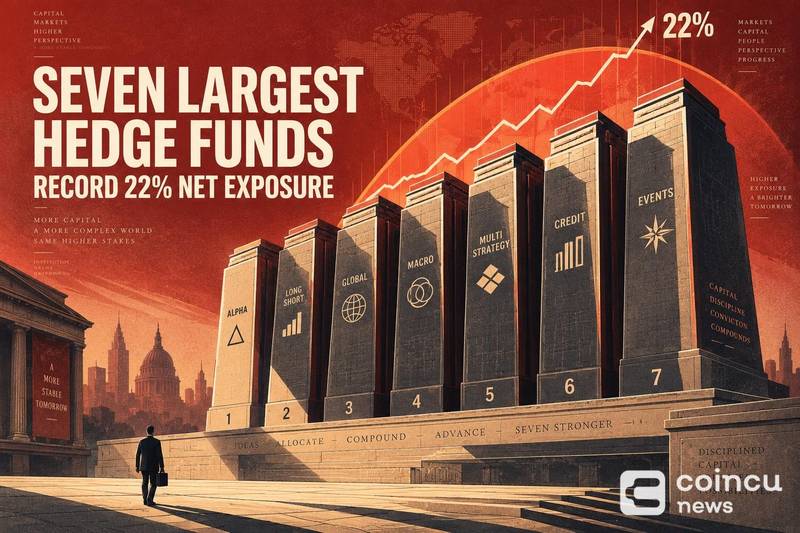
A report that the seven largest hedge funds have collectively reached a record 22% net exposure is drawing attention to crowded-trade risk, as concentrated positioning among the industry's biggest players raises the prospect of synchronized de-risking that could amplify volatility across asset classes, including digital assets where leverage concerns have already resurfaced in the aftermath of prior market dislocations.
What Record 22% Net Exposure Signals
Net exposure measures the difference between a fund's long positions and its short positions as a share of assets under management. A reading of 22% means these funds are, in aggregate, running meaningfully more long exposure than short, a figure the report characterizes as a record high for this group. That stands apart from gross exposure, which captures the total size of both books, and from leverage, which reflects borrowed capital; net exposure specifically reveals the directional conviction a fund is willing to hold at a given moment. For related coverage, see French Assembly Passes Stablecoin Exchange and Crypto Departure Tax Amendments.
The sourcing behind the 22% figure has not been independently verified by this publication, and the report provides no date stamp, asset-class breakdown, or methodology disclosure. Readers should treat the statistic as a reported claim pending primary-source confirmation rather than a settled data point. For related coverage, see France Finance Committee Passes Stablecoin and Crypto Tax Amendments.
Why Crowded Trades Concentrate Downside Risk
A trade becomes crowded when a large share of well-capitalized participants hold similar positions, leaving limited natural buyers on the other side if sentiment shifts. The risk is not the position itself but the correlation: when funds running identical exposure face the same redemption pressure or macro trigger, exits compete for the same liquidity, compressing prices faster than any single seller could achieve alone.
At record net-long readings, the asymmetry tilts toward the downside. The upside from adding more exposure diminishes as the trade becomes consensual, while the unwind path narrows because counterparties who would absorb the selling are already long. Leverage amplifies this dynamic further, as margin calls force liquidations regardless of conviction. Derivatives markets data, tracked in real time via resources such as Coinglass liquidation dashboards, can surface early signals of stress when open interest begins declining faster than price.
Crowded positioning among the seven largest funds matters beyond their own portfolios because of the feedback loops their size creates. Funds of this scale cannot exit quietly; even partial reductions in exposure move markets, trigger stop-losses at smaller participants, and can pull in algorithmic sellers who read the price action rather than the fundamentals. The result is volatility transmission that begins in one positioning pocket and spreads across correlated assets, a pattern crypto market participants observed directly in the leverage-driven dislocations of prior cycles.
High Net Exposure Is Not Automatically Bearish
Record net exposure reflects strong directional conviction, which historically accompanies sustained trending environments. Funds do not build to record longs in deteriorating conditions; the positioning itself implies these managers see a favorable risk-reward on the long side. The concern is not the level in isolation but the fragility it creates if that conviction proves premature or if a macro catalyst arrives ahead of schedule.
The report does not identify which assets, sectors, or geographies underlie the 22% reading, a gap that materially limits any risk assessment. A record net long in short-duration fixed income carries different tail risk than a record net long in speculative growth equities or digital assets. Without that breakdown, the headline figure is a sentiment indicator rather than a precise positioning map.
What Investors and Traders Should Monitor
For participants who want to track crowding and liquidity risk without direct access to fund positioning data, several public signals offer proxy visibility. Cross-asset correlation is one: when equities, credit, and crypto move in lockstep, it often reflects a shared positioning unwind rather than independent fundamental repricing. Funding rates in perpetual futures markets, visible on derivatives platforms, show in real time how much the crowd is paying to stay long, a cost that rises as crowding intensifies and falls as positions are reduced.
Bid-ask spreads and market depth are equally informative. Crowded exits show up as widening spreads and shrinking order-book depth before price fully adjusts, giving attentive traders a narrow window to manage exposure. The pace of institutional inflows and outflows in tokenized and traditional asset markets also provides a forward signal; record tokenized stock trading volumes on Solana in recent months illustrate how institutional appetite can shift rapidly across venue types.
Diversification across uncorrelated strategies remains the structural response to crowding risk, though its effectiveness depends on whether the correlations assumed in normal conditions hold during a stress event. When the seven largest funds reduce net exposure simultaneously, historically low correlations can spike toward one, eroding the diversification benefit at precisely the moment it is most needed.
FAQ: Hedge Fund Net Exposure and Crowded Trades
What does 22% net exposure mean? It means the seven largest hedge funds are, in aggregate, holding long positions that exceed their short positions by the equivalent of 22% of their combined assets under management. The figure describes directional bias, not total capital deployed.
Why can crowded trades become risky? When many large funds hold similar positions, the pool of willing buyers shrinks. A common trigger, whether a macro data release, a regulatory shift, or a margin call, can push all of them toward the exit simultaneously, amplifying price moves beyond what any single seller would cause. Regulatory shifts in related markets, such as those tracked in South Korea's tightened virtual asset exchange oversight, can serve as such triggers for funds with cross-asset exposure.
Does record net exposure automatically mean markets will fall? No. Record longs reflect consensus optimism, which can persist for extended periods if the underlying conditions that attracted the positioning remain intact. The risk is conditional on a catalyst that forces unwinding, not on the exposure level alone.
How can investors monitor crowding and liquidity risk? Watch cross-asset correlations, futures funding rates, open interest trends, bid-ask spreads, and order-book depth across major venues. A live price chart alongside derivatives data provides a dual-layer view of spot and leveraged positioning in real time.
Disclaimer: This article is for informational purposes only and does not constitute financial or investment advice. Cryptocurrency and digital asset markets carry significant risk. Always do your own research before making decisions.
The post Seven Largest Hedge Funds Hit Record 22% Net Exposure was initially published on Coincu.