Shiba Inu trades on Tuesday evening at 5.742 millionths of a dollar and at 5.074 millionths of a euro. That sounds like a quiet day, and measured by the daily move of a good one percent it is
Shiba Inu trades on Tuesday evening at 5.742 millionths of a dollar and at 5.074 millionths of a euro. That sounds like a quiet day, and measured by the daily move of a good one percent it is. The real finding sits elsewhere: the euro order book, through which European investors actually buy, carried only a fraction of the dollar book that day, and at the best ask price it held around ten euros' worth. Anyone buying Shiba Inu with a market order pays exactly for that thinness.
This article takes the price as its occasion and looks at what lies beneath it: the two levels on which the past week was decided, the measured depth of the euro book, turnover in relation to market capitalisation, and the three places where an investor can do something today, namely on order type, tax bookkeeping and custody.
Shiba Inu price on Tuesday evening: 5.742 millionths of a dollar and 5.074 millionths of a euro
On the euro market of the Kraken exchange, Shiba Inu last stood at 0.0000050740 euros on Tuesday evening, on the dollar market at 0.0000057420 dollars. Over the course of the day the dollar price ran between 0.0000055010 and 0.0000059070, the euro price between 0.0000048420 and 0.0000052070. The volume-weighted average price of the day sat at 0.0000056877 in the dollar book, so the current price is slightly above it. The figures are public on the exchange's price page.
Because these figures carry so many zeros, the market usually converts them into millionths. One millionth of a dollar is 0.000001 dollars. Shiba Inu therefore stands at 5.742 millionths of a dollar. It gets more practical in unit counts: one million SHIB cost $5.74 or 5.07 euros on Tuesday evening. Ten million SHIB cost a good 50 euros. Anyone who works that out once loses the feeling of getting an awful lot for little money, and starts counting in euros instead.
The data service CoinMarketCap listed Shiba Inu on Tuesday evening in 31st place with a market capitalisation of $3.40 billion. Against the previous day it showed a gain of 1.17 percent, over seven days a loss of 3.76 percent, over thirty days a gain of 11.07 percent. The weekly loss therefore sits inside a monthly gain. That is not a contradiction but the usual shape of a setback within a running upward stretch.
Four falling daily highs push Shiba Inu away from the 6-millionths level
More interesting than the closing price is the sequence of daily highs. Since September 26 they read 6.0650 in the dollar book, then 6.0070, then 5.9770 and on Tuesday 5.9070 millionths of a dollar. Four days, four lower highs. On September 22 the monthly high still stood at 6.2690 millionths of a dollar.
Such a sequence describes no fate but a behaviour: every attempt at recovery was sold slightly earlier than the one before. For the level at 6 millionths of a dollar that means it was last touched three days ago. The level is therefore the next visible hurdle on the upside, and a daily close above it would be the first interruption of this sequence since September 26.
Why a round number matters at all
Round levels hold no magical power. Such numbers work because many market participants place their limit orders on round numbers. Sell orders accumulate there as a result, and the price needs more buying volume to get through. That is exactly why the volume question further down this article matters so much for Shiba Inu: where little capital is moving, such accumulations hold for longer.
The support at 5.50 millionths of a dollar has survived four tests in seven days
On the downside the picture looks more stable. The daily lows of the past week sat at 5.5380 millionths of a dollar on September 23, at 5.5500 on September 24, at 5.5610 on September 28 and at 5.5010 on Tuesday. Four times in seven days the price ran into this narrow band between 5.50 and 5.57 millionths of a dollar, and four times it came back out.
A band that has been tested repeatedly and has held says two things. First, there are evidently buyers there who step in at that price. Second, a break below it becomes all the more pronounced, because the orders accumulated there have then been cleared out. The monthly range reaches down to 4.7440 millionths of a dollar, in the euro book to 4.1130 millionths of a euro. That is the stretch that would be open without a tested intermediate step.
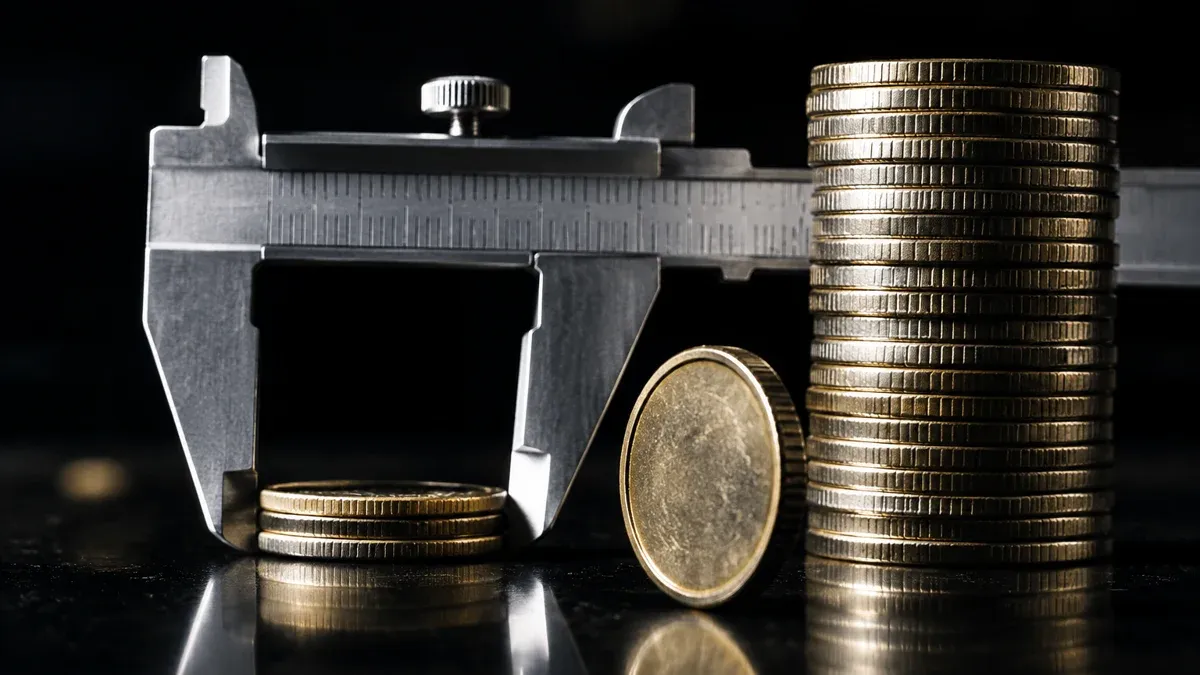
Two stacks, two depths: Shiba Inu's euro book is considerably shallower than the dollar book.
Shiba Inu price in euros: the euro book carried 40.72 billion SHIB, the dollar book 144.81 billion
Here lies the point that concerns European investors directly and that is missing from most price reports. In the exchange's dollar market, 144.81 billion SHIB changed hands on Tuesday, in the euro market 40.72 billion. The euro book therefore carried a good 28 percent of the dollar turnover. The day before, the ratio was similar at 55.42 to 159.77 billion, and on September 27 it was less favourable still at 38.70 to 229.37 billion.
Anyone buying in euros is therefore trading in a considerably thinner market than someone buying in dollars. That is no argument against buying in euros, because the detour via a dollar market costs an additional currency conversion and usually a second fee. It is an argument about order type: in a thin book, the order decides the price, not the quoted figure. Which trading venues run their own euro book for SHIB at all and which settle only in dollars is shown by the crypto exchange comparison.
Market capitalisation $3.40 billion: Shiba Inu turns over 2.8 percent a day, Dogecoin 6.2 percent
The thinness can also be measured without an order book. Set daily turnover in relation to market capitalisation and you get the turnover ratio, that is, the share of total market value traded in one day. At Shiba Inu, $94.4 million of daily turnover stood against $3.40 billion of market capitalisation on Tuesday evening. That is 2.8 percent.
For comparison, the next-largest meme coin: Dogecoin reached $1,002.5 million in daily turnover the same evening on a market capitalisation of $16.12 billion, that is 6.2 percent. Measured against its size, Dogecoin changes hands more than twice as fast as Shiba Inu.
Over thirty days Shiba Inu has held up better than Dogecoin, with 11.07 against 9.14 percent of gains, and over seven days the loss was smaller too, at 3.76 against 5.26 percent. The relative strength therefore comes together with a thinner market. Both belong together: a price that rises on little turnover is more vulnerable to a fast trip back, because less counterparty stands ready.
Spread and market depth: 2.06 million SHIB stood at the best ask price
The snapshot of the euro book on Tuesday evening looked like this: best ask 0.0000050690 euros, best bid 0.0000050670 euros. The gap between them came to 0.04 percent, which taken on its own is tight. The depth, however, tells a different story. At the best ask, 2,064,500 SHIB sat in the book. That is around 10 euros' worth. On the bid side stood 325,819,958 SHIB, a good 1,650 euros.
Spread and depth are two different things
The spread is the distance between the best buy and the best sell offer. The depth is the quantity actually available at those prices. A tight spread over a thin depth looks good on screen and helps only small orders. As soon as the order is larger than the top level, the remainder is filled at the next, worse prices. This difference between expected and actual execution price is called slippage.
The imbalance stands out: on the bid side, roughly 158 times the quantity available on the ask side sat there on Tuesday evening. Buy orders therefore met a thin supply, sell orders a broad demand. These ratios change by the second and are no forecast. The mismatch nevertheless remains an indication of which side got the worse executions that evening.

Every partial fill later becomes its own line: with Shiba Inu, a lot of them add up quickly.
An order of 500 euros runs across several price levels with Shiba Inu
Work that through on a usual amount. A market order of 500 euros corresponds, at 0.0000050690 euros a unit, to roughly 98.6 million SHIB. At the best ask, 2.06 million were available, a good two percent of that. The remaining 98 percent are filled at the next higher prices in the book. How much higher only shows in the full depth below the top level, which a simple price query does not disclose.
From that follows a straightforward practice that costs nothing: in a book of this depth a limit order belongs instead of a market order, because the limit order fixes a maximum price and, in case of doubt, stays unfilled rather than running expensive. Anyone investing a larger sum splits it across several orders over the day. And anyone wanting to check which trading venues permit genuine limit orders on their own book at all, and which execute only at a quoted price, will find the differences in the crypto broker comparison.
How to spot thin depth in your own account
Two signs are enough. First, the execution price of the last order deviates noticeably from the price that stood on screen when it was sent. Second, a single order falls apart into many partial fills at different prices. Both appear in the settlement statement that every trading venue provides. It is worth looking there once before the next order runs.
Holding period, exemption limit and FIFO: 589.24 trillion SHIB make the bookkeeping fiddly
Many partial fills are not only a price matter but a tax matter too. In Germany, gains from the sale of crypto-assets count as private disposal transactions under section 23 of the Income Tax Act. Two rules from it concern every SHIB holder directly.
The first is the one-year period: if more than a year lies between purchase and sale, the gain stays tax-free. The second is the exemption limit: if the total gain from private disposal transactions in a calendar year stays below 1,000 euros, no tax falls due. The word limit is to be taken literally here. Anyone above it pays tax on the full amount and not merely on the excess part.
Why documentation gets laborious with Shiba Inu in particular
What counts for the period is each individual acquisition, not the holding as a whole. Anyone whose order of 500 euros is filled in twelve partial executions has twelve acquisition dates at twelve separate prices. With 589.24 trillion SHIB in circulation and a unit price in the millionths range, the settlement statement carries unit counts with eight and more digits and prices with ten decimal places. Some spreadsheets round such values silently, and then the total no longer adds up at the end of the year.
In practice that means: download the trading statement directly from the trading venue instead of copying it out, and check on one line whether the decimal places were carried over in full. If you use a tool for it, check beforehand whether it processes prices with ten decimal places. The common programs and their limits are set out in the crypto tax software comparison.
Custody and the network switch: 257.14 billion SHIB sit outside circulation
Total supply stands at 589.50 trillion SHIB, in circulation are 589.24 trillion. The difference of 257.14 billion SHIB corresponds to roughly 0.04 percent of the supply. That is a small figure, and it puts a widespread expectation into perspective: the ongoing burning of tokens currently changes supply on a scale that does not carry the price on its own. How much was actually burned in September, cryptoticker worked out in the burn balance of September 28, 2026.
On custody, a second point arises these days. With the recent switch of the Shibarium network, old access addresses for wallets have been shut off. Anyone holding SHIB through their own wallet rather than on an exchange should test a small transfer once before a larger amount is moved. A wallet with a decommissioned network endpoint stored in it still displays the balance and nevertheless gets no connection to the network.
Shiba Inu price: your next three steps
- Switch order type. Set a limit for your next SHIB order instead of buying at market, and take your bearings from the band between 5.50 and 5.91 millionths of a dollar in which the price has moved this past week. Whether your trading venue permits genuine limit orders on its own book is stated in your provider's trading terms.
- Check the settlement statement. Look in the last order statement to see how many partial fills it broke into and how far the execution price deviated from the displayed one. The times of those partial fills are at the same time the acquisition dates for the one-year period. Suitable programs for this are in the crypto tax software comparison.
- Test the wallet connection. Send a small amount to your own wallet before you move a larger one. That way an outdated network connection shows up while it still costs nothing.
(As of September 29, 2026. This article is not investment advice. Prices and fee structures change; check the terms with the provider before you buy.)