Key Takeaways Rothschild slashed Shopify rating from Buy to Neutral, reducing price target from $160 to $130 Shares declined 4.5% in pre-market hours following the analyst’s bearish call Meta
Key Takeaways
- Rothschild slashed Shopify rating from Buy to Neutral, reducing price target from $160 to $130
- Shares declined 4.5% in pre-market hours following the analyst’s bearish call
- Meta’s artificial intelligence solutions for SMBs pose risk to Shopify’s growth momentum
- ARK Investment divested $25.1 million worth of Shopify shares while simultaneously buying Meta
- Morgan Stanley and RBC Capital continue backing the stock despite analyst concerns
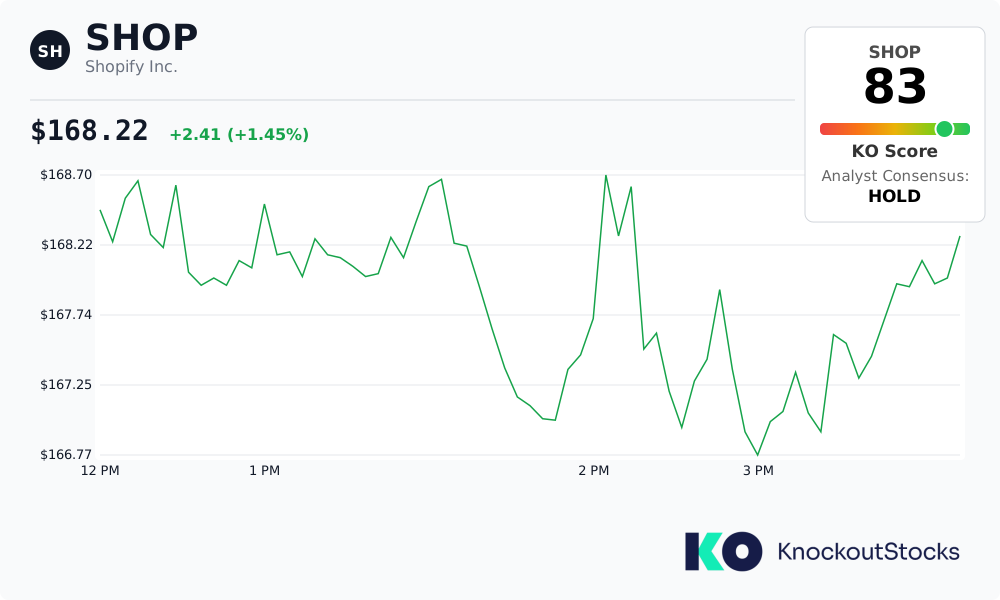
Shares of Shopify experienced a sharp 4.5% decline during pre-market hours on July 21 following a significant analyst downgrade that rattled investor confidence in the e-commerce giant. Rothschild Redburn revised its stance from Buy to Neutral while simultaneously cutting its price objective from $160 down to $130, pointing to intensifying competition from Meta’s artificial intelligence-driven business tools.
 Shopify Inc., SHOP
The timing of this reassessment is particularly noteworthy. Shopify has delivered exceptional performance since the closing months of 2024, with much of that success attributed to robust same-store sales expansion. However, that fundamental pillar now faces scrutiny. Rothschild’s analysts contend that Meta’s advanced language processing technology is specifically designed to capture the small and medium-sized enterprise market that represents Shopify’s primary customer demographic.
The downgrade set off a chain reaction among prominent institutional investors. ARK Investment Management liquidated over 203,000 shares valued at roughly $25.1 million from its main exchange-traded funds during the previous trading session. The significant detail: ARK didn’t merely exit its position—it concurrently acquired Meta stock, delivering an unmistakable signal regarding where sophisticated capital sees the competitive edge shifting.
Wall Street’s Divided Opinion
ARK’s strategic reallocation carried both symbolic weight and material significance. When a prominent fund manager exits one position while establishing the opposing trade on identical timing, it demonstrates a fundamental shift in investment thesis. These synchronized transactions amplified the developing narrative that market participants are recalibrating their assessment of competitive dynamics between Meta and Shopify in the SMB marketplace.
However, consensus remains elusive on Wall Street. Morgan Stanley designated Shopify among its eight top-conviction Overweight recommendations, asserting that recent technology sector weakness has created excessive valuation pressure. RBC Capital similarly reaffirmed its Outperform stance with a $170 target, referencing alternative data sources indicating second-quarter performance may surpass analyst estimates.
Shopify currently trades at $124.48, positioned below even Rothschild’s reduced $130 projection. Based on GuruFocus analysis, the company’s calculated intrinsic worth reaches $145.09, implying the market has embedded substantial pessimism relative to underlying fundamentals. This 14.2% valuation discount prompts consideration of whether investors have disproportionately penalized the stock for competitive concerns.
The company’s financial metrics present a nuanced portrait. Shopify’s trailing price-to-earnings multiple reaches 122.88x, substantially elevated compared to its five-year median of 82.66x. GuruFocus assigns growth characteristics a robust 9/10 rating, while profitability metrics receive a modest 5/10 assessment. The composite GF Score of 83/100 indicates respectable overall quality, though the premium earnings valuation embeds optimistic future expectations.
Market Outlook and Investor Implications
Broader equity market conditions contributed additional headwinds Monday. The S&P 500 retreated 0.2%, the Dow shed more than 300 points, and the Nasdaq finished essentially unchanged, all influenced by escalating U.S.-Iran geopolitical tensions that elevated crude oil prices. Treasury yields advanced as market participants anticipated that higher energy costs would sustain Federal Reserve restrictive policy. Tuesday’s Nasdaq recovery indicates Shopify’s weakness stems from company-specific factors rather than systemic market pressure.
Shopify confronts several challenges in the immediate term. Second-quarter financial results aren’t scheduled until August 5, creating a vacuum where the stock remains exposed to further selling pressure absent positive catalysts. Recent changes to Audit Committee leadership introduce additional governance uncertainty that compounds investor anxiety.
Company insiders have neither purchased nor disposed of shares during the preceding three months, indicating management is adopting a neutral stance. This absence of insider conviction from executives with privileged operational insight warrants investor attention.
The fundamental debate centers on whether Meta’s AI capabilities genuinely undermine Shopify’s sustainable competitive advantages or merely represent transient concerns within an otherwise resilient franchise. Rothschild embraces the structural threat interpretation. Morgan Stanley and RBC view it as temporary noise. Shareholders find themselves navigating these divergent perspectives, with share price action reflecting this uncertainty.
Meta’s competitive approach focuses on leveraging artificial intelligence to enable small business operators to function entirely within Meta’s ecosystem, bypassing the need for independent websites or standalone e-commerce infrastructure. Whether this strategy achieves widespread adoption or remains confined to specific niches continues to be determined. Current market pricing suggests transformative potential. Shopify advocates anticipate limited impact.
Share price trajectory through the August 5 earnings release hinges entirely on whether new information validates either thesis. Until concrete evidence emerges, investor sentiment remains uncertain and downward pressure persists.
The post Shopify (SHOP) Stock Tumbles as Analyst Warns of Meta AI Threat appeared first on Blockonomi.