Sign (SIGN) Token: Verify Utility, Supply, and Unlock Schedule Sign (SIGN) Tokenomics Unlock research means checking four things independently: that the token is the real asset of Sign Protoc
Sign (SIGN) Token: Verify Utility, Supply, and Unlock Schedule
Sign (SIGN) Tokenomics Unlock research means checking four things independently: that the token is the real asset of Sign Protocol and not another project using the same ticker, what the project's own documents say the token does, how supply, circulating supply, and unlocked supply differ, and what the token unlock schedule actually says.
Third-party trackers disagree on the next release, so no single figure should be treated as confirmed. A scheduled unlock is not proof that tokens were sold, and a price fall is not proof that an unlock caused it.
How Does SIGN Token Allocation Shape Supply and Unlock Risk?
Sign (SIGN) Tokenomics Utility Unlock research matters because supply, utility, vesting, and liquidity shape a token far more than a single day’s chart.
A large locked share can bring new supply as vesting ends, and thin liquidity lets small orders move the price. The explainer on thetoken unlock schedule covers why release dates matter.
The project’s published allocation chart, available on theofficial Sign token page, splits supply as follows. It is a snapshot of the allocation, not proof of how much of each category is unlocked or circulating today.
Category
Share of supply
Breakdown
Community Incentive
40%
Community rewards and future airdrops: 30%, TGE airdrop 10%
Backers
20%
Not split further
Early Team Members
10%
Not split further
Foundation
20%
Liquidity incentives 3.5%, compliance budget 2%, operational budget 2%, donations 0.5%, core contributors 12%
Ecosystem
10%
Not split further
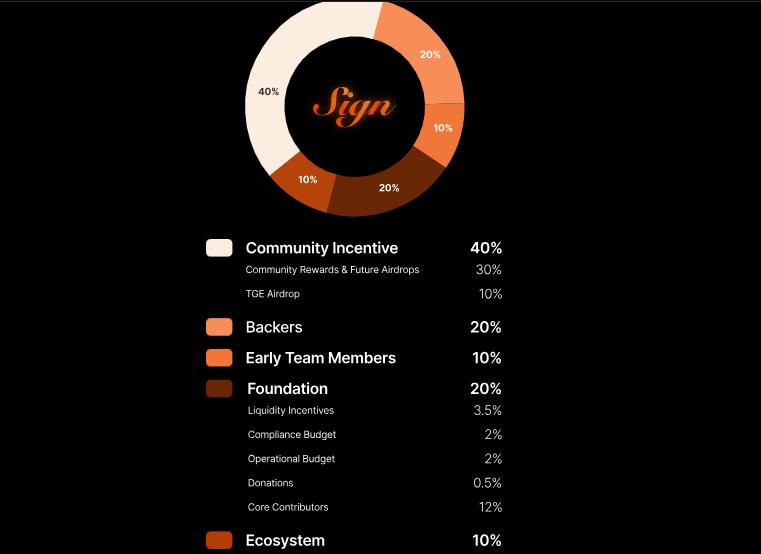
Community Incentive is the largest category, which is why unlock questions often center on community and airdrop releases. Foundation allocations include a core contributors portion, so that category is not only a treasury reserve.
A market snapshot from early November 2026 reportedly showed a sharp one-day fall in SIGN. That snapshot is dated, and its volume figure differs from another tracker’s history, so it needs rechecking.
A price decline alone cannot show that an unlock, an insider sale, or a project event caused it, so this guide treats the movement as context, not as the argument.
Key Terms and Official Facts
Token identity: The SIGN token of Sign Protocol, not another project that shares the ticker.
Total and maximum supply:The project's whitepaper and an exchange research report describe a fixed maximum supply, stated in the billions. The exact figure is on those pages.
Circulating supply:The tokens a market-data provider counts as circulating. Providers use different methods.
Unlocked supply and vesting: Tokens released under the vesting timeline, not all of which circulate.
Liquidity:How easily the token trades without a large price impact.
The exchange research report's launch-era breakdown splits the supply among community incentives, backers, the foundation, early team members, and the ecosystem, and a market-data site shows the same broad categories.
Treat this as a sourced snapshot, not proof that every category is already released. The project's official site is the starting point for its latest disclosures.
How the Mechanism Works
Sign Protocol creates and verifies structured attestations, which are signed records that a fact is true, such as an identity check or an agreement.
Its distribution product, TokenTable, handles token allocation, vesting, and unlocks, so allocations move from locked to unlocked under a schedule.
That machinery produces the unlock events trackers report, and it is the core of any SIGN token unlock schedule check. The entry onsmart contracts explains why such schedules run as code.
Utility needs the same care. The project's regulatory whitepaper describes the token as supporting its attestation infrastructure and lists functions involving attestations, governance participation, and storage.
The exchange research report describes broader ecosystem and community uses. Each claim belongs to its source, and none is a guaranteed, universally active feature.
Using a protocol and needing its token are different things, so product adoption does not automatically create token demand.
Worked Example or Verification Steps
A practical SIGN Tokenomics Utility Unlock check follows six steps.
Confirm the project: Start with the official Sign website and developer documentation.
Confirm the token: Take the contract address from the project's own pages, cross-check it against a trusted listing, and open it on a blockchain explorer. Compare the full address and the network, not just the ticker.
Check supply: Compare total, circulating, and unlocked supply, and record the provider and the time. A market-data tracker is one place to compare them, and a second tracker gives a cross-check.
Check unlocks: Compare the schedule version, the next release date, the amount, and the recipient category across trackers.
Check liquidity: Review trading volume, order-book depth, available pairs, and slippage. Volume alone can mislead.
A worked example in words: a tracker's scheduled release should be compared with circulating and total supply, not described as that many tokens entering exchanges. Recipients may hold, transfer, stake, or sell.
Why Third-Party Unlock Trackers Disagree
Trackers checked in mid-November 2026 and did not match, which is the main reason Sign (SIGN) Tokenomics Utility Unlock work needs several sources.
The Coingecko market-data site showed a community-incentive release at the end of the month in one amount. An unlock-tracking site reported a different overall unlocked total and the same next release date.
A third tracker showed a much larger release amount for that date, and a fourth reported a different circulating figure. One tracker also recorded a schedule revision in late October 2026 that changed the vesting structure for backers, early team members, and community rewards.
These figures must not be combined. Schedule versions, release assumptions, and circulating-supply methods explain much of the gap. Without an official schedule or announcement from the project, no amount for the next release should be stated as confirmed.
What Can Go Wrong
A similarly named token or a wrong contract can produce false identity claims.
Unlocked supply can be mistaken for circulating supply.
Trackers can use different schedule versions or allocation assumptions.
A scheduled release does not prove tokens were transferred or sold.
Fake token sites are a standing risk, as the guide oncrypto phishing protection explains.
Common Misunderstandings
Common assumption
More accurate explanation
Unlocked supply equals circulating supply
Some unlocked tokens may not yet be circulating
Every unlock creates selling pressure
Recipients may hold, transfer, stake or sell
The ticker confirms token identity
The contract address and network must also match
One tracker gives the definitive unlock date
Trackers use different schedule versions and methods
A price decline proves insider selling
Price changes can have several causes
Protocol utility guarantees token demand
Product adoption does not automatically create token demand
Practical Checklist
A short Sign (SIGN) Tokenomics Utility Unlock checklist keeps the process repeatable.
Confirm the official sign project and token identity.
Verify the contract address and blockchain network.
Check total, circulating, and unlocked supply separately.
Compare unlock schedules and their revision dates.
Identify the recipient category for upcoming releases.
Check liquidity and trading volume independently.
Label unverified claims and avoid assuming an unlock means a sale.
Final Thoughts
Sign (SIGN) Tokenomics Utility. Unlock research rewards patience: confirm the token, read the project's own documents, separate the three kinds of supply and treat every tracker's schedule as a claim.
The value is the method, not a single figure, because numbers differ across sources and change over time. For market context, thelatest crypto news page tracks daily moves.
Disclaimer: This article is for educational purposes only and is not financial or investment advice. Token supply, unlock, and market data differ between sources and change. Verify details with official project sources before making any decision.