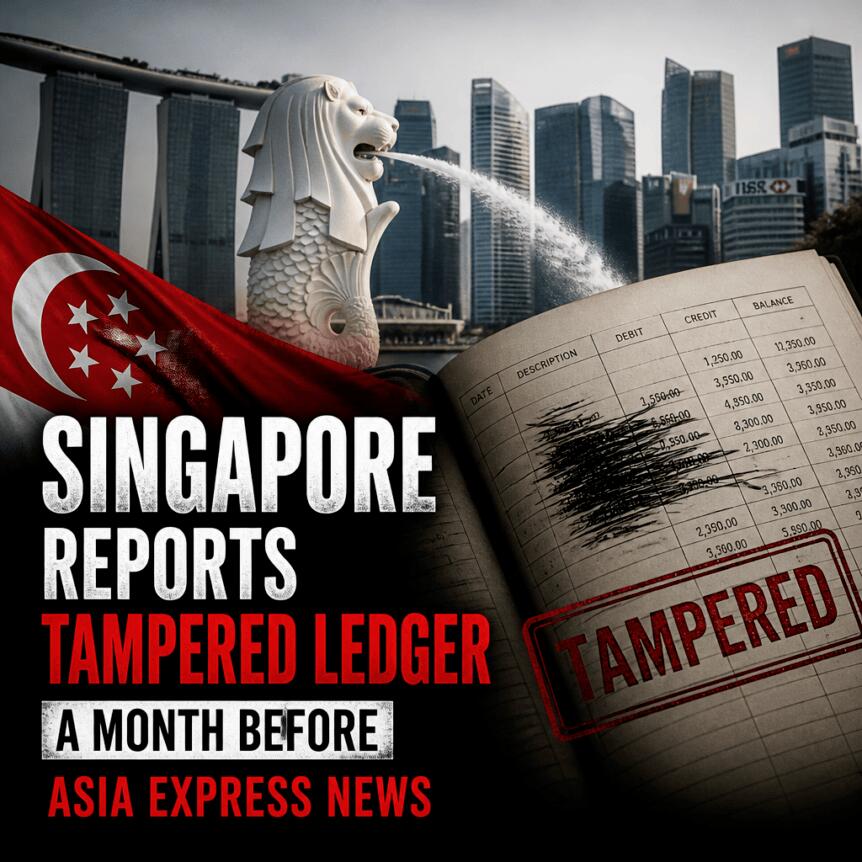
Singapore police say at least two cases involving tampered Ledger hardware wallets have been reported since Sept. 10, with combined losses of about 3.5 million Singapore dollars (roughly $2.7
Singapore police say at least two cases involving tampered Ledger hardware wallets have been reported since Sept. 10, with combined losses of about 3.5 million Singapore dollars (roughly $2.7 million). The cases add urgency to an investigation that—according to earlier public reporting—appeared to surface locally before Ledger’s broader consumer notice went out.
Beyond the Ledger incident, this week’s Asia-focused crypto developments also touch stablecoin policy coordination, evolving crypto-tax timelines in South Korea, further cybersecurity warnings in major exchanges and brokerages, and continued enforcement signals across North Korea-linked laundering networks and global blockchain strategy moves.
Key takeaways
- Singapore Police report losses of about S$3.5 million from tampered Ledger wallet cases reported since Sept. 10.
- Ledger previously warned about tampered devices linked to the CryptoBilis supply chain, and later asked retailers across several countries to suspend sales while investigations continue.
- Malaysia’s central bank and Thailand’s central bank joined Singapore’s BLOOM initiative to support institutional cross-border stablecoin and tokenized-deposit use.
- South Korea lawmakers are reportedly weighing another postponement of the country’s 22% crypto income tax, with implementation currently scheduled for January 2027.
- Thailand’s Supreme Court has ruled that Bitcoin is “property” under criminal law, potentially shaping how courts treat other digital assets.
Singapore Ledger tampering: reported losses, timing questions, and an ongoing probe
Singapore police said at least two tampered Ledger wallet cases were reported since Sept. 10, and that the total losses were about S$3.5 million. The matter ties back to coverage that described Singapore reporting occurring nearly a month before the wider public story became known.
It remains unclear whether the Sept. 10 incident was reported to police immediately or only surfaced later. That uncertainty matters: if law enforcement was notified promptly, it raises questions about how quickly relevant warnings could be issued, and whether Ledger was able to communicate details to affected parties in time.
Ledger’s public alerts provide part of the timeline. The company issued a consumer-facing warning about tampered Ledgers reportedly found in the CryptoBilis supply chain on Oct. 9. In that incident, Ledger said almost $100 million was drained from wallets containing spyware components. Earlier coverage also reported that Ledger later asked retailers in Indonesia, Singapore, Thailand, the Philippines, Vietnam, Malaysia, and Hong Kong to suspend sales of Ledger devices while investigations continued, according to a statement dated Oct. 13.
For users, the Singapore figures underscore that these events can have immediate real-world financial consequences, not just theoretical risk. For investors and compliance teams, the episode is also a reminder that supply-chain and device-integrity issues can create cascading harms—particularly in cross-border retail flows where affected devices may be sold across jurisdictions before risk notices consolidate.
Cross-border stablecoins gain new central-bank participants through Singapore’s BLOOM
Policy coordination remained a major theme in the region. Bank Negara Malaysia and the Bank of Thailand joined Singapore’s BLOOM initiative as policymaker members.
BLOOM—an acronym for Borderless, Liquid, Open, Online, Multi-currency—aims to help financial institutions use stablecoins and tokenized deposits for cross-border payments. The initiative was launched by the Monetary Authority of Singapore in October of the previous year and counts major industry participants including Airwallex, Mastercard, Ripple, Visa, and the World Bank Group as members.
What changed here is the widening of institutional involvement at the central-bank level. By adding Malaysia and Thailand, BLOOM moves closer to its stated goal of practical cross-border usability rather than isolated pilot work within a single regulatory perimeter. While the initiative is not a blanket rule for all markets, the presence of more central banks can increase the odds that stablecoin rails and compliance expectations converge across the region over time.
DBS survey data also points to demand-side momentum: according to a DBS survey described in the context of this initiative, almost 90% of 422 global businesses surveyed are either adopting tokenized cash or are interested in adopting it to accelerate payments.
South Korea: crypto tax delays, breach reports, and stablecoin reporting rules
In South Korea, the question of when crypto taxation becomes fully operational remains unsettled. Government officials are reportedly considering another delay to the country’s cryptocurrency tax policy, which is currently scheduled to start in January 2027.
According to a report from Newsis, the crypto income tax could be pushed to 2029 in part because officials are not expected to be able to share tax information tied to digital asset exchanges with the United States until that point. The policy itself—previously described as imposing a 22% tax on crypto gains for investors earning more than 2.5 million Korean won (about $1,883) annually—would therefore depend on administrative readiness and cross-border data exchange capabilities.
Alongside tax uncertainty, South Korea also faced fresh cybersecurity disclosures. Bithumb said its in-house mobile system was hacked and personal information was leaked. Reuters reported that brokerage Daishin Securities estimated about 38,000 customer records were exposed, and asset manager Mirae Asset Global Investments confirmed a hacking incident.
Regulatory activity also extended to stablecoins. The South Korean government and the Bank of Korea intend to draft amendments to the Foreign Exchange Transactions Act to regulate stablecoins used as payment instruments. The central bank also plans to require monthly reports from crypto transfer service providers starting Dec. 2, with the reporting scope extending back to mid-2024 regarding who has been sending money out of the country.
Taken together, these developments signal a tightening framework: tax enforcement may be delayed, but information-sharing and stablecoin payment oversight are moving forward. Traders and institutions should watch not only the tax effective date, but also what compliance reporting will require in practice for cross-border transfers and payment-linked stablecoins.
North Korea cash-outs, Hong Kong’s strategic enterprise designations, and China’s blockchain push
Sanctions and enforcement continued to dominate the international track. Blockchain analytics firm Chainalysis mapped a network of Russian intermediaries linked to North Korean IT workers cashing out millions in cryptocurrency, in a long-running scheme. The reporting aligns with U.S. Treasury actions: the Office of Foreign Assets Control (OFAC) sanctioned 10 individuals and one entity on Wednesday for supporting North Korean government-run IT worker schemes funding weapons programs, according to a Treasury press release.
The list included Russian nationals Ilya Aleksandrovich Boykov and Vitold Viktorovich Obertas, among others named by OFAC. For market participants, the key point is that enforcement continues to connect on-chain activity to real-world facilitation networks—often through intermediaries who operate across borders and jurisdictions.
Hong Kong also made institutional moves aimed at attracting blockchain infrastructure. The city named Nasdaq-listed Solana Company (HSDT) a strategic enterprise under a government program designed to bring businesses that support economic development. Solana Company said it was selected as part of the seventh batch of businesses through Hong Kong’s Office for Attracting Strategic Enterprises (OASES), and Hong Kong’s government confirmed the addition of 18 enterprises, bringing the total to 142.
Elsewhere, China set out a national direction for blockchain development. A new five-year digital development plan published recently set a target for 2030 to largely complete a national blockchain network buildout. The plan also calls for stronger blockchain technical standards and increased use of the technology in data circulation and trading. At the same time, mainland China continues to ban cryptocurrency-related business activities, while promoting blockchain technology as a national priority—an approach critics argue has historically struggled when “blockchain without crypto” is framed as a practical substitute.
Thailand: legal precedent for Bitcoin and a new tourist payments wallet
Thailand’s Supreme Court issued a ruling with potential implications beyond Bitcoin alone. The court recognized Bitcoin as property under criminal law, setting a precedent that could influence how Thai courts treat other cryptocurrencies in similar legal contexts.
The case involved sustaining a 10-year prison sentence tied to a robbery involving about $50,000 in Bitcoin.
On the product side, Thailand launched a digital wallet for tourists. The WORPT wallet is designed to allow travelers to convert USDT or USDC into Thai baht for spending via PromptPay QR codes, and it is positioned as part of the Tourist DigiPay sandbox.
For observers, these two moves point in different directions—one judicial and precedent-setting, the other focused on usability for cross-currency retail spending. Together, they highlight how Thailand is experimenting with both legal classification and practical payment infrastructure for crypto-linked users.
Looking ahead, investors and users in the region should track whether Singapore’s Ledger case prompts earlier coordinated warnings in other jurisdictions, whether BLOOM-related participation translates into more concrete cross-border stablecoin use cases, and how South Korea’s delayed tax timeline interacts with expanding stablecoin reporting requirements.
This article was originally published as Singapore Reports Tampered Ledger a Month Before Asia Express News on Crypto Breaking News – your trusted source for crypto news, Bitcoin news, and blockchain updates.