How Does Sirius Network Architecture Connect Its Five Core Layers? Most crypto projects show a token and a roadmap. Far fewer show the machinery underneath. Sirius Network does, in its whitep
How Does Sirius Network Architecture Connect Its Five Core Layers?
Most crypto projects show a token and a roadmap. Far fewer show the machinery underneath.
Sirius Network does, in its whitepaper. It lays out a stacked design where every layer has one job, from the phone screen to the blockchain. This guide breaks down the Sirius Network architecture, shows where off-chain records end and on-chain rules begin, and follows one user’s path from the first step to the last.
Key Takeaways
Sirius Network is built in five layers, and each one handles a single job.
Contribution records stay off-chain, while token issuance, locking rules and treasury run on-chain.
Off-chain data must pass several checks before it enters a vesting contract, and administrators cannot change rights already recorded there.
A Quick Look at Sirius Network
Sirius Network is a mobile-first contribution mining ecosystem. People join from a phone, build an identity, and earn credit for real participation, such as learning, missions and referrals.
According to the official website, mobile is the entry point, and the system tracks meaningful participation before bringing on-chain assets and application services in gradually. Identity comes first, and rewards follow.
Source: official website.
How Is Sirius Network Built?
The short answer is in layers. The Sirius Network five-layer architecture stacks five parts on top of each other, and each part passes its output to the next.
Think of it like a building. The lobby is where people walk in, and the vault sits several floors away. This Sirius Network infrastructure keeps daily activity separate from the assets that carry long-term value.
Here is the flow in one view.
Mobile Application Layer ↓ Identity and Account Layer ↓ Contribution Calculation Layer ↓ Blockchain Asset Layer ↓ Ecosystem Application Layer
What Are the Five Layers of Sirius Network?
Here are the Sirius Network layers side by side.
Layer
Core modules
Main job
Mobile Application
App, DApp, Web
Registration, mining, learning, missions, migration access
Identity and Account
Sirius ID, Passport, Trust Circle
Identity, relationships, reputation, risk control, wallet mapping
Contribution Calculation
Contribution Power, SST, Ecosystem Seasons
Time, referrals, learning, missions, quality
Blockchain Asset
SRT, Vesting, Staking, Treasury
On-chain assets, treasury, governance
Ecosystem Application
Learn, Mission, Creator, Game, Merchant, RWA
Real use, services, revenue, partnerships
The Mobile Application Layer
This is the layer people actually touch. It is the front door to everything else, and every journey starts here.
Users register, mine, study, finish missions and, later, reach migration. Nothing about identity or tokens happens without passing through this layer first.
Sirius Network Identity and Account Layer
This layer answers a simple question: who is taking part?
A Sirius ID is a 64-character code generated locally in the official client, and users are asked to back it up. Earlier coverage of the whitepaper notes that a Sirius ID is not a blockchain private key.
The Sirius Network Trust Circle is the relationship piece. Users build it step by step, and Sirius Passport is activated progressively as the circle grows. Together, these parts also handle reputation, risk control and wallet mapping.
Sirius Network Contribution Calculation Layer
Activity only matters once it is measured. This layer turns time, referrals, learning, missions and quality into numbers.
Contribution Power builds through time and ecosystem activity, while SST piles up as the record of that effort. Ecosystem Seasons add a periodic checkpoint, where a snapshot confirms valid SST and feeds the allocation calculation.
Sirius Network Blockchain Asset Layer
This is where records turn into assets. SRT is issued and transferred here, and reward pools and mission escrow also run on-chain.
Sirius Network staking and treasury functions sit in this layer too, alongside governance. The long-term vesting rules are approved through governance, so locking terms are not set by one person.
Sirius Network Ecosystem Application Layer
The top layer is where tokens meet real services. It covers Learn, Mission, Creator, Game, Merchant and RWA, short for real-world assets.
Its purpose is real use. It brings in services, revenue and partnerships, and it gives the network reasons to exist beyond collecting points.
Where Off-Chain Ends and On-Chain Begins
Not everything lives on the blockchain, and that is deliberate.
Off-chain records
On-chain execution
Sirius ID, referral relationships, Contribution Power, SST, learning and mission records, risk status
SRT issuance and transfers, vesting, staking, reward pools, mission escrow, treasury, governance
Off-chain data cannot jump straight on-chain. Before it can enter a vesting allocation, it passes four checks: a snapshot, a validity review, user wallet confirmation, and an auditable batch distribution.
Once rights are written into an immutable vesting contract, off-chain administrators cannot directly alter them. That one rule protects users from after-the-fact edits.
One User’s Journey in Eight Steps
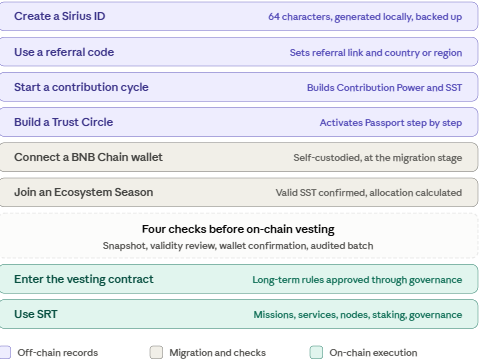
The whitepaper lays out the full path of a participant. In plain words, it goes like this:
The user generates a Sirius ID locally and saves a backup.
A referral code creates a unique referral relationship, and the user confirms a country or region.
A contribution cycle begins, building Contribution Power and collecting SST.
The user forms a Trust Circle and gradually activates Passport.
At the migration stage, a self-custodied BNB Chain wallet is connected.
The user joins an Ecosystem Season, where valid SST is confirmed and a vesting allocation is calculated.
The allocation enters a vesting contract under long-term rules approved through governance.
SRT is then used for missions, services, nodes, ecosystem staking and governance.
Why the Layered Design Matters
A fair reading of this design is simple. Fast, flexible record-keeping stays off-chain, while fixed, auditable rules stay on-chain.
That split lets the project adjust daily activity without touching what users already hold. It also gives each layer a clear owner, which makes the system easier to check and explain.
Design Versus Delivery
The official whitepaper describes how the system is meant to work. Some parts, like on-chain SRT, staking and wider services, are planned and arrive in stages.
Readers should check the roadmap and official announcements to see what is live.
Final Thoughts
The Sirius Network architecture is clear about one thing: activity, identity and assets each get their own layer, and the line between off-chain and on-chain is drawn on purpose.
For full details, the official website and the whitepaper are the best places to start.
Disclaimer: This article is for information only and is not financial advice. Project details can change.