Sirius Network KYC: Understanding the New Ecosystem Development Phase Crypto projects often grow faster than their explanations. Members join, collect points and wait for answers. Sirius Netw
Sirius Network KYC: Understanding the New Ecosystem Development Phase
Crypto projects often grow faster than their explanations. Members join, collect points and wait for answers. Sirius Network has now signalled a shift. Its latest post says the ecosystem is moving into a new stage, with identity verification leading into the Sirius DApp.
This guide explains what the post says, why the change matters and how Sirius Network KYC fits into the bigger plan.
Key Takeaways
Sirius Network KYC is the identity step the project places before the launch of the Sirius DApp.
SST points are a record of activity. They are not tokens, and no fixed rate turns them into SRT.
The project has promised more details soon. Until then, members should rely only on its official website and app.
What Is Sirius Network?
Sirius Network is a project built on mobile-first crypto mining. Its tagline reads “Mobile Mining. Powered by Participation.”
It works as a free crypto mining app. A member does not buy hardware or pay to begin. The account starts with a Sirius ID instead of an email address or phone number. Members join a 24-hour cycle in the Sirius Network app and return each day. This model of Sirius Network mining rewards steady habits more than one-time visits.
It is also a clear case of Web3 community mining, because the community’s daily activity is the engine of the whole system.
Source: official website.
Why Sirius Network Is Moving Toward Verified Identity
The project describes its growth as a path with clear stages. Identity verification comes first, the Sirius DApp follows, and the SST and SRT systems keep being refined along the way.
Stage
Purpose
Plain meaning
Identity verification (KYC)
Confirm real users
One person, one account
Sirius DApp
Give members a place to use the ecosystem
The front door for verified members
SST and SRT refinement
Improve points and token design
Rules get clearer over time
The order is deliberate. Any reward system based on activity attracts fake accounts, because one person can open many profiles. Verified identity makes each account carry real meaning.
This is an interpretation, but it matches the project’s own design. Its token plan weighs identity, reputation, quality and risk, so a verified profile counts for more than an anonymous one.
Why Identity Comes First
The order in the post is deliberate. Identity sits at the front, and the reason becomes clear from how rewards are designed.
A reward plan that depends on activity attracts fake accounts. One person can create many profiles and collect points on each. The project’s token plan weighs identity, reputation, quality and risk, so a verified account carries more meaning than an anonymous one.
This is an interpretation, not a statement from the team. Still, it matches how the system is described in its own documents.
How the Pieces Connect
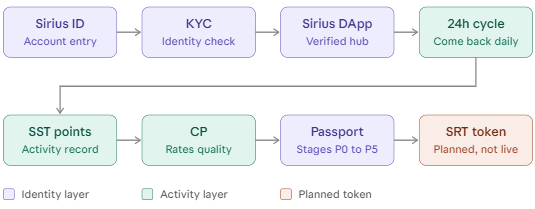
Three terms cause most of the confusion, so a short comparison helps.
Term
What it is
Status
SST points
The record of what a member did
Collected inside the app
Contribution Power (CP)
A weight that rates how good that work was
Part of the reward calculation
SRT token
The planned ecosystem token
Planned, not live
The path from first login to reward looks like this:
Sirius ID → Daily cycle → SST → CP weighting → Passport → Seasonal pool → Vesting → SRT
The official whitepaper states that SST is not converted into SRT at a fixed ratio. A member with 1,000 points does not receive a set number of tokens. Routine mining also does not automatically pay out USDT.
Sirius ID and Sirius Passport
Sirius ID and Sirius Passport work as a pair. The ID opens the account. The Passport tracks identity and progress through six stages, from P0 to P5.
Points and the ID stay inside the app. A wallet connects the account to BNB Smart Chain, which is where the planned token would live. So the app handles identity, and the chain handles ownership.
What Is Sirius Network KYC?
KYC stands for Know Your Customer. It is a check that confirms a real person is behind an account.
For Sirius Network, the check is not a side feature. The post lists it first among the milestones, ahead of the DApp. That placement shows how much weight the project gives to real, verified members.
How Sirius Network KYC Verification Works
Crypto apps usually ask for a government photo ID, such as a passport, driving licence or national ID card. Some also request a selfie to match the face with the document.
The Sirius team has not published every requirement. Members should therefore follow only the prompts shown inside the official app and treat any other source with caution.
Sirius Network KYC Verification Process Step by Step
The exact screens may change, but verification flows in crypto apps usually follow this order:
Install or refresh the app from the official website only.
Open the profile and look for the verification prompt.
Enter personal details exactly as written on the document.
Upload a clear, well-lit photo of the ID.
Complete a face check if the app asks for one.
Wait for the review and check the status inside the app.
Blurry photos and spelling mismatches are the most common reasons any verification gets delayed.
Safety Rules for Members
Do
Don’t
Use the official app and website
Click links sent in direct messages
Submit documents only inside the app
Send ID photos through chat apps
Keep the seed phrase private
Share it with anyone
Treat SST as points
Treat SST as money
Anyone offering to “approve KYC” for a fee is a warning sign.
Community, Referrals and the Foundation
Growth in Sirius Network is social. A Sirius Network referral code adds a 5% boost for each referral, but only when that person is eligible, active and direct.
The Sirius Sentinels badge is aimed at members known for consistent mining. It connects to the SST contribution system, so loyalty is recorded and visible.
Behind the community stands the Sirius Foundation. Published plans mention a $30M fund to grow the SRT ecosystem, which should be read as a plan, not a promise.
The Roadmap in Brief
When
Planned milestone
Q4 2026
Global SST contribution network
2027
SRT, vesting and staking contracts built, tested and audited
2028
On-chain SRT access, plus audited staking and governance
The project calls every date a planning target, so timelines can move.
Final Thoughts
Sirius Network KYC marks a move from simple daily tapping toward an identity-based ecosystem. The direction makes sense, but the project is still early, and many details are pending.
Careful verification, private documents and realistic expectations are the best habits for any member. More clarity should arrive as the team shares the next details.
Disclaimer: This article is for information only and is not financial advice. Crypto projects carry risk, so readers should do their own research.