Key points Solana was trading at $74.95 on Wednesday morning, 2.9 percent above the previous day (CoinGecko, 08:50 CET). On November 16, the Solana Foundation dropped the "Mainnet Beta" label
Key points
- Solana was trading at $74.95 on Wednesday morning, 2.9 percent above the previous day (CoinGecko, 08:50 CET).
- On November 16, the Solana Foundation dropped the "Mainnet Beta" label after six years and introduced a shared protocol version called Solana 1.0.
- According to TokenPost, the US spot ETFs on Solana recorded no net inflow on November 17, after $11.7 million the day before.
The Solana price is extending its recovery from last week's low. According to CoinGecko, one SOL cost $74.95 at 08:50 CET on November 18, or €68.30. Over 24 hours the price moved between $71.15 and $75.55. The talking point in the Solana camp, however, is less the price than a change of name: since Monday, the main network has officially been called simply Mainnet. It had carried the "Beta" suffix since its launch in March 2020.
Solana price today in euros: €68.30 after a $4.40 range
With a gain of 2.9 percent over 24 hours, Solana clearly outperformed Bitcoin. The largest cryptocurrency barely moved over the same period, according to CoinGecko, and stood at $64,638 at 08:49 CET. Trading volume in SOL came to just under $3 billion and market capitalisation to $44.3 billion. That puts Solana in seventh place among the largest crypto assets.
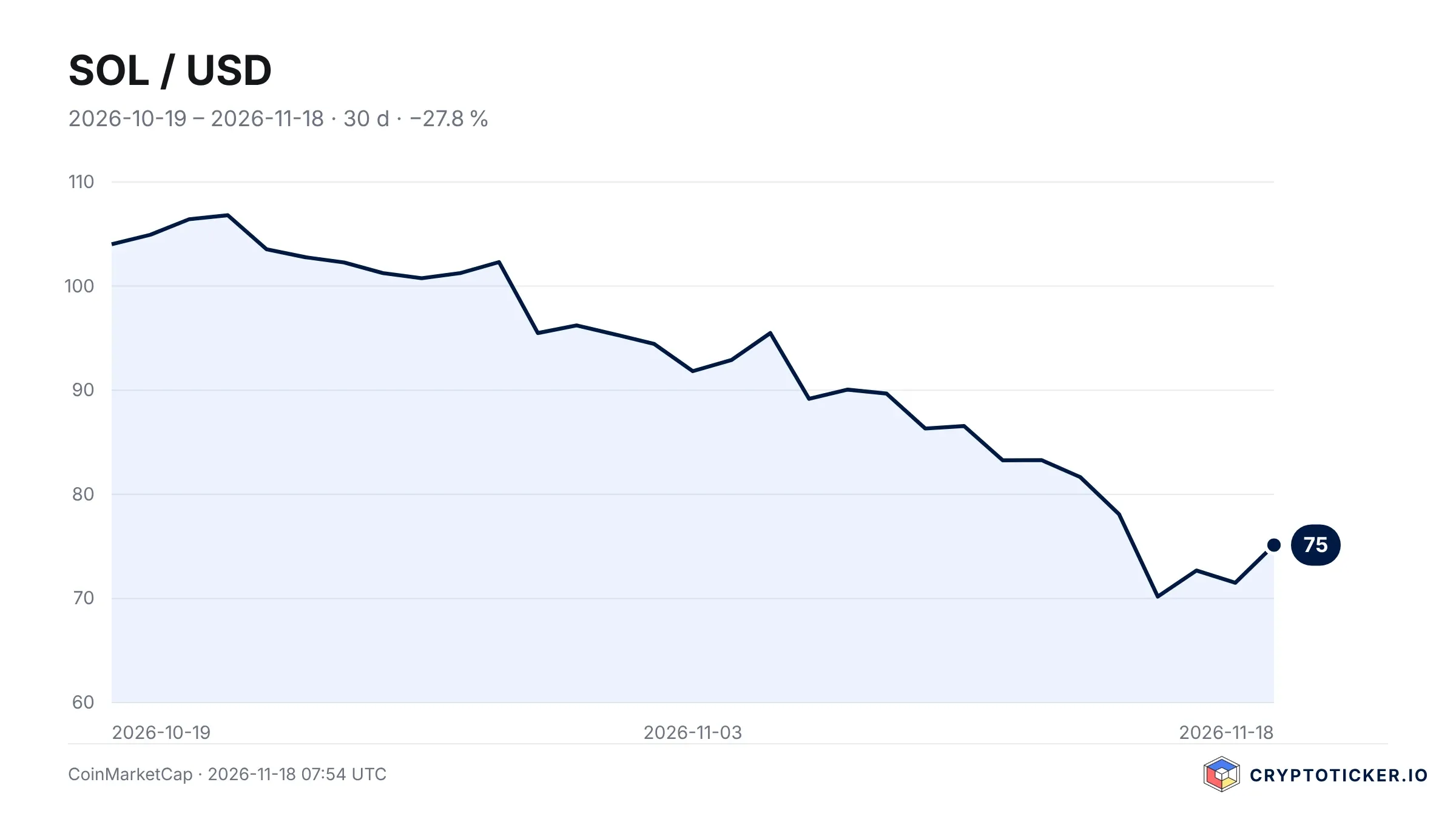
The Solana price in US dollars over the past 30 days, daily closing prices and current price. Source: CoinMarketCap, as of November 18, 2026, 08:54 CET
The longer time frames show how deep the slump of recent weeks has been. Over seven days, SOL is down 9.2 percent according to CoinGecko, and over 30 days 29.1 percent. On October 21, the daily close was still just above $106. The token remains around 74 percent below its record high of $293.31 from January 19, 2025. Sentiment across the market remains weak: the Fear and Greed Index from alternative.me stood at 11 points on Wednesday, after 12 the day before. The index is a sentiment gauge built from volatility, trading volume and market data, ranging from 0 (extreme fear) to 100 (extreme greed).
Solana news: after six years, the network is no longer called Mainnet Beta
In a blog post on November 16, the Solana Foundation announced that the main network will in future be referred to only as Solana Mainnet. Alongside this comes a shared protocol version named Solana 1.0. A protocol version is a number for the rulebook of the network itself, meaning the rules by which blocks are produced and transactions become valid. That number is independent of whichever software a validator runs.
This is exactly where things had been blurred until now. Two major validator clients run on Solana: Agave, developed by Anza, and Firedancer, which Jump Crypto built independently. Each has its own code, its own release dates and its own version numbers. Until now, the identity of the protocol was in practice tied to the version number of a single client. In future, an Agave version and a Firedancer version can support the same protocol version. According to Decrypt, the foundation coordinated the change with Anza and the Firedancer team.
Announcing a protocol version does not activate all of the associated improvements at once.
Solana Foundation, blog post of November 16, 2026, paraphrased (source)
Solana 1.0: what changes for SOL holders and validators
For investors, nothing changes, according to the foundation. Balances, accounts, applications and transaction history stay as they are. Nobody has to swap tokens, switch wallets or install software. Anyone holding SOL on an exchange or in their own wallet therefore does not need to act. Documentation and block explorers will adopt the new name gradually.
For validator operators, on the other hand, the work stays the same. Operators continue to follow their client's updates and the respective activation dates. According to Decrypt, the tracker on solana.com lists Agave 4.4 for November and Agave 4.5 for December. The new number brings no extra speed. Shorter finality comes from the Alpenglow consensus upgrade, which went live on October 21 and is meant to cut the time to final confirmation from about 12.8 seconds to around 150 milliseconds. If you put SOL to work with a validator for yield, you will find the providers' terms in our comparison of staking platforms.
The move carries mainly symbolic weight. The network went down for almost five hours in February 2024 and for nearly 19 hours a year earlier. Critics long saw the beta label as an admission that Solana was not yet mature. Whether the new name strengthens the confidence of larger investors will only become clear from the inflows.
Solana ETFs: no net inflow on November 17 after $11.7 million
Those inflows are currently lacking. According to TokenPost, the seven US-listed spot ETFs on Solana recorded a net inflow of zero dollars on November 17, with no fund seeing inflows or outflows. On the previous trading day, $11.7 million flowed in. Over five trading days the balance adds up to $0.8 million, and since launch to $1.415 billion. A spot ETF is an exchange-traded fund that holds the coin itself rather than only futures contracts on it. The outflow streak of the previous weeks has been halted for now, but the data does not yet show a reversal.
Solana price prediction: the levels that matter after the low near $70
On the downside, the daily low of $71.15 is the first support. Below that lies the daily close of November 15 at $70.24, the lowest value of the recent decline in CoinGecko's daily data. On the upside, the 24-hour high of $75.55 is the first hurdle. The next zone sits at around $78, where SOL closed on November 14, and above that at just under $82, the close of November 13. Our Solana price prediction summarises the scenarios analysts see for the coming months.
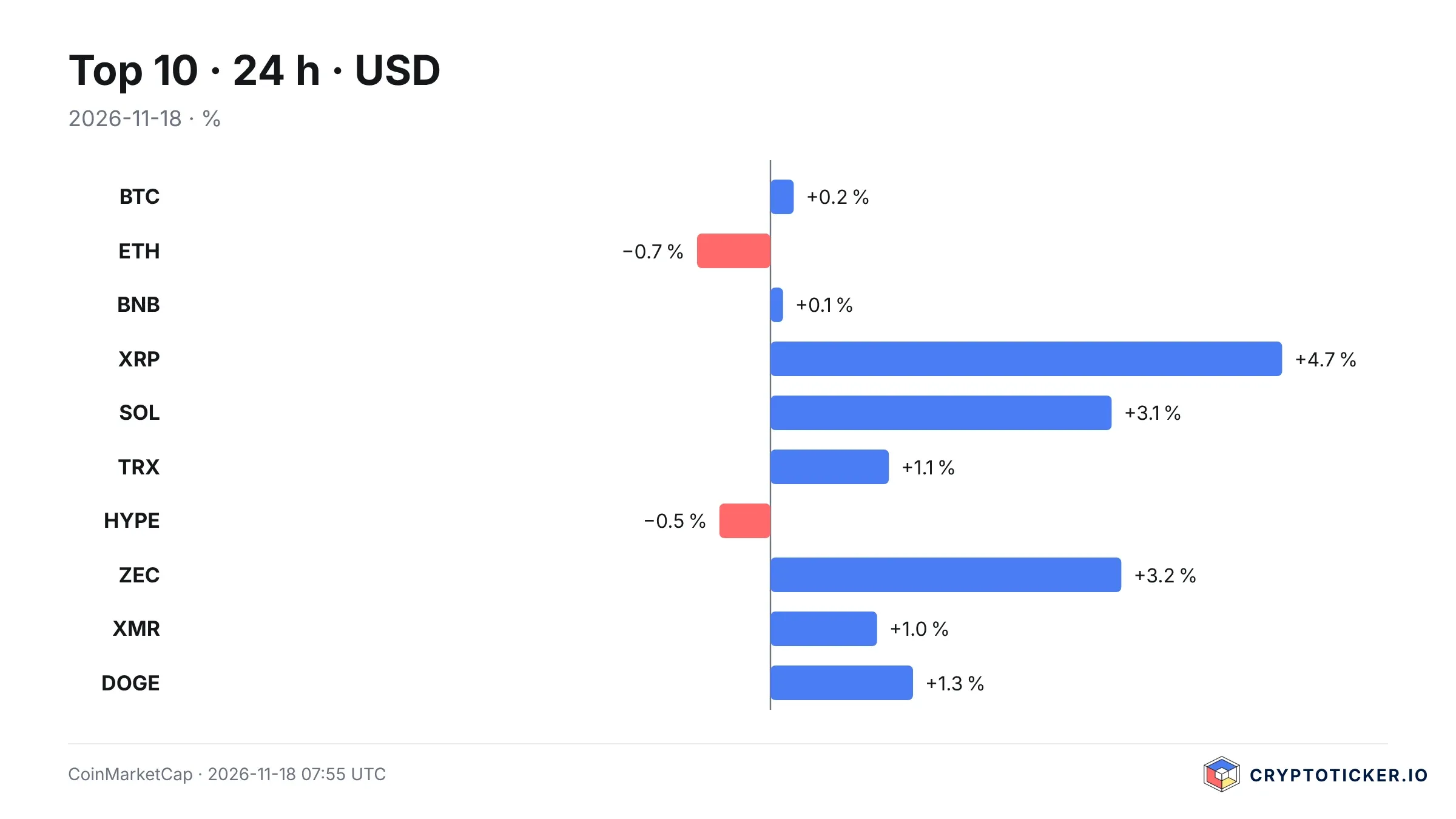
The ten largest crypto assets excluding stablecoins, price change over the past 24 hours in percent. Source: CoinMarketCap, as of November 18, 2026, 08:55 CET
No price direction can be derived from the change of name. Since October, Solana has mainly tracked the broader market, and that market is in extreme fear. If you want to trade SOL, you can compare providers' fees in our crypto exchange comparison.
Solana at $75: a new name, but the downtrend is not yet broken
By ending the beta label, Solana has taken a long-awaited step, though technically it changes nothing for holders. The price has recovered by a good 6 percent since the weekend from the close at $70.24, but remains almost 30 percent below its level of a month ago. The zone around $78 and the question of whether the ETFs attract money again will be decisive for the coming days.
(As of November 18, 2026. This article is not investment advice. Prices and fee structures change; check the terms with the provider before you buy.)