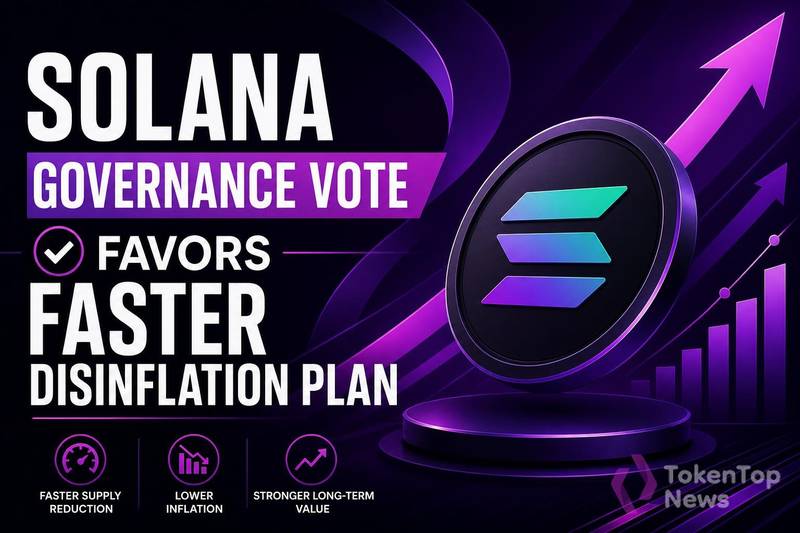
A Solana governance vote has favored a faster disinflation plan for SOL issuance, while a competing proposal to burn roughly $800,000 worth of SOL per day trailed behind, sharpening the debat
A Solana governance vote has favored a faster disinflation plan for SOL issuance, while a competing proposal to burn roughly $800,000 worth of SOL per day trailed behind, sharpening the debate over how the network should manage its token supply.
What the Solana Governance Vote Decided
The core outcome of the on-chain governance proposal was support for accelerating Solana's disinflation schedule, the path that reduces how quickly new SOL enters circulation over time. For related coverage, see Bitcoin and Solana Turned Early Investors Into Millionaires: Could Apeing’s Upcoming Launch Be the Next Crypto to Explode?.
Disinflation in Solana's context does not mean fewer tokens outright; it means the rate at which new SOL is emitted through staking rewards declines more steeply toward the network's long-run terminal inflation floor. A faster schedule pulls that reduction forward. For related coverage, see Whales Who Invested in Solana and Litecoin are Eyeing Apeing as the Next 1000x Crypto with High Growth Potential.
The direction that validators and stakeholders endorsed matters more for the network than any short-term price reaction, because it changes the trajectory of SOL's baseline supply growth rather than betting on market timing. This vote follows an earlier decision when a Solana vote to double disinflation passed in a narrow result, underscoring how contested emissions policy has become.
Why the $800K Daily Burn Proposal Fell Behind
The alternative, laid out in a separate governance proposal, would have destroyed roughly $800,000 in SOL each day, permanently removing those tokens from supply rather than slowing the rate at which new ones are created.
The distinction is central to why the two proposals diverged. Reducing emissions changes the future issuance curve without touching existing tokens, while a daily burn actively subtracts circulating SOL, a more aggressive and continuous drain on supply.
The burn proposal was notable even in trailing because it framed the governance tradeoff directly: predictable, gradual issuance reduction versus a standing, market-facing burn mechanism. Voters leaned toward the former.
What the Vote Signals for Solana Tokenomics and Stakeholders
For validators and stakers, a faster disinflation schedule points toward lower nominal staking rewards over time, since those rewards are funded largely by new issuance that the plan curtails.
The contrast with the rejected burn approach signals that the ecosystem's near-term preference is to reshape the emissions curve rather than introduce a continuous token-destruction line item, a choice that shapes narrative more than it guarantees any price outcome. The broader institutional backdrop keeps SOL in focus, as seen when Charles Schwab moved to add Solana to its crypto trading platform and as MoonPay's integration enabled AI agents to handle crypto lending on Solana.
Observers should watch how the approved disinflation path is implemented and whether the burn concept resurfaces in a revised form, since governance debates over Solana's supply mechanics have proven recurring rather than settled.
Disclaimer: This article is for informational purposes only and does not constitute financial or investment advice. Cryptocurrency and digital asset markets carry significant risk. Always do your own research before making decisions.
Read original article on tokentopnews.com