A routing failure at Teraswitch, a data center and network provider used by a portion of Solana’s validators, disrupted several of its own international sites in the early hours of August 12,
A routing failure at Teraswitch, a data center and network provider used by a portion of Solana’s validators, disrupted several of its own international sites in the early hours of August 12, 2026. Solana’s blockchain did not stop. Blocks kept getting produced and transactions kept landing throughout the incident, according to Jacob Creech, the Solana Foundation’s vice president of technology.
Solana’s 7-day moving average of daily validators has declined to around 691 as of August 13, 2026. The three-month trend shows a steady drop from more than 750 validators in May, while long-term data highlights a broader decline from the network’s 2023 peak.
Creech said 597 of the network’s 699 staked validators kept voting throughout the disruption. Separately, 102 of the network’s staked validators stopped voting during the incident, a count consistent with Creech’s figure once subtracted from the total of 699.
- August 12, 2026 – Early hours: A routing failure at Teraswitch begins disrupting several of its international sites.
- ~10 minutes later: Teraswitch engineers identify the fault.
- During the outage: 597 of 699 staked validators continue voting.
- During the outage: 102 staked validators stop voting.
- During the outage: 28.83% of staked SOL becomes delinquent, according to incident data cited by Marinade Finance.
- ~33 minutes after the failure began: Teraswitch reports that service is fully restored.
- Within 40 minutes: Solana Foundation Vice President of Technology Jacob Creech says the affected validators recover.
- After recovery: Solana continues producing blocks and processing transactions without a network halt.
Solana Validator Impact and Finality Margin
MetricFigureWhat It ShowsTotal staked validators699Network validator base cited by CreechValidators still voting597Validators maintaining participationValidators not voting102Validators affected during the incidentStaked SOL delinquent28.83%Economic and consensus weight affectedFinality threshold33.34%Level at which Solana stops finalizing transactionsDistance to threshold4.51 percentage pointsRemaining margin during the incident
Creech also said validators in the Solana Foundation Delegation Program, the Foundation’s own validator support initiative.
Why the Network Held and What Almost Broke It
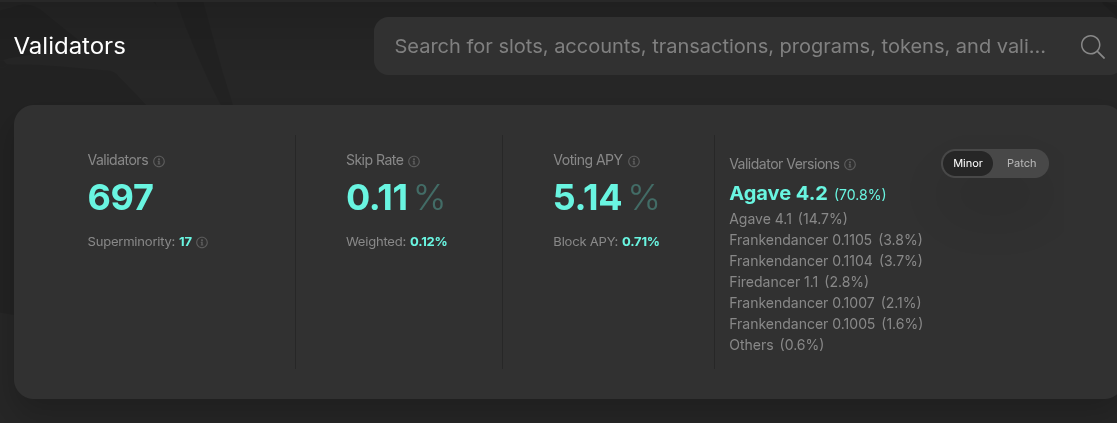 Solana Beach dashboard showing validator network metrics
Solana currently has 697 validators supporting the network, with a 0.11% skip rate and 5.14% voting APY. The latest validator data provides a snapshot of network participation, performance, and infrastructure diversity.
The reason a single provider’s failure did not stop the network, in Creech’s telling, is that Solana’s validators run across independent infrastructure providers rather than one shared system. When Teraswitch’s routing broke, the validators hosted elsewhere kept the network running.
That structure is real, and it worked this time. It also came closer to failing than the outcome alone suggests. Validator-tracking data cited at the time of the incident showed that Teraswitch’s autonomous system, identified as AS20326, held 27.34 percent of all staked SOL, above the Solana Foundation’s own 25 percent cap on how much stake a single network operator should control. Roughly 94 percent of that operator’s stake went offline at once.
Multiplying the two figures puts close to 89 percent of the incident’s delinquent stake behind that single autonomous system. Marinade Finance, the Solana liquid staking protocol that flagged the concentration, put the network’s overall stake delinquency at 28.83 percent, just short of the 33.34 percent threshold at which Solana stops finalizing transactions. Marinade said of the concentration figures: “Nobody should be comfortable with that, us included,” and noted that its own stake allocation carries similar concentration in a handful of network operators.
Infrastructure Diversity Prevented a Network Halt
Solana’s validators absorbed this failure because most of the network was not sitting behind Teraswitch. The stake that was concentrated there, above the Foundation’s own limit, accounted for most of what went offline. Infrastructure diversity did what Creech said it did.
MoneyGram is expanding its Solana presence beyond validator infrastructure with the launch of MoneyGram Ramps, enabling cash-to-crypto and crypto-to-cash transfers through Solana applications.
Rift is the first Solana wallet to integrate the service. MoneyGram says Ramps connects developers to its global cash network, supporting cash access across more than 170 countries and territories. The move follows MoneyGram’s decision to become a Solana validator, giving the payments company a role in both network infrastructure and user-facing crypto payments.