The Solana price stands at $108.21 on Tuesday morning, around 3.4 percent below its level 24 hours earlier. The number alone explains little. More important is a condition that has been sitti
The Solana price stands at $108.21 on Tuesday morning, around 3.4 percent below its level 24 hours earlier. The number alone explains little. More important is a condition that has been sitting in a corporate announcement since Sunday evening: US company SkyAI intends to buy back its own shares for up to $201 million, and under that announcement the offer holds only as long as the SOL closing price stays above $100 for the entire period. The buyback is funded by selling Solana. For the first time, then, the round number carries not just a chart line but the calculation of one of the largest listed SOL holders.
Solana price at $108.21: 7.6 percent of headroom above the $100 condition
There are 7.6 percent between the current price and the condition. Over the past trading night the range ran from $102.19 to $111.83, so the low sat only a good two percent above the threshold. Over the week SOL is down 9.4 percent; over the month the price is around 11 percent below the interim high of $122.08 on September 26. Market capitalisation is $63.7 billion, and turnover over the past 24 hours around $3.99 billion (CoinGecko figures, as of Tuesday morning).
The last daily close below $100 was on September 16, at $96.87. SOL has not touched the level in the 27 trading days since. That very quiet is what makes the condition interesting: the threshold sits close enough to the market to be reached in a bad week, and far enough away to cause no panic today.
The $201 million buyback offer and its conditions
SkyAI, listed on the Nasdaq under the ticker SKYA and known as Sharps Technology until May 2026, announced a cash offer to its own shareholders on October 11. It is offering $3.00 per share and per pre-funded warrant, for up to 46.37 million shares and around 20.72 million warrants. That is 95 percent of the outstanding paper in each class, at a maximum cost of around $201 million. The price is 65 percent above the closing price of October 9 and more than double the volume-weighted average of the past 60 trading days.
What a tender offer is
A tender offer is a company's invitation to its own shareholders to tender paper at a fixed price within a fixed window. It differs from a rolling buyback over the exchange: price and deadline are set in advance, and the offer may be tied to conditions. That is exactly where SOL comes in.
Under the announcement, the offer is to start on or around October 15 and run for ten trading days. The company names four conditions: at least 50 percent of each class must be tendered, the SOL closing price must stay above $100 throughout, there must be no court injunction and no general trading halt, and the buyback must not trigger a delisting from the Nasdaq. There is no financing condition, and SkyAI may waive individual conditions. Which price source and which closing time apply for the $100 is not stated in the announcement. That only becomes binding with the offer document, which must be filed with the US securities regulator by October 15 and will be available there under SkyAI, Inc. in the EDGAR register.

Just above the limit mark: 7.6 percent separate the Solana price from the $100 condition.
One million SOL have already been sold, around one million are still there
SkyAI says it has sold around one million SOL, roughly half its holding, worth approximately $107 million. Around one million tokens remain with the company, and the firm itself writes that it may keep selling depending on market conditions. In September SkyAI still reported 2,009,494 SOL worth around $207 million at the time, by its own account the fifth-largest listed Solana reserve, funded without debt.
The movements behind this can be followed publicly. Analyst Ember reported 468,000 SOL worth $51.1 million within 24 hours on October 10, of which 218,000 went to centralised exchanges and 250,000 to custodian BitGo. Analytics service Lookonchain counted 568,000 SOL for around $63.87 million moving to exchanges within three days on the same date. On October 12 a further 211,623 SOL arrived at Coinbase Prime, according to Ember, taking the total to around 1.25 million SOL worth some $138 million moved towards trading venues over five days. A transfer to an exchange is not yet a sale, and that holds here too. It is, however, the step before one, and it lands in the same order book you buy in.
How a treasury company turns into a permanent seller
A crypto treasury company raises money on the equity market and buys a coin with it. As long as its own share trades above the value of the tokens held, the model works: the company issues new shares, buys tokens with the proceeds, and the token holding per share rises. Reverse the ratio, so that the share trades below the value of the reserve, and the mechanism inverts. The fastest route to creating value per share is then buying back your own paper below its intrinsic value. That is paid for out of the reserve, which means with tokens.
At SkyAI the figures are in the open. Lookonchain estimates the average entry price at around $194 per SOL. On the remaining million or so tokens at a price of $108.21, that works out as a book loss of about $86 million. The buyback price of $3.00 per share also sits well below what early investors paid in August 2025, which was $6.50 per unit of share and warrants. Together the two numbers describe why the company would rather hand over tokens than keep waiting.
The arithmetic behind the $100 condition
This is where the threshold becomes tangible. The first sale raised around $107 million. The residual holding of roughly one million SOL is worth around $108 million at today's price. Together that is about $215 million against a maximum offer volume of $201 million, a buffer of a good $14 million. If SOL falls to $100, that buffer shrinks to around $6 million. The condition therefore does not protect the company against a price decline as such, but against the point at which the reserve no longer covers the offer. This calculation is derived from the figures named above and is not a company statement.
The rival belongs in the picture. Forward Industries had offered SkyAI 0.306 of its own shares per SkyAI share. The special committee unanimously recommended rejection and the board followed, reasoning that the offer valued the firm too low. Forward reported 8.5 million SOL at the end of September and describes itself as the largest Solana treasury. The buyback is therefore also a defensive measure: collect 95 percent of your own paper and you are harder to take over.
The 200-day line at $98.37: the condition meets an old level
Two moving averages place today's price. From 366 daily closes, our own calculation gives a 50-day average of $107.45 and a 200-day average of $98.37. The price therefore sits just above the short line and a good ten percent above the long one. What stands out is how close the long line is to the contractual condition: $98.37 against $100, less than two percent apart. Trade SOL below $100 and you are trading the coin below its annual average at the same time.
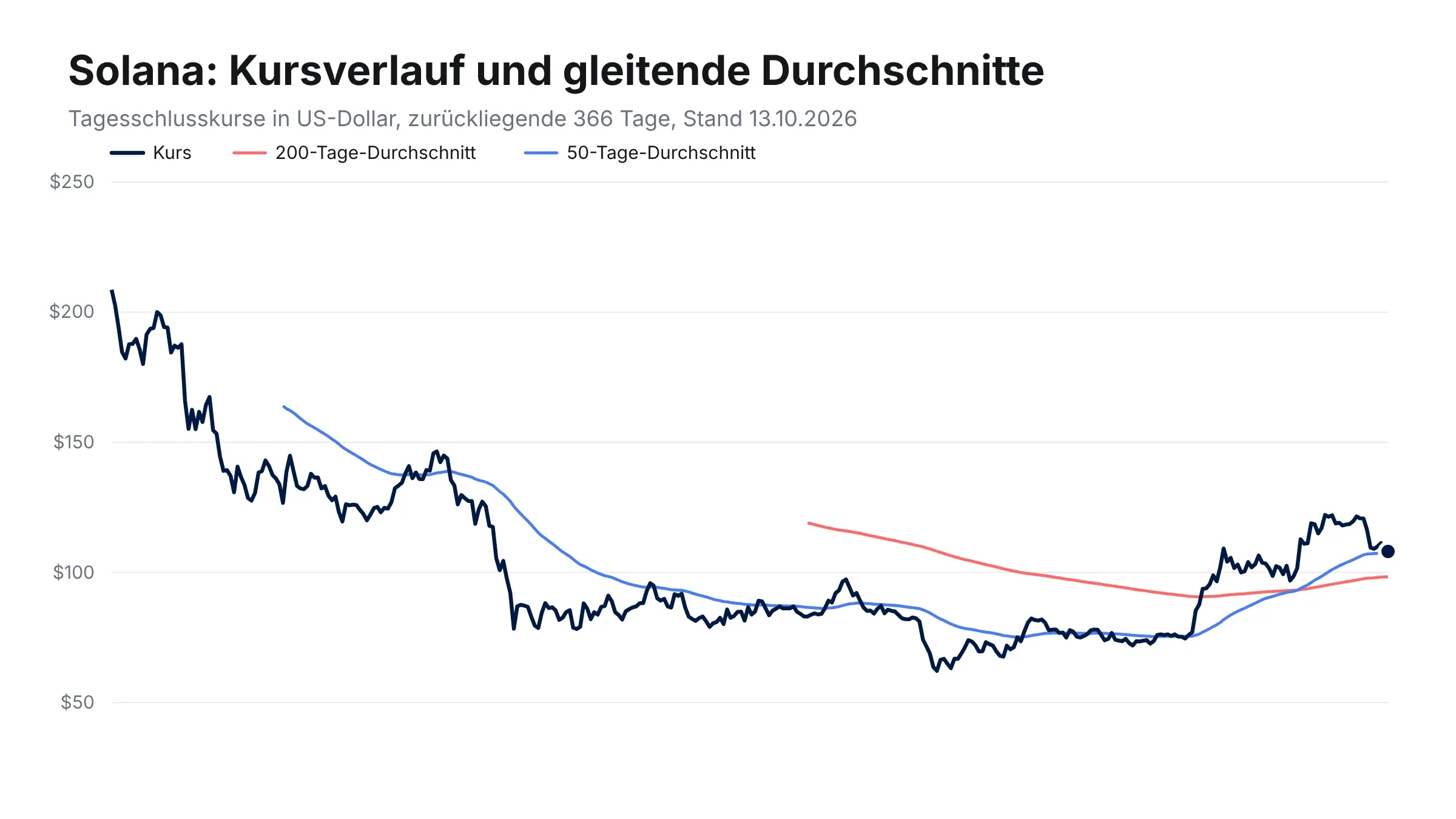
The 200-day average sits at $98.37 and therefore close to the threshold from the buyback offer.
The range of the past twelve months runs from $62.18 to $208.61. Measured against the high, SOL is some 48 percent lower; measured against the low, some 74 percent higher. Three levels can therefore be justified for the coming days: $111.83 as Monday's daily high, $107.45 as the 50-day line, and the zone between $98.37 and $100, where the annual average and the offer condition coincide. The $117 target named in our October 12 article is unaffected by this; it lies above the current range.
ETF outflows on a sixth consecutive trading day
The second source of selling is the exchange-traded funds. On TokenPost data, the US spot Solana ETFs recorded a sixth consecutive trading day of net outflows on October 12. The sum was small at around $0.7 million, and it fell entirely on VanEck's VSOL; no fund took in money that day. Over the five trading days before, outflows added up to $16.5 million. Since launch, cumulative net inflows nonetheless stand at $1.574 billion.
The orders of magnitude show where the weight lies. A daily outflow of $0.7 million does not register against $3.99 billion of daily turnover. The 1.25 million SOL from a single company, by contrast, amount to around 3.4 percent of daily turnover and meet an order book that will not absorb them without trace on a weak day. Anyone watching the SOL price these days is watching a balance-sheet decision rather than a fund statistic.
What has changed since the Solana article of October 10
On October 10 SOL stood at $109.84, and the subject was a technical one: the 200-millisecond blocks after SIMD-0525 had gone live. Since then the price has moved 1.5 percent to $108.21, so almost not at all, while two things have been added below the surface. First the announced buyback with its price condition, second the continuation of the ETF outflows, which had begun on October 10 with the end of a 14-week inflow streak.
The level that counted back then was the interim low at $102. That low has held, because the lowest point of the past 24 hours was $102.19, exactly there. What is new is that a second level now waits below it, one that comes not from the chart but from a contract.
Selling pressure in the order book: limit order versus market order
A market order buys or sells immediately at the next best price in the order book. A limit order sets a price and is executed only if the market reaches it. In quiet phases the difference is small. When a large holder hands over hundreds of thousands of tokens in a few hours, it gets expensive: the market order then works its way through several price levels, and the actual execution price diverges from the one displayed. That gap is called slippage.
In practice that means two things. When buying, a limit order just below the current price caps the damage if a large sale comes through. When selling the same holds in the other direction, and it is also worth a look at trading hours: order books are thinner during the European morning than during the overlap with US trading in the afternoon. Move larger amounts and you split them up and avoid the minutes immediately after an announcement.
What matters when choosing an exchange in Germany
Since MiCA has applied in full, providers need authorisation as a crypto service provider to do business with investors in the EU. What counts for you there is less the marketing promise than the question of who holds the tokens and at what fees trading happens. The spread between the buy and sell price is the larger cost block at many providers than the stated fee. A look at the crypto exchange comparison shows where the differences lie.
Holding period, exemption threshold and staking: the German tax rules for SOL
For investors in Germany, SOL counts among other assets. A sale falls under private disposals pursuant to section 23 of the German Income Tax Act. After one year of holding, a gain is tax-free; before that it counts at the personal income tax rate. Within the one-year window, gains stay untaxed up to the exemption threshold of 1,000 euros per calendar year. Exemption threshold means one euro above it makes the entire amount taxable, not just the excess.
With staking things sit differently. The ongoing rewards are other income under section 22 no. 3 of the German Income Tax Act, with an exemption threshold of its own at 256 euros a year. They are valued at the price at the moment of inflow. The once-discussed extension of the holding period to ten years for staked coins was dropped by the tax administration in its May 2022 circular, so one year stands. Anyone with many small inflows needs clean records; the common tax tools and portfolio trackers take that on.
Staking ties the tokens up for around two days
SkyAI itself says it generated more than $12 million of staking proceeds up to June 30, with its own validator reaching 6.01 percent against 5.57 percent for the network average. The difference of 0.44 percentage points does little to the book loss of around $86 million. For private holders the second number matters more: stake SOL and you cannot reach it immediately. Unstaking takes effect only at the end of the current epoch, and an epoch lasts around two days on Solana. If you want to react in a fast move, leave part of the holding unbound. Which providers set which lock-up periods and yields differs considerably and belongs checked before staking.
Our assessment: the $100 level now carries a second meaning
From the newsroom's point of view, the condition is the real news value of this week, not the daily loss of 3.4 percent. Three pieces of evidence argue for that: the coverage calculation, under which the buffer between reserve and offer volume shrinks from $14 million to $6 million at $100; the closeness of the threshold to the 200-day average of $98.37; and the fact that around one million SOL still sit with the company and may expressly be sold. Against it stands the order of magnitude: against $3.99 billion of daily turnover, even a million tokens is no automatic move lower, and SkyAI can waive the condition. Whether the buyback happens or fails cannot be derived from this, and a price target even less so.
What can be derived: the zone around $100 will be watched more closely than usual during the ten trading days from October 15, because a company with a concrete sum is reading along there. Levels that many eyes are on are rarely passed unnoticed.

Ten trading days from October 15: that is how long the condition has to hold, according to the announcement.
Solana buyback: the $100 condition runs to the end of October
- Settle the buying route and the costs. Before your next order, compare the spread between buy and sell price and the custody arrangements at a provider authorised in the EU. The exchange comparison sorts the fee models.
- Separate bound and free holdings. Work out which part of your SOL sits in staking and therefore needs around two days to unstake. Yields and lock-up periods are in the staking comparison.
- Record the purchase data. Note the date, quantity and price for every purchase, so that the one-year window and the 1,000-euro exemption threshold can be evidenced later. The tax tools in comparison take the bookkeeping off your hands.
(As of October 13, 2026. This article is not investment advice. Prices and fee structures change; check the terms with the provider before you buy. Crypto investments can lead to a total loss.)