The record shows this: Whale Alert reported two transfers to Coinbase Institutional on October 31, 609,699 SOL worth $58.5 million and 550,157 SOL worth $52.7 million, together 1,159,856 SOL
The record shows this: Whale Alert reported two transfers to Coinbase Institutional on October 31, 609,699 SOL worth $58.5 million and 550,157 SOL worth $52.7 million, together 1,159,856 SOL or $111.2 million. Over the same stretch, from October 26 to 30, the US fund wrappers on Solana lost $71.5 million across five consecutive trading days, according to SoSoValue data. Our assessment follows further down: fund flows are the smaller of the two channels at Solana, and anyone explaining the price from them alone is working with the wrong magnitude.
The SOL price stood at $94.62 on Sunday afternoon, after a daily high of $96.15 and a daily low of $94.38. Over seven days the token is down 6.8 percent, over 30 days down 21.1 percent. Where the price can point on a horizon of months is set out in our Solana price prediction.
What counts at Solana this Sunday
Two figures sit side by side this weekend, and they point in the same direction but carry very different weight. On one side, the exchange-traded Solana funds in the US have been giving up money for weeks. On the other, individual large addresses are shifting amounts that exceed a whole week of fund outflows.
If you hold SOL, that is no academic distinction. A fund outflow is a sale that lands in the order book and pushes the price down. A transfer to a custody address, by contrast, is at first only a relocation: the SOL can be sold, but they do not have to be. Lumping the two together reads a selling pressure out of $182 million in movement that the data does not support.
The two transfers Whale Alert reported on October 31
Whale Alert is a service that automatically reports large transfers on public blockchains as soon as they cross a threshold. Both senders are flagged there as unknown wallets, while the destination carries the Coinbase Institutional label. Which address received the SOL does not appear in the report, and therefore neither does whether a sale, a new custody arrangement or the collateralisation of a loan sits behind it.
The order of magnitude deserves its own calculation. 1,159,856 SOL is 0.197 percent of the circulating 590,150,380 SOL. Measured against the past 24 hours' trading volume of $1.344 billion, the $111.2 million amounts to 8.3 percent of a single day's turnover. That is a lot for one address and little for the market as a whole.
A second signal came a day earlier from the opposite direction. Lookonchain reported on October 30 that a newly created wallet withdrew 68,773 SOL worth $6.7 million from Kraken, Bybit and OKX, so away from exchanges into self-custody. Taken together, the two reports show no single picture but capital changing its form of custody.
Five consecutive losing days for the Solana ETFs
The fund side is better documented than the wallet side, because inflows and outflows are published every trading day. From October 26 to 30, money flowed out on each of the five trading days, $71.5 million in total. October 27 brought $19.16 million in outflows according to SoSoValue data, the largest daily loss since December 3, 2025. Two days later, on October 29, $27.69 million followed. Farside attributes $23.7 million of that to the Bitwise fund BSOL and $4 million to the Grayscale fund GSOL.
A word on the data, because the figures diverge slightly from provider to provider: SoSoValue and Farside differ by a few hundred thousand dollars in individual weeks, because they draw the boundaries of trading days differently. We therefore quote the values as each provider carries them, and do not smooth them into a single number.
Self-custody of SOL saves the fund fee but puts the key risk on you alone.
Where things stand in October: four weeks of outflows
October was the first consistently negative month for the Solana funds since their launch. The run of weeks reads as follows:
Period
Net outflow
Notable
October 5 to 9
$24.8 million
end of 14 consecutive inflow weeks
October 12 to 16
$25.52 million
highest weekly figure since launch at the time
to October 22
$30.3 million
new record, daily figure on the 22nd: $8.51 million
October 26 to 30
$71.5 million
five consecutive losing days
Net inflows occurred on only two days in the whole month, October 2 and October 21. For the full month, estimates range between $99.62 million and a good $105 million in outflows, depending on which provider counts. Fund assets fell over the course of the month from around $1.61 billion on October 22 to around $1.4 billion on October 30. Cumulatively, net inflows of around $1.51 billion still stand on the books since the funds launched.
The legal position and the products available from a German brokerage account are set out in our overview of crypto ETFs in Germany. The US products are hard for retail investors in the EU to access, yet the flows act on the same world market price.
Why the fund channel weighs less at Solana than at Bitcoin
Here lies the point missing from most reports. What decides is not the absolute size of an outflow but its ratio to the market it arrives in.
Solana's market capitalisation came to $55.83 billion on Sunday. Fund assets of $1.4 billion to $1.61 billion therefore amount to 2.5 to 2.9 percent of the total value. The outflow of $71.5 million does weigh a good 5 percent of fund assets, but only around 1 percent of the five days' turnover that accumulated on exchanges over the same stretch. A single wallet transfer of $111.2 million in one day, by contrast, reaches 8.3 percent of a day's turnover.
For comparison, the magnitude on the supply side: by our own survey of October 31 the network issues 62,415 new SOL a day, around $5.91 million at the current price. The two transfers of October 31 therefore correspond to roughly 19 days of fresh issuance. A whole week of fund outflows corresponds to about twelve days.
That leads to a sober reading: at Bitcoin the fund wrappers hold a share of supply in the double-digit percentage range, and there fund flows move the price directly. At Solana they are a marginal channel. The price here continues to follow exchange trading, futures positioning and the supply from issuance and unlocks.

Two capital channels feed into the same price, but exchange trading is the far wider one.
What has changed since the Solana article of October 31
Our Solana analysis of October 31 put the supply side at the centre, meaning the 62,415 new SOL a day at a network inflation rate of 3.5777 percent a year. Three things have changed since.
First the price: on October 31 SOL traded at around $96, on Sunday afternoon at $94.62, so 1.4 percent lower. Second the $100 level, which gave way on October 29 and has not been reclaimed since; the distance to it comes to 5.7 percent. Third, the wallet transfers have added a factor that did not appear in the issuance calculation: demand and supply from individual large addresses, which cannot be planned the way an inflation rate can.
The levels carrying the SOL price on Sunday evening
Levels are only usable when they are reasoned. These four can be derived from the day's data.
- $94.38, the daily low. As long as it holds, the sideways move of recent days remains intact.
- $96.15, the daily high. It is the first hurdle to the upside and sits 1.6 percent above the current level.
- $100, the round level from October 29. A close above it would be the first technical sign that October's downtrend has broken.
- $293.31, the all-time high of January 19, 2025. The price sits 67.7 percent below it, and over the year the loss comes to 49.2 percent. That figure belongs in every assessment, because it sets the frame.
This is not a forecast, and nobody here knows the next price level. What these levels provide is an order of checks: first the daily low, then the daily high, then the 100.
Custody: fund share, exchange or your own key
The transfers to an institutional custodian lead straight to a question that matters in a small portfolio too: where do your SOL sit, and who holds the keys?
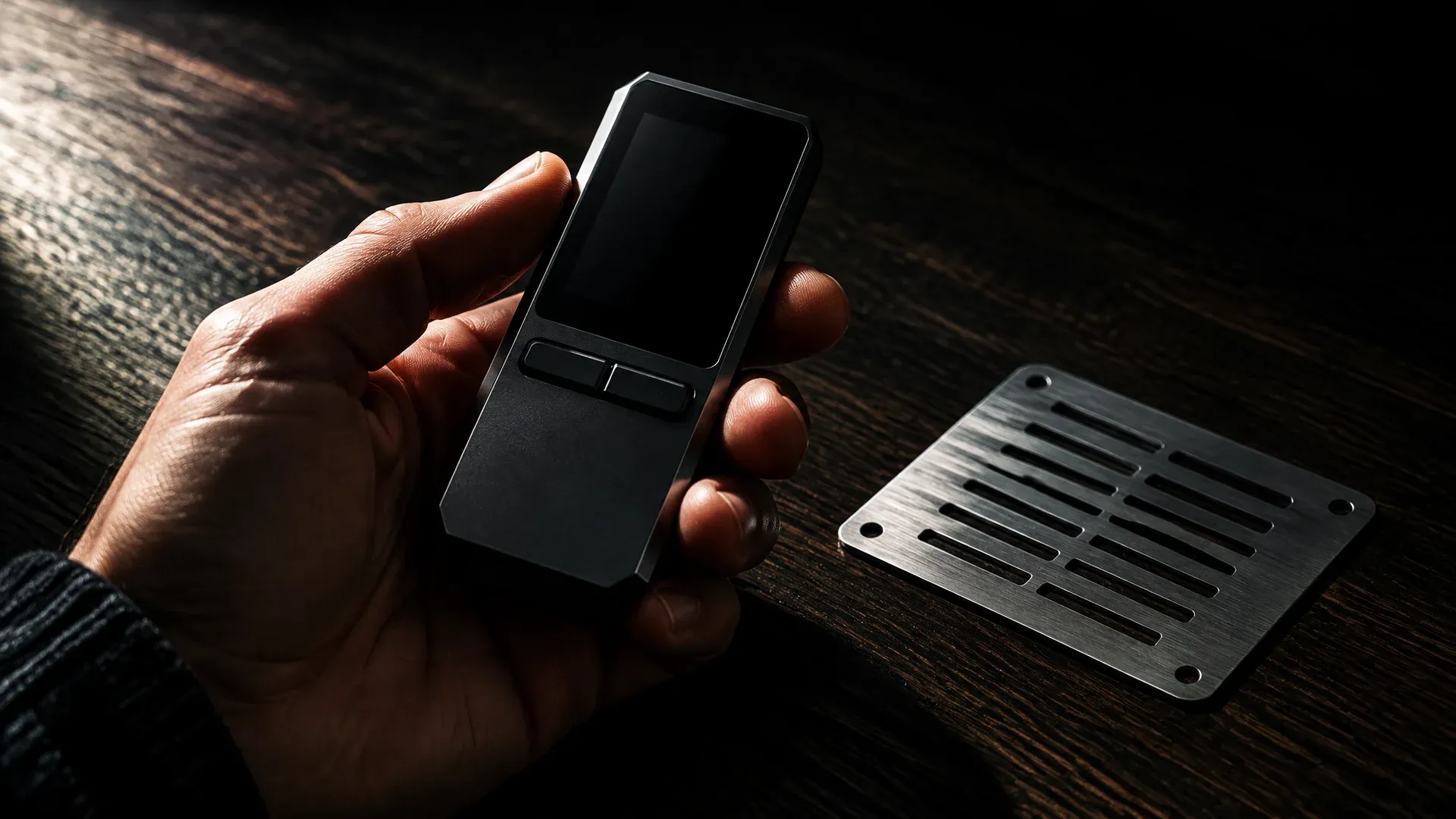
A fund share is a security. You hold a claim rather than SOL itself, and you pay an ongoing management fee for it. In return, key management falls away. At an exchange the coins sit in its custody; you can trade them immediately but carry the platform's default risk. With self-custody on a hardware wallet you hold the private key yourself, pay no ongoing fee and are solely responsible for securing the recovery words. Which device supports which blockchain and what the models cost is set out in our hardware wallet comparison.
One peculiarity at Solana: delegated SOL stays in your wallet and is not transferred to the validator. So you can stake and keep the key. Anyone running staking through a provider, by contrast, hands the coins into that provider's custody and pays a share of the yield.
Holding period and loss offsetting before the turn of the year
This section is why a 21 percent loss in October is more than bad news for German investors. Private disposals are governed by section 23 of the German Income Tax Act. If you sell SOL within a year of buying, the gain is taxable, but the loss is also offsettable: against gains from other private disposals in the same year, and on application in the previous or in future years.
After a year has passed, a gain is tax-free. The flip side, which often gets lost: a loss is then no longer usable for tax purposes either. So anyone holding SOL at a loss for less than a year who has realised gains from other crypto sales this year has a window until December 31 that closes afterwards. That is no recommendation to sell. It is a deadline that stands in the calendar.
Three things are needed for it: the purchase date of every single tranche, the acquisition costs and a consistent allocation method. On the planned reform of the holding period and the current state of the legislation we maintain a separate page on the holding-period reform, which we keep up to date.
How to buy SOL in Europe under MiCA
MiCA is the EU regulation on markets in crypto assets. It has applied in stages since 2024 and requires trading platforms to hold an authorisation in an EU member state. In practice that means the platform has to demonstrate a European licence, it has to identify you and it has to disclose its fees.
At the point of purchase, three items decide the price, and only the first is written large on the page. The trading fee ranges from 0.1 to 1.5 percent depending on the platform. Added to that is the gap between the buying and selling price, which on small orders often weighs more heavily than the fee. And finally the withdrawal costs, if you move the SOL to your own address. Which platform is cheap in which combination is something we calculate in the overview of crypto exchanges.
Our assessment of where Solana stands
From the newsroom's point of view, the Solana ETF outflow is currently overrated. Three documented figures support that: fund assets of $1.4 billion to $1.61 billion are 2.5 to 2.9 percent of the market capitalisation of $55.83 billion; the outflow of $71.5 million over five days corresponds to around 1 percent of the daily turnover in the same week; and a single day with two wallet transfers set one and a half times that amount in motion, at $111.2 million.
One point stands against it, and it is not a small one: fund flows are a gauge of institutional sentiment. Fourteen consecutive inflow weeks ended in October, and four outflow weeks in a row show a change of stance in exactly the group that carried the upswing in 2026. Anyone reading the flows as a signal rather than as a price driver is reading them correctly.
What follows from that: the next solid piece of information comes from the order book rather than the funds. If part of the 1,159,856 SOL at Coinbase Institutional is sold, it will show up first in trading volume and at the daily low of $94.38. If volume stays at around $1.3 billion and the low holds, the transfer was a relocation. This appraisal is an assessment of the situation and not a buy or sell recommendation; with crypto assets a total loss is possible.
Solana at $94: the fund channel decides less than assumed
- Clarify custody. Check where your SOL sit and whether the recovery words are secured outside the device. The devices and their costs are listed in the hardware wallet comparison.
- Assemble your purchase data. Draw up a list of your tranches with purchase date and acquisition costs by mid-December, so that you can decide before December 31 whether loss offsetting works for you. The legal position is tracked on our holding-period page.
- Weigh the fees. Before your next purchase, compare your platform's trading fee, price gap and withdrawal costs, not just the percentage on the home page. The calculation is set out in the overview of crypto exchanges.
(As of November 1, 2026. This article is not investment advice. Prices and fee structures change; check the terms with the provider before you buy.)