Schroders has launched its first Solana fund, offering tokenized access to actively managed emerging-market sovereign and corporate debt. The fund uses an onchain feeder share class, connecti
- Schroders has launched its first Solana fund, offering tokenized access to actively managed emerging-market sovereign and corporate debt.
- The fund uses an onchain feeder share class, connecting traditional investment management with blockchain-based ownership and distribution.
- Solana's estimated $5 billion in real-world assets provides context, but the fund's committed capital remains undisclosed.
Solana tokenization gains another institutional participant as Schroders brings its emerging-market bond strategy onchain through a partnership with Centrifuge.
Schroders Introduces Its First Solana Fund
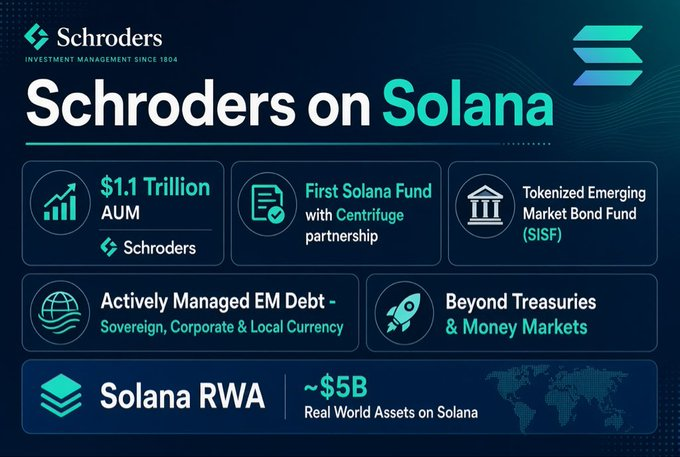
Minus Wells reported that Schroders had launched its first fund on Solana. The 200-year-old asset manager holds about $1.1 trillion in assets. Its new product tokenizes the Schroder International Selection Fund Emerging Market Bond strategy.
Source:
X
The offering uses an onchain feeder share class linked to the existing fund. This structure gives investors exposure through tokenized fund interests. It does not require investors to purchase each underlying bond individually.
The strategy covers actively managed sovereign and corporate debt across emerging markets. Its holdings can include government obligations and corporate bonds. Local-currency exposure also forms part of the investment strategy.
This launch differs from tokenized Treasury and money market products. Those offers typically are based on the short-term government bond or cash management. Schroders instead brings a broader emerging-market bond strategy onto the network.
Centrifuge Connects Traditional Finance With Solana
Centrifuge provides the infrastructure connecting the investment strategy with Solana. Its involvement links an established fund structure with blockchain-based ownership records. The partnership places traditional asset management within a public blockchain environment.
The feeder share class is central to this arrangement. It represents an onchain route into the underlying investment strategy. However, the investment decisions remain with the fund's management team.
Active management sets this product apart from less complex tokenized asset structures. Portfolio managers may change their holdings when conditions vary. Those decisions can be affected by credit evaluations, interest and currency fluctuation.
Even with tokenization, there are risks involved in the debt of emerging markets. There are risks for sovereign issuers of getting repaid or of changing fiscal circumstances. Corporate borrowers can encounter financial difficulties, while currencies may lose value.
Solana's Real-World Asset Market Gains Another Product
The supplied graphic estimates Solana's real-world asset value at approximately $5 billion. Schroders' launch adds another institutional product to that ecosystem. However, the announcement does not disclose the fund's onchain allocation.
Schroders' overall assets under management should not be confused with fund size. The reported $1.1 trillion covers the firm's wider investment operations. It does not represent capital entering Solana through this launch.
Access to investors will be based on the product's distribution plan. Other eligibility criteria, custody and subscription processes also play a role. Redemption conditions will determine how investors can exit their positions.
The launch therefore represents a specific institutional use of blockchain infrastructure. Its eventual scale will depend on participation and fund allocation. Solana gains another traditional investment strategy, while its financial contribution remains undisclosed.
The post Solana Tokenization Gains Schroders Fund Launch appears on Coin Futura. Visit our website to read more interesting articles about cryptocurrency, blockchain technology, and digital assets.