Solstice's token has settled into a markedly different price range than where it traded just weeks ago, and the path it took to get there tells its own story about how quickly sentiment can s
Solstice's token has settled into a markedly different price range than where it traded just weeks ago, and the path it took to get there tells its own story about how quickly sentiment can shift for a freshly launched DeFi token. SLX is currently trading around $0.4389, with technicals showing the token holding above all major EMAs and RSI sitting near 60. That's a meaningful recovery from the volatility that defined its first few weeks on the market.
Expanding Exchange Access
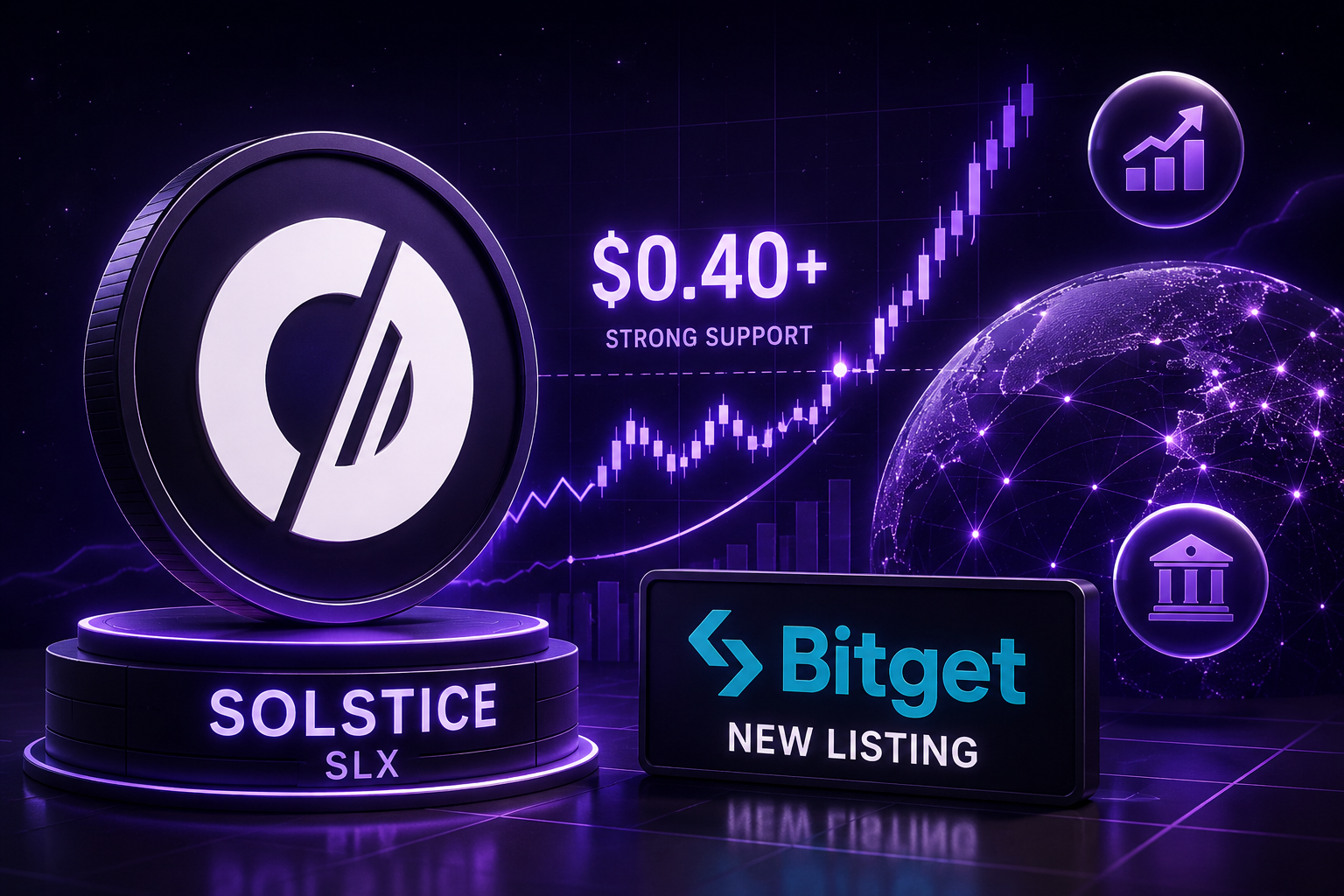
Bitget added Solstice Finance to its platform for spot trading in the Solana ecosystem zone, with the SLX/USDT pair opening on May 25 and withdrawals enabled the following day. The listing came as part of a coordinated multi-exchange rollout, with the token going live simultaneously across platforms — claims opened through the Legion platform, with trading also starting on Binance Alpha.
Bitget describes itself as the world's largest Universal Exchange, combining traditional exchange infrastructure with on-chain access through a single account. For Solstice, broader exchange distribution matters less for the headline visibility and more for what it does to liquidity depth — more venues generally mean tighter spreads and reduced slippage for larger trades, which is exactly the kind of market structure institutional participants look for before committing meaningful capital.
A Volatile Path to Current Levels
The token's trading history since launch hasn't been a straight line. SLX saw a sharp momentum event where price moved from $0.1692 to as high as $0.2632, with volume hitting $253 million — more than four times the market cap at the time, a clear signal of a speculative momentum spike rather than organic accumulation. The token has since climbed well beyond those levels, suggesting the early volatility settled into a more sustainable trading range as initial speculative positioning worked through the system.
Even with the broader recovery, SLX has shown short-term softness, underperforming the wider crypto market over a recent 7-day window with an 8.40% decline, despite a single-day gain of 12.80% — the kind of choppy price action typical of a token still finding its equilibrium just weeks after launch.
What's Anchoring the Token's Value Proposition
The underlying protocol fundamentals haven't changed since launch, and they remain the core argument for SLX's longer-term thesis. Solstice supports over $400 million in total value locked across its dollar and yield products, with Chainlink's oracle network powering the USX/USD redemption rate feed for real-time settlement pricing. Independent proof-of-solvency audits are conducted weekly by Accountable and published on-chain, while the smart contract architecture runs on SPL programs with PDA-controlled minting and time-locked multisig governance — a level of operational transparency that's relatively uncommon even among established DeFi protocols.
CEO Ben Nadareski has framed SLX as a mechanism for letting users directly benefit from infrastructure Solstice has spent the past three years building, while also giving the community a real voice in shaping the protocol's direction going forward.
What to Watch From Here
Analysts following the token see a near-term trading range of roughly $0.43 to $0.46, with a weekly close above $0.46 potentially opening a path toward $0.50, while failure to hold the 50-day EMA could trigger consolidation back toward $0.42. The bigger external risk to watch isn't on-chain — it's macro. Inflation data releases have a track record of hitting risk appetite for small-cap tokens like SLX first when results surprise to the upside.
The Bitget listing adds another credible distribution channel to a token that's already built genuine TVL and institutional interest in a remarkably short window. Whether SLX can convert that exchange access into sustained price stability above $0.40 will likely depend on broader market conditions cooperating as much as anything specific to the protocol itself.