South Korea Crypto Bill: Could Exchanges Pay for Hack Losses? South Korea crypto bill news: on November 24, the Financial Services Commission (FSC) released a government Proposal that would m
South Korea Crypto Bill: Could Exchanges Pay for Hack Losses?
South Korea crypto bill news: on November 24, the Financial Services Commission (FSC) released a government Proposal that would make exchanges compensate users for hack losses, even without fault. It also allows fines of up to 10% of revenue for security breaches.
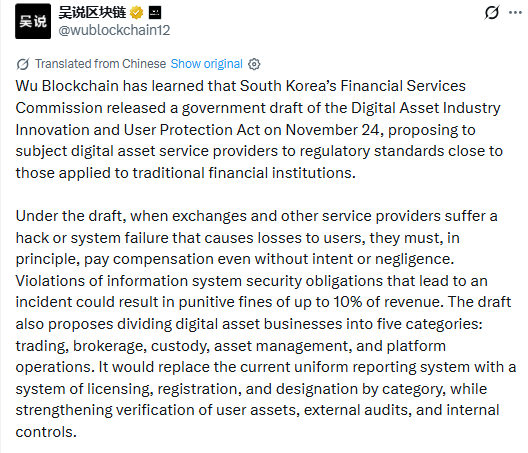 Source: X (formerly Twitter)
It is a proposal. It still needs National Assembly approval.
What Does the FSC Propose?
The draft is called the Act on the Innovation of the Digital Asset Industry and Protection of Users. The FSC announced its main points at a Virtual Asset Committee meeting chaired by Chairman Lee Eok-won.
Proposal
What the draft says
Hack liability
Providers compensate losses from hacks or system failures, in principle
Revenue fine
Up to 10% of revenue if an incident follows a breach of IT security duties
Business types
Trading, brokerage, custody and management, plus platform operators
Entry rules
Licence for trading, brokerage, custody; registration for management; designation for platform operators
User assets
Kept separate, with ongoing checks and periodic external audits
The draft would replace today's blanket reporting system with these category-based approvals.
When Must Exchanges Pay for Hacks?
Liability is no-fault only in principle. A provider would owe compensation whether or not it acted intentionally or negligently.
The draft names exceptions. Users can bear the loss if they acted intentionally or with gross negligence, or where the terms of service say so.
The 10% fine is not automatic. It is tied to incidents that follow a violation of information-security obligations. The draft creates the legal basis for it. The amounts are set later, and 10% is a ceiling.
The two tools differ. Compensation goes to affected users. The fine is a penalty for a security breach.
Other duties in the announcement include:
Officers: a compliance officer and a risk management officer
Owners: FSC approval for changes of major shareholders
Reports: monthly business reports
Exits:prior approval, with 30 days' notice, to close a business
South Korea Crypto Bill: What Else Changes for Exchanges?
The draft goes beyond security rules:
Ownership: a major shareholder's stake, with related parties, would be capped at 20% in principle, or 34% with FSC approval. Reports differ on the grace period after designation, giving three years and up to six.
Token sales: domestic ICOs would be allowed with prior disclosure. They have been banned since 2017.
Stablecoins: called digital payment tokens, with issuance first open to consortia where banks hold a majority. Issuers need at least 5 billion won in equity capital.
Reports also differ on whether the ownership cap limits holdings or only voting rights. The draft text was not independently checked.
Next steps are political. The bill must pass the National Assembly. One report expects it to be submitted around November 25. No passage or start date is set.
This South Korea crypto bill would not apply today. Existing rules stay in force until a law is passed and takes effect.
The Bottom Line
The South Korea crypto bill proposes no-fault hack liability, fines up to 10% of revenue and category-based licensing. It is a draft, not law. Details such as the ownership cap and grace period may change in the Assembly.
Disclaimer: This article is for informational purposes only and is not financial, legal or trading advice. It is based on reports and indexed copies of the FSC’s November 24, 2026 announcement. The proposed rules may change before becoming law, and some details remain disputed. Verify updates through official sources. Crypto assets carry a risk of loss.