South Korea's five largest crypto exchanges saw average daily trading volume fall roughly 89% year over year to about $305 million, a steep retreat that points to a sharp cooling in the count
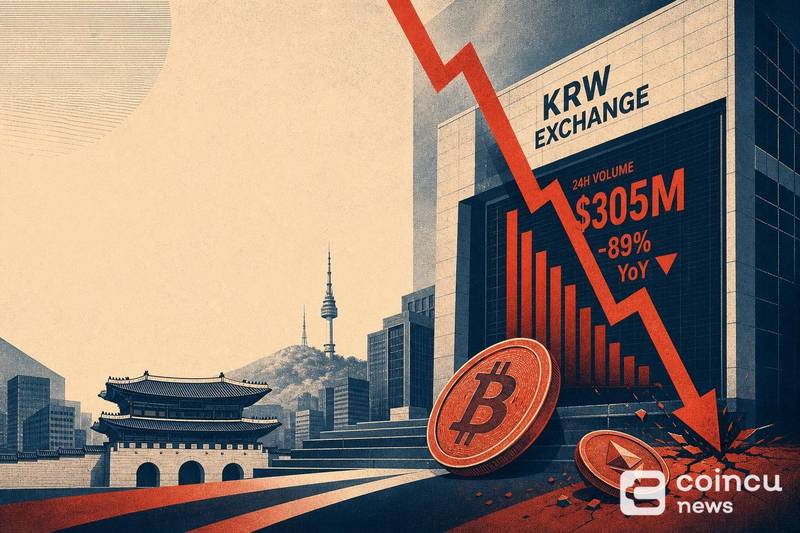
South Korea's five largest crypto exchanges saw average daily trading volume fall roughly 89% year over year to about $305 million, a steep retreat that points to a sharp cooling in the country's once-frenetic retail trading activity.
South Korea's Top Five Crypto Exchanges Recorded a Sharp Volume Drop
The decline covers the country's five biggest platforms, whose combined average daily trading volume slid to about $305 million, reflecting an 89% drop from a year earlier. The figure measures average daily turnover, not a one-day snapshot, which makes the size of the pullback harder to dismiss as noise. For related coverage, see South Dakota Crypto Investor Indicted in Alleged $20M Investment Fraud.
Additional reporting put the year-over-year decline at close to 88%, broadly consistent with the same trajectory of falling activity across Korea's leading venues. For related coverage, see Japanese Senate Passes Revised Financial Products and Exchange Act, Setting 20% Crypto Tax and Lifting ETF Ban.
What an 89% Drop Actually Looks Like
Put plainly, average daily trading is now running at barely a tenth of its level a year ago. For a market that has historically ranked among the world's most active for retail crypto trading, that is a dramatic thinning of day-to-day flow. For related coverage, see Crypto Liquidations Top $70M in One Hour as BTC Hits $45.65M.
How Big Was the Decline Compared With Last Year?
Working backward from the headline numbers, an 89% year-over-year fall to $305 million implies a prior-year average daily volume of roughly $2.77 billion. That figure is derived arithmetically from the stated decline and current level, not reported separately.
Current Level Versus the Implied Year-Ago Baseline
The contrast is stark: an implied ~$2.77 billion in average daily turnover a year ago against about $305 million now. Even allowing for rounding between the 88% and 89% figures cited across reports, the direction and scale of the retreat are unambiguous.
Why Korean Crypto Trading May Have Slowed So Sharply
The available reporting confirms the drop but does not attribute it to a single cause. What follows is interpretive, framed against the data rather than presented as established fact.
A Shift Toward Equities
One account tied the softer crypto activity to investors rotating toward stocks, according to coverage of the volume slump. If capital is chasing returns elsewhere, exchange turnover naturally thins.
Weaker Speculation and Lighter Retail Participation
Lower volume could also reflect reduced speculative appetite or fewer active retail traders, a plausible reading given the depth of the decline. The brief stops short of quantifying either driver, so these remain candidate explanations rather than confirmed ones.
What the Volume Collapse Means for Bitcoin, Altcoins, and Local Liquidity
Because the drop concerns the largest exchanges, it is a meaningful signal for overall local market activity rather than an isolated venue's problem. Thinner turnover generally points to weaker participation and shallower liquidity.
For traders, lighter volume can translate into wider spreads and choppier execution across both Bitcoin and altcoin pairs, where domestic order books tend to be more sensitive to swings in retail flow. These are market signals about conditions, not predictions of price direction.
The backdrop matters for policy as well, given that South Korea's finance ministry has been weighing state asset legislation for crypto and separately moving to introduce civil seizure rules for crypto assets. A quieter trading environment shapes the market those measures will govern.
FAQ About South Korea's Crypto Exchange Volume Slump
What does the 89% drop mean? It means average daily trading volume across the five largest Korean exchanges is now about a tenth of what it was a year earlier.
How should the $305 million figure be read? As an average daily turnover across those five platforms, not a single day's total or a full-market figure.
Why does exchange volume matter? Volume is a proxy for participation and liquidity; when it falls this far, spreads can widen and market activity generally weakens.
Does this signal weaker Korean crypto demand? The data shows sharply lower activity. Reporting has floated a rotation into stocks as one possible driver, but the underlying cause is not definitively established in the available evidence.
Disclaimer: This article is for informational purposes only and does not constitute financial or investment advice. Cryptocurrency and digital asset markets carry significant risk. Always do your own research before making decisions.
The post South Korea Crypto Exchange Volume Falls 89% YoY to $305M was initially published on Coincu.