South Korea Crypto Wallet Rule: Exchanges May Check Who Owns Yours As of November 16, 2026, a South Korea crypto wallet proposal leads South Korea crypto news today: exchanges would have to c
South Korea Crypto Wallet Rule: Exchanges May Check Who Owns Yours
As of November 16, 2026, a South Korea crypto wallet proposal leads South Korea crypto news today: exchanges would have to confirm who controls a personal wallet.
Democratic Party lawmaker Kim Hyun-jung filed the amendment on November 13, 2026, per theDigital Asset report published November 16 at 10:00 KST. The South Korea crypto bill is not law yet and still needs National Assembly approval.
South Korea Crypto Wallet Bill Explained: What Changes for Exchanges?
The Kim Hyun-jung crypto bill amends the Specific Financial Information Act, which sets anti-money laundering (AML) duties for digital asset firms.
TheINTN report adds that the Travel Rule, sender and recipient data sharing, would move into the statute instead of a presidential decree.
Provision
What the bill says
Korean exchanges personal wallet verification
Confirm address and owner via electronic signature or micro-transfer verification
Counterparty review
Check the real owner and licensing of other crypto exchanges before new dealings
Risk response
Limit or halt a transfer, hold the credit, or return the asset
Penalty
Fine of up to 100 million won
A South Korea crypto exchange wallet owner check applies when a counterparty is not an exchange and says it manages its own authentication tool. Self-custodied wallet verification covers both directions, according to Digital Asset.
The South Korea crypto fine 100 million won ceiling falls on operators, not users, per INTN.
Does South Korea Ban Personal Crypto Wallets?
No. The bill does not ban self-custody. It asks platforms to confirm the address and owner when users move assets to or from a personal wallet.Crypto wallet owner verification would use an electronic signature or micro-transfer verification, and transfers could be limited only where money laundering risk cannot be reduced.
Any South Korea crypto wallet verification law faces National Assembly debate first.
Why Is Seoul Targeting Unhosted Wallets?
When the FSC enforced the Travel Rule on March 25, 2022, it covered exchange-to-exchange transfers of 1 million won or more, and theFSC release called personal address pre-registration a voluntary industry measure.
Korea exchange wallet rules were therefore industry-led then. The Korea crypto AML law would now gain wallet address verification as a legal duty.
For the unhosted wallet South Korea is now targeting, global pressure is rising. The FATF said on July 16, 2026, that 83% of surveyed jurisdictions have passed Travel Rule legislation, up from 73% in 2025, per itsseventh targeted update.
The Block also covered this news inits tweet on X, saying News1 reported it on Monday.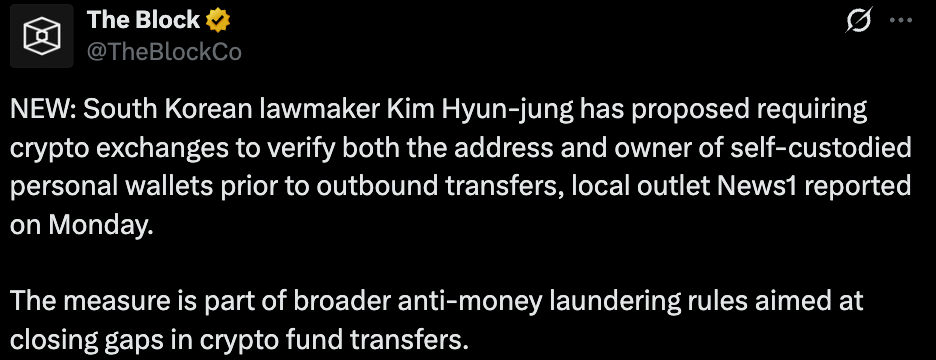
BTC Price Today: CoinGecko Snapshot
Bitcoin Price Today Data fromCoinGecko, as of November 16, 2026:
Metric
Value
Price
$64,499.97
24h change
-0.2%
7d change
-12.5%
24h volume
$30.009B
None of the sources reviewed ties the bill to Bitcoin’s seven-day drop.
Expert View: What Could the Bill Mean?
Analysts following crypto news may read the proposal as a shift of self-custody checks from industry practice into law. The South Korea crypto wallet debate could turn on whether users accept extra transfer steps.
South Korea self-custody wallet rules would still need approval, and the text could change. South Korea unhosted wallet rules, if passed, may add friction for users.
The South Korea crypto AML amendment could also push operators to upgrade monitoring, though no source quantifies the cost.
Disclaimer: This article is for information only and is not financial, legal, or investment advice. Digital assets are volatile.