Everything You Need to Know About the Upbit Sanctions Case Something strange is playing out in South Korea's crypto world right now. One of the country's biggest exchanges isn't just answerin
Everything You Need to Know About the Upbit Sanctions Case
Something strange is playing out in South Korea's crypto world right now. One of the country's biggest exchanges isn't just answering to its users anymore.
It's answering to the government, and this time there's no quiet way to slide past it.
Upbit Sanctions Case Officially Begins
Regulators have officially opened the Upbit sanctions case against Dunamu, the company behind Upbit.
South Korea's Financial Supervisory Service sent Dunamu a formal inspection opinion letter around July 18-19.
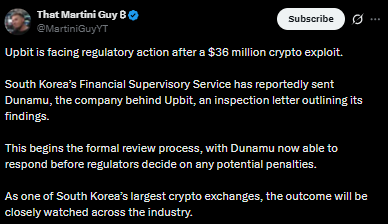
Source: X PostThat letter kicks off the whole legal process. It's not a punishment yet, just the first formal step. Dunamu now gets a window to respond and clarify things before the Financial Supervisory Service (FSS) decides what, if any, penalty applies.
What stands out here is the timing. Nearly eight months have passed since the original breach, and regulators spent most of that stretch quietly investigating before finally taking this step in public.
Authorities clearly aren't just watching from the sidelines anymore. They're moving, even if it's slow going.
How the November 2025 Upbit Hack Led to This Point
Here's the backstory, and it explains a lot about why this case matters so much.
Back in November 2025, the exchange suffered a serious security breach.
Attackers broke into its Solana hot wallet and pulled off one of the more embarrassing hacks South Korea's crypto industry has seen in years.
Date of the breach: November 27, 2025
Duration: roughly 54 minutes
Start time: around 4:42 AM KST
Amount stolen: about $36 million, or 44.5 billion won
Wallet involved: a Solana-based hot wallet
Customer funds affected: around 38.6 billion won, fully covered by the exchange itself
Funds traced or frozen so far: about 2.3 to 2.6 billion won, roughly $1.5 to 1.9 million
Suspected actor: North Korea's Lazarus Group, though this has never been confirmed
What made things worse wasn't just the hack. It was the delay in coming clean about it.
The exchange didn't announce the breach right away, choosing instead to disclose it later that same day, right after a separate merger event involving Naver Financial.
Critics weren't thrilled about that timing, and honestly, neither were regulators. When you're holding other people's money, a few quiet hours can look worse than the breach itself.
Whether Lazarus Group was really behind the attack still isn't officially confirmed, not by the exchange, not by South Korean authorities.
That uncertainty didn't stop the damage to public trust, though. And that's really the core reason this sanctions letter carries so much weight. It isn't only about the stolen funds anymore.
It's about how the whole thing was handled in the hours and days that followed.
Upbit's Official Response to the Security Breach
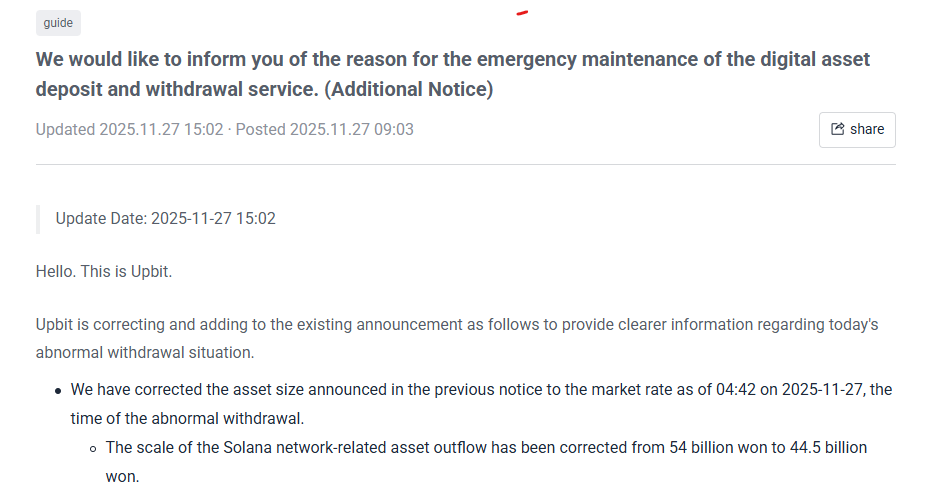
In its own statement at the time, the exchange confirmed the breach, acknowledged that funds had been taken from a Solana-based wallet, and told users losses would be covered using company funds rather than customer assets.
This part of the story is genuinely official, straight from the source, not filtered through outside reporting.
What Happens Next for Dunamu and Upbit
Since the breach, the exchange has been trying to rebuild trust while this sanctions case moves along in the background.
A few concrete steps stand out:
Wallet architecture got overhauled to close the gaps that allowed the attack in the first place
All assets were moved away from the compromised wallets
Every deposit address on the platform was wiped and rebuilt from scratch, instead of just patching the one affected wallet
An automated tracking tool called the Onchain AI Tracer System launched in December 2025 to help follow stolen funds across the blockchain
The legal side is where things get murky, though. South Korean law doesn't have a direct penalty provision written specifically for hacking incidents or system failures at exchanges, not even under the Virtual Asset User Protection Act, the main framework governing crypto platforms there.
Because of that gap, any decision has to pass through a longer chain of review:
First, the Sanctions Review Committee weighs in
Then the Securities and Futures Commission reviews it
Finally, the Financial Services Commission has its say
Only after all that does Dunamu find out what kind of penalty it's actually looking at.
The FSS governor has already acknowledged this legal gap publicly, saying the law's teeth are limited here, but an incident this size wasn't something regulators could just let slide.
What This Means for South Korea's Crypto Industry
The outcome of the Upbit sanctions case could influence how South Korea regulates crypto exchanges after major security incidents.
The exchange ranks third globally among crypto spot exchanges by trading activity, so this isn't some small player getting a symbolic slap on the wrist.
How this case plays out could end up shaping compliance rules and customer fund protection standards across the region for years.
Any platform that runs into a similar security incident down the line might find its own regulatory fate tied, at least partly, to this outcome.
This piece is for educational and informational purposes only and shouldn't be taken as financial or investment advice.
Always do your own research before making investment decisions.
Disclaimer:- This article is for educational and informational purposes only and should not be considered financial or investment advice. Always conduct your own research before making investment decisions.