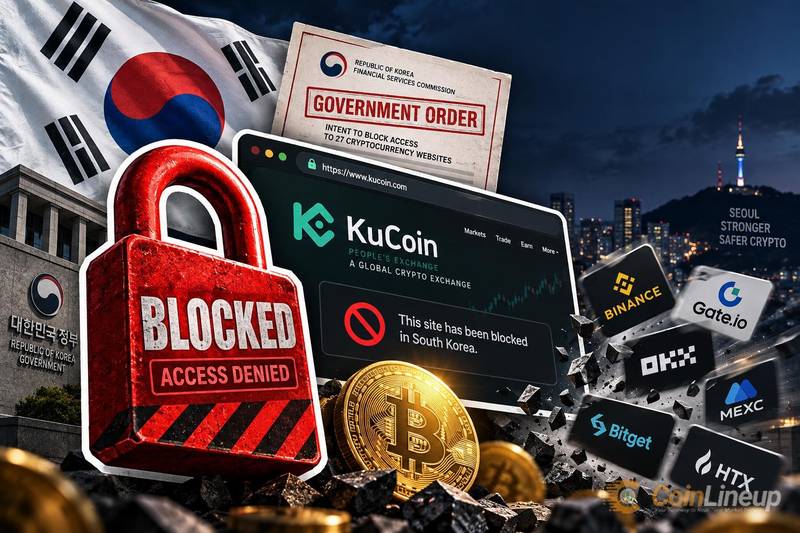
South Korea has ordered domestic access blocks on 27 cryptocurrency websites run by exchanges that were not registered with the country's financial regulator. The list includes well-known pla
South Korea has ordered domestic access blocks on 27 cryptocurrency websites run by exchanges that were not registered with the country's financial regulator. The list includes well-known platforms KuCoin, MEXC, Phemex, BingX, and BitMart, all of which are popular with Korean traders but were operating without the required government registration.
South Korea's Financial Intelligence Unit (FIU) announced that the Broadcasting, Media and Communications Review Commission approved the blocks after reviews on October 6 and 7, 2026. The decision extends earlier restrictions, which had already prevented these platforms from being downloaded through Google and Apple app stores, to their full websites. For related coverage, see FNB Launches 24/7 Crypto Trading With VALR From R10.
What the order actually covers
The blocks target websites operated by "unreported virtual-asset businesses." Under South Korean law, any exchange that serves Korean customers must register with the FIU and meet requirements including a government-certified information security standard. The rule applies to foreign companies too, not just Korean ones. For related coverage, see BitGo Expands Into Crypto Trading and Lending.
The Financial Services Commission (FSC) says an overseas platform can be treated as operating domestically if it offers a Korean-language site, runs marketing aimed at Korean users, or accepts payments in Korean won. Many of the 27 affected sites met at least one of those criteria. For related coverage, see Crypto Prediction Markets Go Global, but Gambling Laws Could Force Them Local.
The communications-review body approved domestic access blocks for 27 websites operated by unreported virtual-asset businesses.
South Korea enforcement action
27
Crypto websites approved for domestic access blocks
Source: South Korea Financial Services Commission
The regulator also confirmed that 44 illegal businesses had already been referred to investigative authorities before this website-blocking round. That number suggests the October action is part of a broader, ongoing enforcement effort rather than a one-off move. The FSC said it will seek rapid blocks of any replacement domains that emerge.
Why fees are at the center of this
The FSC did not frame this action purely as a compliance exercise. It cited a June 2026 review by DAXA, South Korea's domestic crypto industry association, which found that detected unregistered businesses charged average trading fees between 1.5% and 10%.
South Korea's five largest registered won-based exchanges charged an average of just 0.16%, meaning some unregistered platforms were charging up to 62 times more. That fee gap is central to the regulator's consumer-protection argument for the crackdown.
FSC-cited fee comparison
1.5%–10%
Average trading-fee range at detected businesses, versus 0.16% at the five largest domestic won exchanges
Source: South Korea Financial Services Commission
If you are in South Korea and use any of the 27 affected sites, you will likely lose direct browser access once the blocks take effect. The FSC has not published an exact cutover date. Existing accounts and funds are a separate question that depends on each exchange's own response, which none of the named platforms had publicly detailed at the time of writing.
The penalty for running an unregistered virtual-asset business in South Korea can reach five years in prison or a fine of up to 50 million won, roughly $36,000 at current rates. That level of consequence gives affected platforms a strong incentive to either register or exit the Korean market entirely. South Korea has seen similar regulatory pressure reshape the local crypto landscape before, as detailed in coverage of how Korean delisting risk forced a project to cancel a major merger.
For users outside South Korea, the blocks have no direct effect. KuCoin, MEXC, and the other named exchanges continue to operate globally. The action is specifically a domestic access restriction, not a global shutdown or asset freeze.
South Korea is not alone in tightening its rules around unregistered crypto platforms. Regulators in the US, EU, and elsewhere have moved toward requiring formal registration for exchanges that serve local customers, a trend that has pushed custody and compliance requirements higher across the industry. Korean users looking for registered alternatives have options among the country's domestic exchanges, which operate under full ISMS certification and FIU oversight.
Key takeaways
- South Korea ordered blocks on 27 crypto websites, including KuCoin, MEXC, Phemex, BingX, and BitMart, after reviews on October 6 and 7, 2026.
- The action expands earlier app-store restrictions to full website access and is backed by a finding that unregistered platforms charged fees up to 62 times higher than registered Korean exchanges.
- Korean-based users of these platforms should expect access disruptions; what happens to existing accounts depends on each exchange's individual response, which has not yet been publicly confirmed.
Additional source references: source document 1.
Disclaimer: This article is for informational purposes only and does not constitute financial or investment advice. Cryptocurrency and digital asset markets carry significant risk. Always do your own research before making decisions.
Read original article on coinlineup.com