South Korea’s financial regulator has finalized new rules requiring domestic cryptocurrency exchanges to scrutinize transfers heading to overseas platforms and personal wallets, marking the l
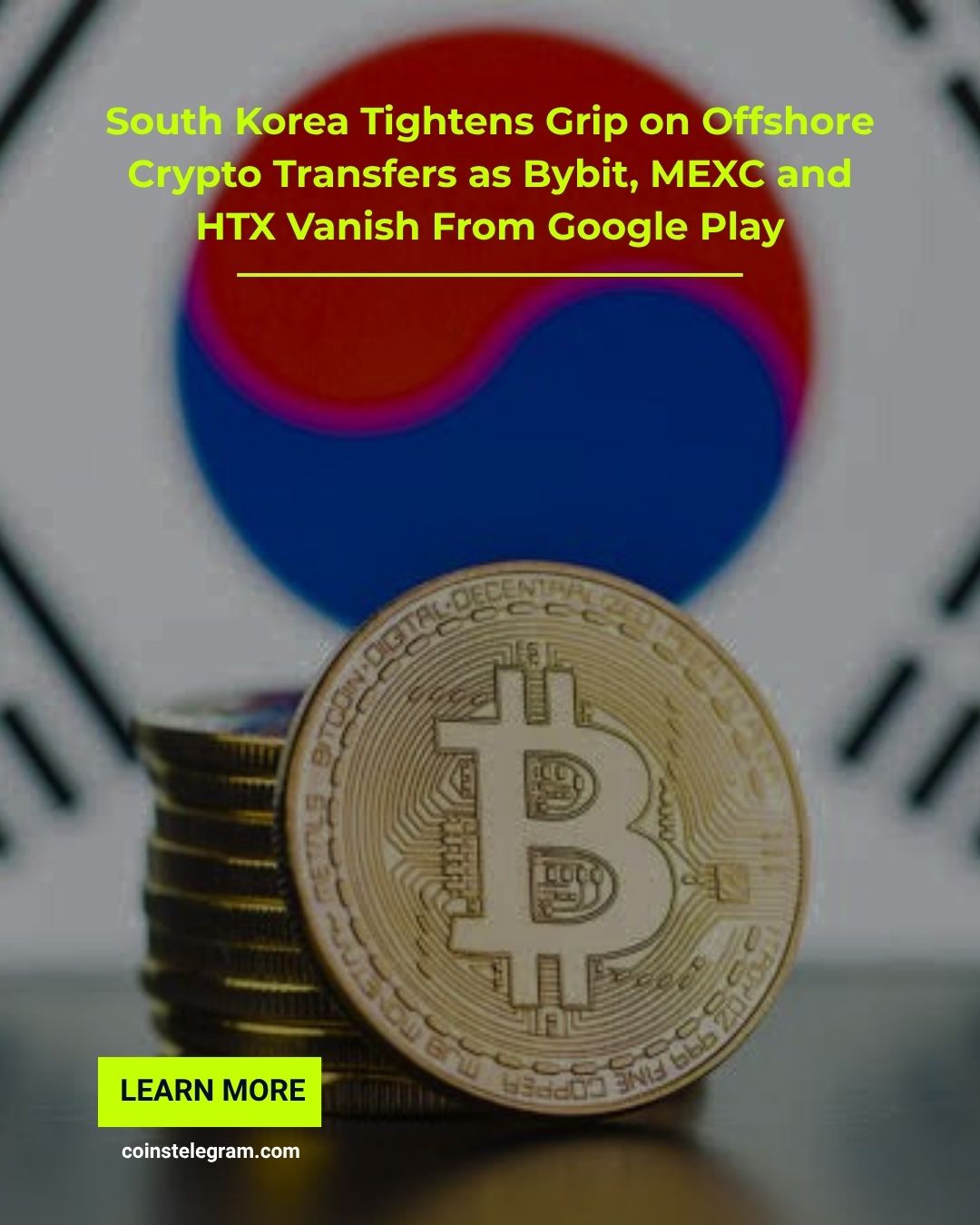
South Korea’s financial regulator has finalized new rules requiring domestic cryptocurrency exchanges to scrutinize transfers heading to overseas platforms and personal wallets, marking the latest move in an intensifying campaign to control capital flows out of one of the world’s most active retail crypto markets.
The rules arrive within days of Bybit, MEXC, and HTX being pulled from Google Play in South Korea, underscoring how aggressively regulators are working to funnel trading activity toward licensed domestic platforms.
What the New Rules Actually Require
South Korea’s Financial Services Commission (FSC) confirmed that registered virtual asset service providers will now be required to apply risk-based controls specifically to outbound transfers, alongside internal monitoring systems designed to flag suspicious transactions once transfer amounts reach 10 million won — roughly $7,000.
Under the finalized framework, exchanges gain the authority to demand proof of account ownership, documentation of a transfer’s purpose, and evidence tracing the source of funds before processing a transaction. If a user cannot produce sufficient documentation, the exchange can delay the transfer or reject it outright.
Crucially, the rules apply not just to transfers heading to overseas exchanges, but to personal, self-hosted wallets as well — a detail that has drawn particular attention from crypto analysts, since it extends heightened scrutiny beyond platform-to-platform transfers and into the realm of individual self-custody.
A Softer Landing Than Regulators Originally Proposed
The finalized rules represent a meaningful retreat from South Korea’s initial proposal. In March 2026, the Financial Intelligence Unit (FIU) floated a much stricter framework that would have automatically classified every single transfer above 10 million won to an overseas exchange or personal wallet as inherently suspicious — regardless of context, documentation, or the sender’s history.
That approach drew significant pushback from the domestic crypto industry, and regulators ultimately shifted course. Rather than triggering automatic suspicious-transaction reports purely because a transfer crossed the monetary threshold, each registered exchange will now independently assess risk under its own internal controls, filing reports only when a transaction genuinely warrants scrutiny rather than as a blanket, threshold-based requirement.
How the Risk Tiers Work in Practice
The approved framework establishes a tiered system based on counterparty risk. Transfers directed to overseas exchanges classified as low-risk will generally be allowed to proceed without additional friction. For transfers involving other overseas platforms or self-hosted wallets, the default rule requires that the sender and recipient be verifiably the same person — a safeguard aimed at preventing crypto from being used to anonymously move funds to third parties abroad. Transfers involving counterparties deemed high-risk can be blocked outright under the new rules.
Domestic exchanges have also been granted latitude to request supplementary evidence — such as documentation proving a customer owns a specific overseas account, an explanation of a transfer’s purpose, or verification of where the funds originated — specifically in cases presenting elevated risk indicators. Notably, the FSC has stopped short of publishing a standardized, universal checklist mandating these documents for every single transaction, leaving exchanges some discretion in how they apply the framework.
The Timing Isn’t Coincidental
The rules landed just days after Bybit, MEXC, and HTX — three prominent offshore cryptocurrency exchanges — were removed from South Korea’s Google Play store, cutting off one of the primary channels through which domestic users had been accessing platforms outside the country’s licensing regime. Taken together, the app removals and the new transfer restrictions represent a coordinated regulatory push to steer trading activity toward exchanges operating under South Korea’s own licensing and compliance framework, rather than platforms based overseas with limited accountability to domestic regulators.
The Self-Custody Debate
The inclusion of self-hosted wallets within the enhanced monitoring threshold has generated notable debate among industry observers. Critics of this approach argue that treating self-custody transfers as inherently suspicious risks producing counterproductive outcomes: users seeking to avoid scrutiny may simply structure transfers to stay just under the 10-million-won threshold, a pattern that would make the resulting monitoring data noisier and less useful for identifying genuinely illicit activity, rather than more effective at catching it.
Why South Korea’s Crypto Market Matters
South Korea occupies an outsized position in global cryptocurrency markets relative to its population size. The country hosts one of the world’s most active and engaged retail crypto trading bases, with won-denominated trading volume frequently representing one of the largest shares of global spot trading activity — consistently ranking among the top currencies used for crypto transactions worldwide, trailing only the U.S. dollar in some measurement periods.
That scale of retail participation is precisely what makes South Korea’s regulatory posture toward offshore platforms and self-custody so consequential: rules implemented here don’t just affect a niche market, they influence a meaningful slice of global crypto trading flow.
What Comes Next
For South Korean crypto users, the practical impact will depend heavily on how individual exchanges choose to implement their risk-based controls under the new framework. Transfers to reputable, low-risk overseas platforms should continue with minimal disruption, while transactions involving self-hosted wallets or less-established international exchanges are likely to face additional documentation requirements and potential delays.
As South Korean regulators continue tightening the boundary between domestic and offshore crypto activity, the coming months will reveal whether this risk-based approach succeeds in curbing illicit fund movement without simply pushing determined users toward more fragmented, harder-to-monitor transfer patterns.