South Korean police have reportedly raided the residence of a former Incheon mayor as part of an investigation into the alleged concealment of 21,000 crypto assets, marking one of the country
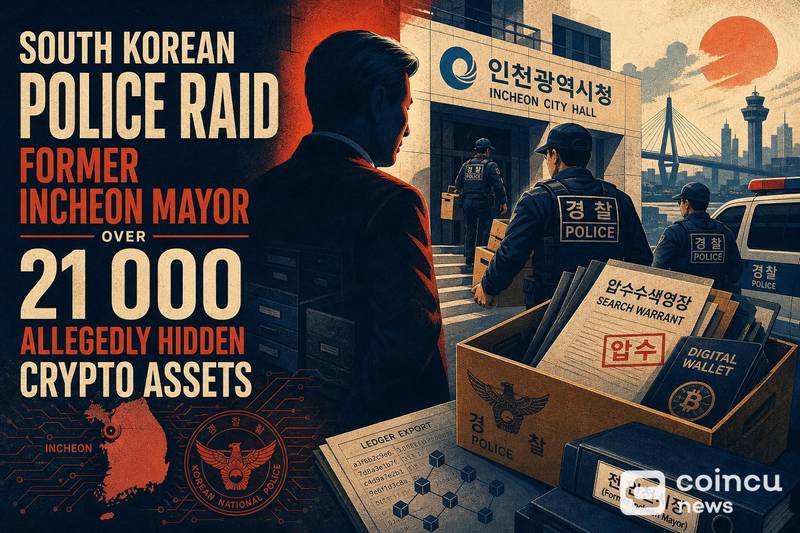
South Korean police have reportedly raided the residence of a former Incheon mayor as part of an investigation into the alleged concealment of 21,000 crypto assets, marking one of the country's latest instances where a public official faces scrutiny over undisclosed digital holdings.
The search is a law-enforcement action rather than a market event, and at this stage the underlying accusations remain unproven. According to reporting from Chosun, the raid targeted the former mayor's home in connection with allegations tied to the concealment of the digital assets. For related coverage, see Top Characters Caused The Crypto Market Crisis In 2022.
Additional Korean-language coverage of the July 28 search has been carried by Newsis, which frames the police action as an investigative step rather than a conclusion of wrongdoing. The former mayor has not been convicted of any offense connected to the reported holdings. For related coverage, see DOJ Seizes $25M Crypto From Global Investment Fraud Network.
Why the 21,000 crypto assets allegation is the central detail
The case draws attention because it centers on a specific, quantified figure rather than a vague claim of financial misconduct. The reported total of 21,000 assets is the strongest concrete detail available, and it anchors public interest in the story. For related coverage, see Japan May Ease Crypto's 2x Leverage Limit to Restore Liquidity.
The allegation concerns concealment rather than ownership alone. Holding digital assets is legal in South Korea; the reported issue is whether those holdings were properly disclosed, which is a question of transparency and reporting obligations for a person who held public office.
The research available does not clarify the valuation of the assets, and no verified figure for their worth has been established. For that reason, the number itself, not any dollar estimate, remains the focal point.
Potential legal and political fallout
A physical search of a former mayor's residence typically signals that an investigation has reached a substantive stage. Coverage from Chosun Biz situates the raid within an active inquiry, though the outcome remains undetermined.
Crypto-related concealment allegations can intersect with disclosure requirements, financial-reporting rules, and public-office accountability standards. Any of those threads could shape the next investigative steps, but none has been confirmed as a formal charge.
The matter sits at the intersection of politics and digital-asset oversight, a combination that tends to attract wider attention than a routine political dispute. Earlier stages of the broader saga were reported when the country's election watchdog referred the Incheon mayoral candidate to authorities.
Where this fits in South Korea's crypto enforcement picture
South Korea remains one of the most closely watched jurisdictions for digital-asset regulation, and cases involving officials naturally broaden a local story into a national oversight theme. The environment has already seen authorities remove overseas exchange apps from Google Play as part of tighter compliance efforts.
Regulators have also pressed on market access and reporting standards even as domestic exchange volumes have contracted sharply, underscoring how enforcement and transparency have moved to the center of the country's crypto conversation. A case involving a former public official fits squarely within that accountability narrative.
The dynamic mirrors enforcement momentum seen elsewhere, including U.S. actions such as the DOJ's seizure of crypto from a fraud network, where authorities increasingly treat digital assets as a focus for financial scrutiny.
FAQ
Who was targeted in the raid? A former mayor of Incheon, whose residence was searched by South Korean police in connection with the reported allegations.
What do the reported holdings refer to? The reported figure covers crypto assets said to be at the center of a concealment allegation. The available reporting does not specify a valuation or a precise breakdown of tokens versus coins.
Why did police conduct the raid? The search relates to allegations of concealment. It is an investigative measure, and no conviction or formal outcome has been established.
Does the case have broader implications? Because it involves a public official and digital assets, it feeds into South Korea's wider debate over crypto disclosure, transparency, and oversight.
Disclaimer: This article is for informational purposes only and does not constitute financial or investment advice. Cryptocurrency and digital asset markets carry significant risk. Always do your own research before making decisions.
The post South Korean Police Raid Former Incheon Mayor Over 21,000 Allegedly Hidden Crypto Assets was initially published on Coincu.